
Alexandria Real Estate Equities Strengthens Life Science Megacampus Leadership with Q1 2026 Momentum
Alexandria’s latest quarterly filing underscores its operational resilience and capital strategy amidst evolving life science real estate demand.
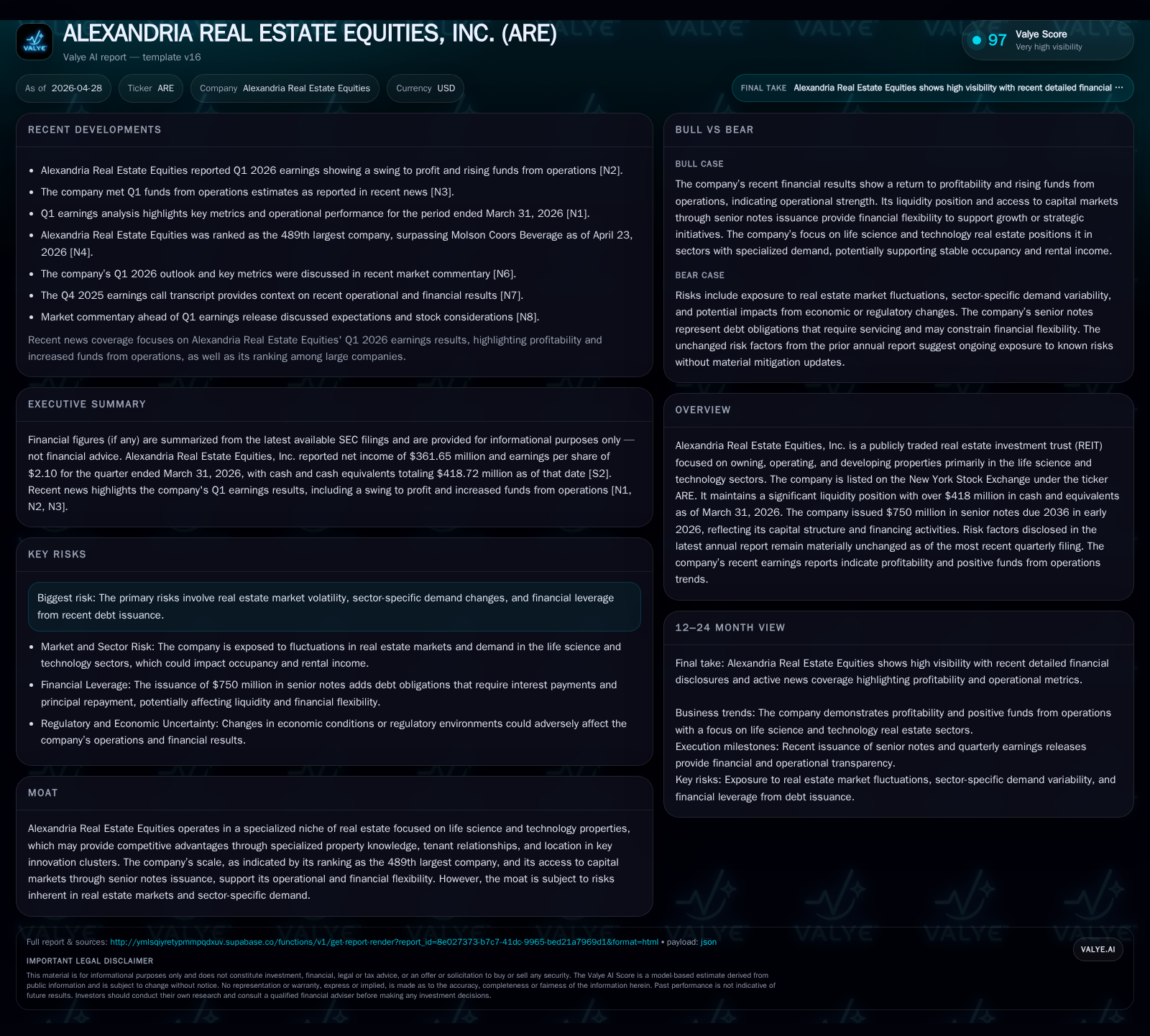
In Q1 2026, Alexandria Real Estate Equities (ARE) demonstrated stable occupancy, improved profitability, and extended capital capacity via a $750 million senior notes issuance. The company continues to leverage its niche expertise in developing and operating Class A/A+ life science Megacampuses across major innovation hubs, supporting high-quality tenant ecosystems. Growth prospects hinge on ongoing development projects and tenant expansions, constrained by litigation over one key parcel and real estate market volatility. Financially, solid liquidity and prudent leverage management underpin the balance sheet amid sector-specific risks.
Latest Quarterly Update: Operating Metrics and Capital Activity
Alexandria Real Estate Equities reported its first quarter ending March 31, 2026 results in its April 27, 10-Q filing [S2] alongside an event filing summarizing operational highlights the same day [S3]. The company maintained operating property occupancy at levels consistent with its year-end 2025 benchmark of approximately 90.9% for North America [S1], indicating steady demand in key life science clusters despite some broader economic pressures. Profitability indicators were positive as earnings swung back into profit territory supported by higher funds from operations (FFO), underscoring operational resilience within this specialized REIT niche [N4][N5].
A pivotal capital market event was the successful issuance of $750 million in senior notes due 2036 early in 2026 [S15]. This debt instrument at a coupon of 5.25% extends Alexandria’s maturity profile and enhances financial flexibility amid ongoing development needs. Having cash and equivalents of approximately $418 million at quarter-end provides liquidity to bridge capital outlays on megaprojects [F1]. These moves reinforce Alexandria's strategy to capitalize on growth opportunities while managing leverage prudently.
Niche Business Model: Life Science Megacampuses and Specialized Tenant Ecosystem
At its core, Alexandria operates a unique business model focused on the development and management of Class A/A+ properties configured into vibrant Megacampus™ ecosystems specifically tailored for life science innovation clusters [S1]. These campuses are located in prime markets such as Greater Boston, San Francisco Bay Area, San Diego, Seattle, Maryland, Research Triangle, and New York City.
The properties’ design emphasizes collaborative space configurations that facilitate R&D productivity — critical for tenants including multinational pharma firms, public/private biotech entities, digital health companies, academic institutions, government research bodies, and venture capitalists [S1]. This specialization creates high switching costs and supports longer lease terms relative to typical office or industrial real estate.
Moreover, Alexandria integrates a venture capital platform that provides strategic equity capital to transformative life science companies alongside traditional leasing activity. This dual approach positions the company not just as a landlord but as an innovation partner helping tenants scale — translating into superior tenant quality with over half the rental revenue tied to investment-grade or large cap tenants as of late 2025 [S1].
Competitive Landscape: Market Position and Sector-Specific Demands
Within the REIT universe, Alexandria stands out as a leading pure-play life science landlord with a #489 ranking among U.S. companies by market cap [N6]. This scale confers advantages such as access to capital markets evidenced by recent bond issuance activity [S15], along with deep location expertise vital given the highly concentrated nature of premier scientific campuses.
The life science real estate industry exhibits notable entry barriers: specialized lab buildouts require compliance with complex scientific infrastructure needs; proximity to academic hubs is essential; regulatory approvals can be protracted; all contributing to supply constraints in desirable markets. These factors enable durable pricing power uncommon among broad commercial landlords.
However, demand within these sectors is partially cyclical tied to fluctuating biotech/pharma R&D spending patterns and venture funding availability. While long lease durations provide income stability through economic cycles, eventual rent resets must navigate prevailing scientific investment climates.
Growth Opportunities: Development Pipeline and Tenant Expansion
Alexandria’s near-term growth hinges largely on its active construction pipeline comprising multiple Class A/A+ projects totaling millions of RSF under development or redevelopment across core hubs [S1][S2]. Beyond ground-up completions, optional expansion parcels such as the East River Science Park site in NYC represent significant potential rent-earning additions once litigation obstacles are cleared — currently delayed by ongoing legal disputes involving city entities [S1].
Tenant demand is expected to normalize post-COVID disruptions as life science companies resume expansions informed by renewed therapeutic pipelines and digital health innovations. Cross-leasing activity within megacampuses also enables efficient space reallocation supporting occupancy improvements.
Cautiously optimistic management commentary reflects awareness of external uncertainties but underscores confidence in cluster dynamics driving sustained leasing momentum [S3].
Risks and Constraints: Market Volatility, Litigation, and Leverage Considerations
Despite strengths, Alexandria’s risk profile remains material. Real estate market volatility can impact valuation multiples and leasing velocity especially if macroeconomic headwinds dampen tenant expansion plans [S2][S16].
Litigation concerning the East River Science Park Option Parcel significantly delays utilization timing for a valuable expansion site with nearly $178 million invested in pre-construction costs so far [S1]. Resolution timelines remain indeterminate posing uncertainty for future earnings contributory uplift.
Financial leverage is elevated reflecting large-scale bond issuances culminating in net debt near $13.25 billion after adjusting for cash holdings [F1]. While this supports developmental scale-up today, refinancing risk ahead must be actively managed given interest rate environments.
No material change has been reported in risk factors since the last annual filing — reinforcing steady but non-trivial exposure to sector-specific dynamics including climate-related risks overseen via formal governance structures [S2][S1].
Key Milestones and What to Watch Next
Market participants should monitor several value-inflecting events in upcoming quarters:
- Progress on permitting or legal settlements resolving the East River Science Park site development uncertainties will materially affect asset utilization timelines [S1][N3].
- Leasing activity statistics within flagship megacampuses reflecting tenant expansions or new entrants help gauge demand health directly impacting occupancy percentages.
- Quarterly earnings relative to forward guidance offer insights into operational execution effectiveness amidst external pressures [N1][N4].
- Capital raising or deployment initiatives signal management’s balancing act between growth ambitions versus prudent financial stewardship.
Tracking these milestones provides tangible KPIs that correlate closely with underlying fund flows from operations trajectories central to valuation trends.
Financial Snapshot: Liquidity, Leverage, and Capital Deployment
As of March 31, 2026 Alexandria held cash balances of approximately $418 million providing a strong liquidity cushion for near-term capital expenditures and operational contingencies [F1]. Total debt was approximately $13.7 billion as of September 30, 2025, with net debt near $13.25 billion after adjusting for cash holdings [F1], underscoring sizeable leverage typical of high-growth REITs financing mega-development cycles.
The February issuance of $750 million senior notes due 2036 at a fixed coupon rate affords prolonged maturity matching asset duration profiles while maintaining financing cost predictability [S15], essential amid fluctuating rates.
Overall capital structure resources appear adequate for current needs although refinancing horizons warrant close attention amidst evolving credit markets.
This analysis relies exclusively on publicly filed SEC documents and credible news sources as cited. It reflects factual interpretation up to April 28, 2026 without speculative forecasts or investment advice.
Disclaimer: This is research-only, informational analysis and not investment advice. It may include AI-generated interpretation and general industry context. Always verify important details using primary sources.

Comments