
Franklin Resources Illuminates Q2 2026 Growth Amid Market Headwinds
Q2 2026 results show Franklin's profit growth and liquidity strength despite sequential AUM declines, driven by strategic digital asset expansion.
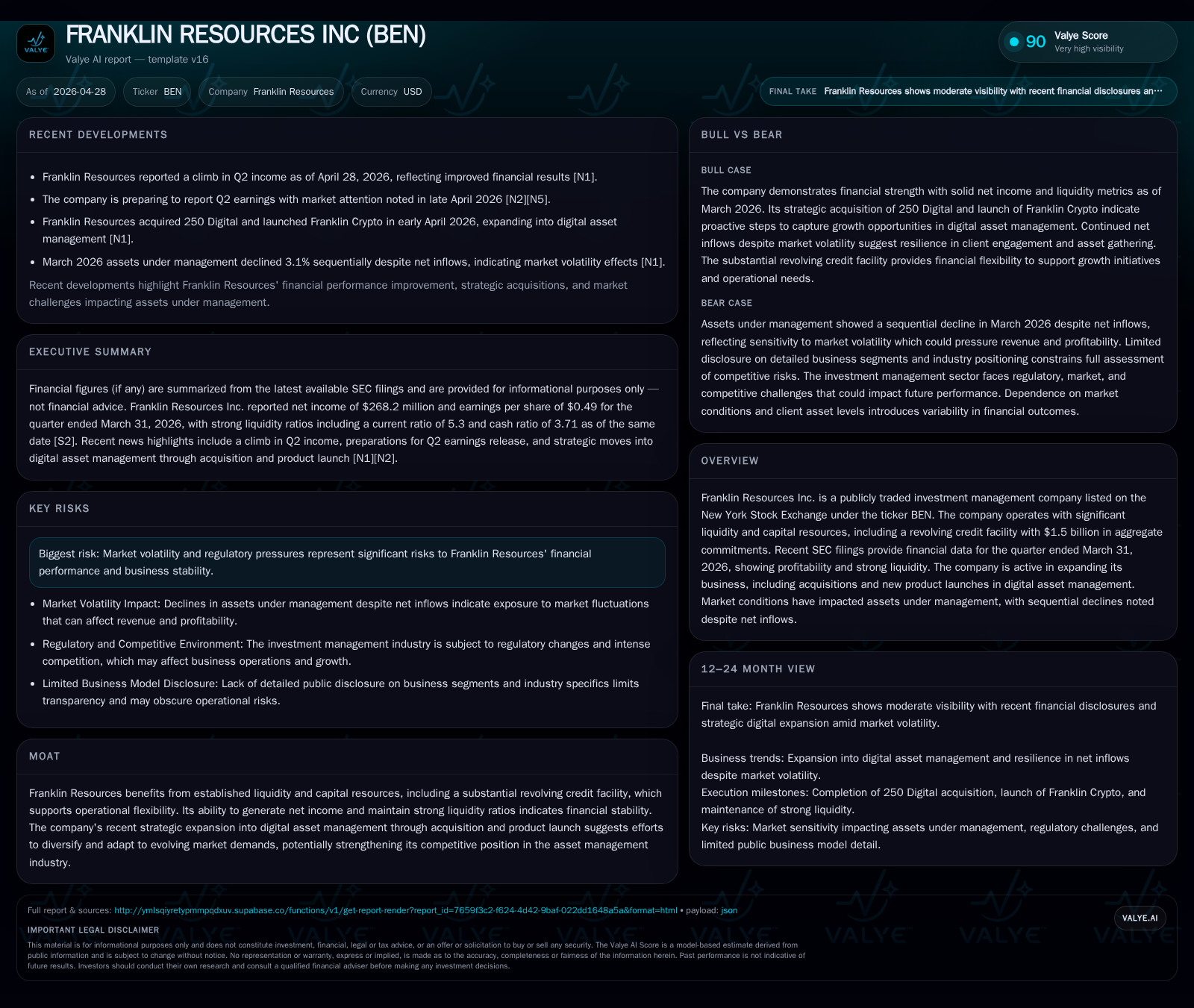
In Q2 2026, Franklin Resources delivered improved profitability and maintained robust liquidity, underscoring financial stability amid a challenging market environment marked by sequential declines in assets under management (AUM). The company continues to execute on its strategic pivot toward digital asset management through key acquisitions and new product launches. While market headwinds have tempered near-term AUM growth, Franklin’s diversified revenue streams and substantial capital resources position it well to adapt and pursue growth opportunities. Monitoring client adoption of digital offerings and regulatory developments will be critical to its medium-term trajectory.
Q2 2026 Operating Update: Profit Gains and AUM Pressures
Franklin Resources reported second quarter fiscal 2026 results that underline a nuanced operating environment. The company achieved a rise in net income for the quarter ended March 31, 2026, signaling effective cost control and margin resilience [S2][N8]. This profitability uptick comes against a backdrop of declining assets under management (AUM), which fell by approximately 3.1% sequentially in March despite positive net client inflows [N11]. The decline illustrates prevailing market headwinds—particularly volatile equity valuations—that impacted total portfolio valuations more than net new business could compensate.
Maintaining this profitability during AUM contraction speaks to Franklin's diversified revenue base, which blends traditional asset fees with growing streams from alternative and digital asset offerings. Moreover, the company’s liquidity profile remained strong as it holds net cash of roughly $2.29 billion (total debt of $2.25 billion offset by cash reserves) alongside an expanded revolving credit facility totaling $1.5 billion in commitments [F1][S16]. These capital resources underpin operational flexibility crucial for navigating current market instability.
Business Model Overview: Diversified Asset Management with a Digital Pivot
Franklin Resources traditionally generates revenue primarily through management fees charged on assets under management across mutual funds, separate accounts, and advisory platforms. Its historical strength lies in actively managed equity and fixed-income strategies distributed via financial advisors and third-party platforms [S1]. The company also benefits from sub-advisory arrangements contributing fee layers.
Strategically, Franklin is pivoting to incorporate digital asset management—a response to evolving investor preferences favoring cryptocurrency exposure and blockchain-related investment products. This shift accelerated with the acquisition of 250 Digital and the launch of 'Franklin Crypto' services earlier this fiscal year, marking a clear endeavor to capture growth in this nascent yet rapidly expanding segment [N7][S1]. Inclusion of these products broadens the firm's service offering beyond conventional vehicles and aims at securing a foothold among younger demographics increasingly comfortable with digital assets.
Client engagement within their advisor networks combines traditional personal relationship management with enhanced digital tools enabling better portfolio monitoring—critical for maintaining stickiness amid fierce competitive pressures.
Competitive Landscape and Industry Dynamics
The asset management sector is intensely competitive with scale leaders such as BlackRock exerting pricing pressure through ETF innovations alongside robust advisor ecosystems [N5]. Regulatory compliance burdens have increased substantially particularly concerning fiduciary duties and transparency requirements, imposing operational challenges for midsize firms like Franklin [S1][S11].
Customer switching costs remain moderate; differentiating factors include brand reputation, fund performance consistency, technology platforms, and advisor relationships. Capacity constraints are subtle but evident in advisor bandwidth limiting penetration rates for new product adoption.
Across the industry, cyclical fluctuations in market values drive volatile AUM trends—a structural factor reflected at Franklin now with valiant efforts underway to offset through product diversification.
Growth Drivers: Acquisitions, Product Innovation, and Market Adaptation
Franklin’s recent acquisition of 250 Digital not only introduces crypto custody capabilities but also bolsters technology infrastructure catering to institutional-grade digital assets [S2][N7]. Such inorganic moves are complemented by organic innovation via branded crypto products aiming at retail investors.
Net inflow figures indicate client appetite remains but subdued by uncertain macroeconomic outlooks; successful adoption rates for these new offerings will be vital to reversing current AUM declines [N8]. Continued focus on operational efficiencies along with cross-selling capabilities within existing client segments provides additional traction levers.
Emerging trends show that firms deploying multi-asset class solutions with integrated digital access are gaining relative market share—highlighting Franklin’s effort to align offerings accordingly.
Key Risks and Constraints: Market Volatility and Regulatory Challenges
Volatility in global capital markets directly affects periodic valuation assessments driving subsidiary earnings variability seen recently at Franklin [S4][S11]. Regulatory uncertainty over digital assets poses additional execution risks given the evolving SEC stance on crypto fund registration requirements and custody safeguards [S11].
Legal proceedings tied to internal investigations within subsidiaries add complexity but currently do not impair core operations materially—the DOJ has communicated readiness to resolve without criminal charges as per disclosures late last year [S19].
Heightened compliance costs could temper margin expansions especially if intensified governance standards arise within the fast-developing crypto regulatory landscape.
Upcoming Milestones and What to Watch
Market watchers should monitor Q3 fiscal results for shifts in net inflow trajectories as macro volatility persists [N1][S3]. Progression metrics for 'Franklin Crypto' including user retention rates, assets held under custody in the digital platform, and revenue contributions will offer signals on execution success.
Regulatory announcements impacting crypto fund approvals or heightened capital requirements may influence near- to medium-term strategic pivots. Moreover, any updates from DOJ settlement discussions or new litigation matters should be noted given potential reputational implications.
Efficiency ratios following integration phases of acquisitions will further elucidate operational leverage capabilities within Franklin’s hybrid business model.
Financial Position: Liquidity Strength Backing Strategic Initiatives
The latest filings confirm Franklin Resources' solid balance sheet footing with net liquidity positioning net debt at around negative $2.29 billion owing largely to cash exceeding total debt levels ($2.25 billion) as of March 31, 2026 [F1]. Coupled with a $1.5 billion revolving credit facility secured late last year enhancing borrowing capacity [S16], this capital structure lends significant flexibility to invest in growth avenues or absorb episodic market shocks.
Overall liquidity adequacy confirms that financial policy remains conservative amidst uncertainty while allowing dynamic capital allocation aligned with strategic imperatives.
This analysis is based exclusively on Franklin Resources’ publicly filed SEC disclosures through April 28, 2026 (), verified numeric data ([F1]), news reports (), and does not constitute investment advice or recommendations. All forward-looking statements are subject to inherent risks outlined by the company’s risk disclosures.
Disclaimer: This is research-only, informational analysis and not investment advice. It may include AI-generated interpretation and general industry context. Always verify important details using primary sources.

Comments