
Trip.com Group Releases Latest Quarterly Results Amid Regulatory Pressures and Innovation Efforts
Trip.com’s Q4 2025 report underscores AI-driven platform advancement amid escalating regulatory scrutiny in China.
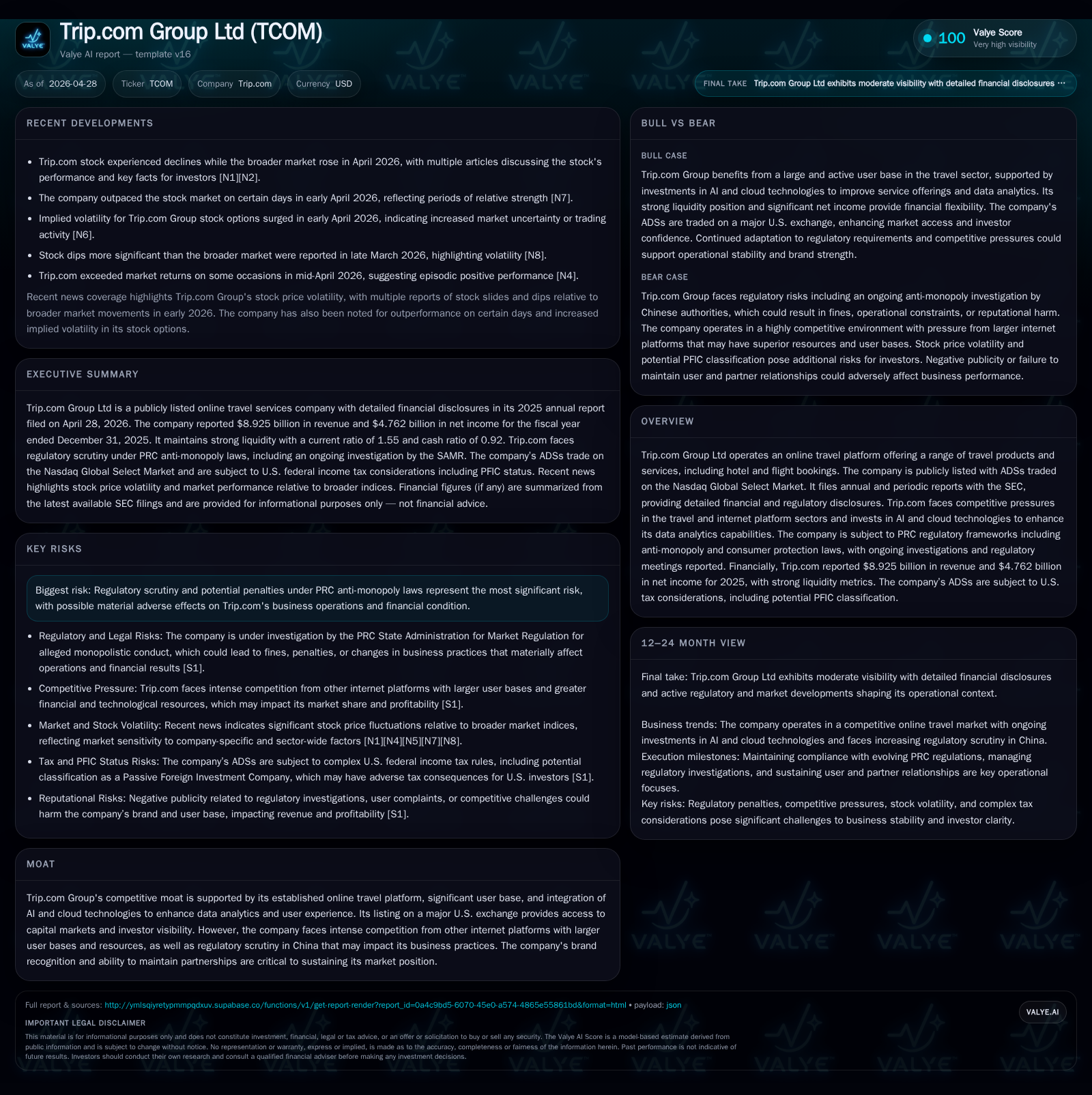
The latest quarterly filing from Trip.com Group Ltd reveals continued revenue strength with $8.925 billion reported for 2025, driven by its diversified online travel services. The company aggressively invests in AI and cloud technologies to enhance its user experience, but faces intense competitive pressures and ongoing anti-monopoly investigations by Chinese regulators. Its financial position remains solid with strong liquidity, though regulatory risks weigh on near-term execution. Market watchers should monitor outcomes of regulatory proceedings and progress in monetizing AI capabilities as key growth catalysts.
Latest Quarterly Update: Operational Highlights and Regulatory Developments
Trip.com Group’s most recent quarterly disclosure filed April 28, 2026 [S2] reconfirms the company’s fiscal year performance culminating in $8.925 billion revenue for 2025 [F1]. Though precise quarterly top-line segmentation is not explicitly broken down, the filing confirms continued operational momentum supported by sustained travel demand recovery globally.
However, the company remains under considerable regulatory scrutiny from Chinese authorities. The ongoing investigation by the State Administration for Market Regulation (SAMR), initiated in January 2026, examines potential abuse of dominant market position under PRC anti-monopoly law [S4][S6][S7]. Management acknowledges cooperation with regulators but highlights uncertainty around timing and penalties.
Regulators at provincial levels have also raised compliance issues regarding pricing practices and platform rules [S9]. These engagements reflect tightened oversight on platform operators’ conduct including fair competition, price transparency, and consumer protection within the burgeoning internet travel marketplace.
Management narratives around these developments underscore a cautious tone; while operational disruption has been limited thus far, any adverse regulatory findings could compel costly remedial actions or constrain strategic initiatives.
Trip.com Business Model: Revenue Streams and Product Quality
Trip.com operates an online travel ecosystem offering flight bookings, hotel reservations, package tours, car rentals, and ancillary travel services primarily across China but expanding internationally [S1]. The business model hinges on facilitating transactions between consumers and suppliers while generating revenues through service fees, commissions, and advertising partnerships.
Customer stickiness derives from a comprehensive product mix enhanced by real-time pricing engines and seamless digital interfaces. The company's investment in AI-powered data analytics drives personalized recommendation algorithms aimed at increasing platform traffic conversion rates — an important KPI given the high user acquisition cost environment [S23].
Technology integration extends beyond front-end personalization; backend cloud infrastructure supports scalability during peak travel seasons without compromising reliability or latency. However, maintaining high-quality service standards remains challenging amidst variable user experiences leading to complaints that can impact brand reputation if not promptly managed [S26].
Brand recognition efforts include endorsements via celebrity ambassadors alongside targeted marketing campaigns designed to sustain active user bases and solidify partner relationships [S26].
Competitive Environment and Industry Dynamics
Trip.com faces fierce competition from large-scale internet platforms that benefit from extensive existing user ecosystems which they leverage to direct traffic toward their travel offerings [S23]. These competitors command deeper financial resources enabling aggressive promotional spending that pressurizes margins within this cutthroat marketplace.
The presence of multi-service conglomerates creates cross-platform synergies difficult for standalone OTAs to replicate efficiently. Promotional intensity also raises risks of becoming locked into expensive discounting cycles eroding profit margins despite volume gains.
Traffic acquisition dynamics require continuous innovation in content curation and algorithm performance—domains where Trip.com's substantial R&D efforts seek parity or advantage against peers [S23]. The lack of durable switching costs limits pricing power with consumers increasingly price sensitive due to comparable service levels offered across platforms.
AI and Cloud Technology as Growth Catalysts
A significant pillar of Trip.com's strategy involves deploying AI technologies to improve content quality via personalized feeds that anticipate traveler preferences, enhancing engagement metrics such as session length, booking frequency, and net promoter scores [S23][S1].
Investment in cloud computing supports scalable infrastructure needed for rapid feature deployment and resilience during volatile demand periods typical in travel sectors. This technological edge is positioned as a differentiator intending to counterbalance competitive threats through superior user experiences.
Nonetheless, these advances carry substantial research & development expenses contributing to short-term margin pressure even as they underpin long-term growth potential.
Regulatory Landscape and Associated Risks
The regulatory environment in China has increasingly tightened around dominant internet platforms with enhanced enforcement of anti-monopoly laws aiming to curb unfair competitive behavior [S6][S7][S8][S9].
Trip.com disclosed ongoing investigations including SAMR's probe into monopolistic conduct based on alleged exclusionary practices which may result in penalties up to double annual sales revenue amounts under certain conditions [S7][S8].
Additional local bodies have issued rectification notices targeting pricing transparency and commercial autonomy affecting contractual terms with hotel operators [S9]. These measures reflect system-wide government intent to foster fair market access and consumer protection at the expense of incumbent platforms' business flexibility.
Beyond financial fines or forced divestitures, reputational damage triggered by publicized inquiries poses risks impairing customer trust pivotal for user retention amid competitive intensity [S24][S26].
Growth Opportunities and Challenges Ahead
Demand expansion is expected to stem from further adoption of AI capabilities that enhance personalization depth translating into improved booking velocity. Geographic diversification outside mainland China presents incremental growth avenues albeit subject to localized competitive pressures.
Strategic partnerships leveraging Trip.com's technology stack remain core growth drivers enabling broader product offerings without incurring full direct operational costs.
Challenges include balancing marketing spend efficiency against diminishing returns in saturated digital advertising markets alongside mitigating brand sensitivity to complaints amplified by swift social media dissemination.[N1][N4]
Continued adherence to evolving regulatory mandates will require agile compliance frameworks potentially slowing time-to-market for new initiatives.
Key Milestones and What to Monitor Next
Investors should closely observe updates related to:
- Outcomes and potential settlements from SAMR anti-monopoly investigations impacting business model or financial provisions.
- Quarterly metrics on active users, booking volumes, and platform traffic conversion indicating traction of AI-driven improvements.
- Progress on geographic market expansions or strategic alliances influencing future growth trajectory.
- Margins trending related to R&D spending fluctuations tied to new technology rollouts.
- Any shifts in brand ambassador program effectiveness or marketing channel performance influencing customer acquisition costs.
Public regulatory meetings expected over coming quarters will be critical bellwethers for risk assessment given their capacity to trigger swift operational changes or investor sentiment shifts.
Financial Position Briefing
At year-end 2025, Trip.com held cash & equivalents totaling approximately $5.7 billion with total current assets of $17.3 billion versus current liabilities around $11.8 billion implying a current ratio of about 1.55 evidencing prudent liquidity management [F1].
Total debt stands near 8.7 billion CNY (~$1.27 billion USD based on exchange), with net debt after cash offsets estimated around 3 billion CNY (about $440 million USD) suggesting moderate leverage when considering operational cash flow generation capacity [F1].
The company employs interest rate swaps mainly to hedge floating rate exposure though fixed-rate borrowings remain largely unhedged as per latest disclosures [S1][S5]. Currency risk is managed cautiously given predominance of Renminbi revenues but current foreign exchange volatility imposes some translation uncertainty.
These capital resources support ongoing investments in product innovation while providing buffer against short-term regulatory cost headwinds without compromising financial flexibility.
Disclaimer: This analysis is provided solely for informational purposes based on publicly available filings as of April 28, 2026. It does not constitute investment advice or recommendations concerning securities of Trip.com Group Ltd or any other entity.
Disclaimer: This is research-only, informational analysis and not investment advice. It may include AI-generated interpretation and general industry context. Always verify important details using primary sources.

Comments