
AnaptysBio Transforms into Royalty Manager with Strong Cash Position Post-Spin-Off
Following its April 2026 spin-off of First Tracks Biotherapeutics, AnaptysBio refocuses on royalty management supported by robust liquidity and streamlined operations.
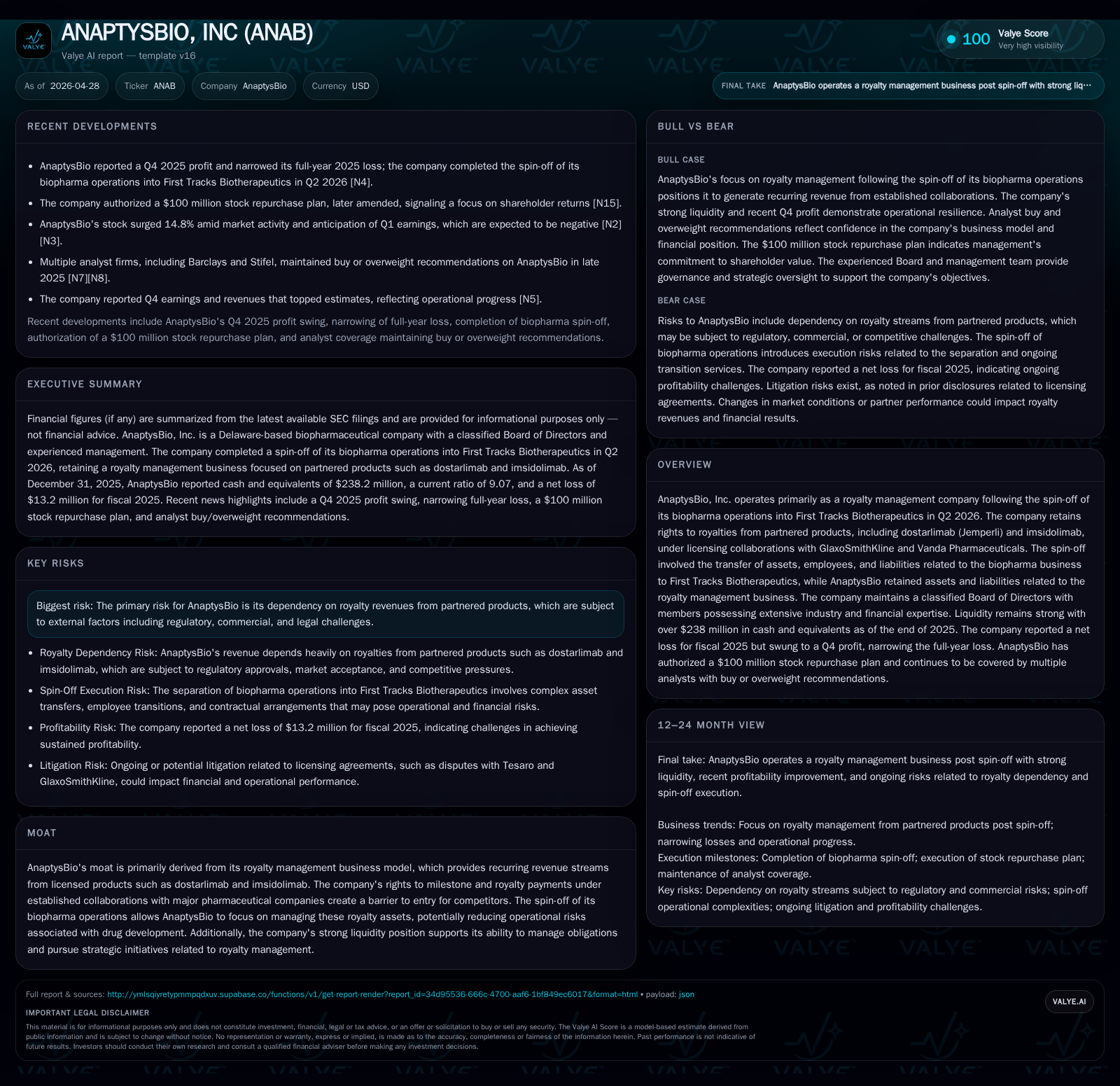
AnaptysBio completed the spin-off of its biopharmaceutical segment into First Tracks Biotherapeutics in April 2026, transitioning fully to a royalty management entity. The company now derives revenue primarily from milestone and royalty streams linked to collaborations with GlaxoSmithKline and Vanda Pharmaceuticals, including products like dostarlimab (Jemperli) and imsidolimab. This strategic pivot reduces operational complexities and development risks inherent to drug discovery in favor of more predictable cash flows. With over $238 million in cash and zero debt at the end of 2025, AnaptysBio is financially positioned to support ongoing royalty management activities and shareholder return initiatives such as a $100 million stock repurchase program. Key risks remain tied to the performance of partnered drugs and external regulatory or commercial factors.
Spin-Off Completion Reshapes Operating Focus
AnaptysBio's most consequential recent development is the completion of its previously announced spin-off of First Tracks Biotherapeutics on April 20, 2026 [S3][N4]. This transaction effectively peeled off AnaptysBio’s biopharmaceutical operations—including all related assets, employees, liabilities, intellectual property tied directly to drug development—and established First Tracks Biotherapeutics as a separately traded public entity. Post-spin-off, AnaptysBio retains ownership solely of its Royalty Management Company business segment.
Organizationally, this separation has resulted in significant executive turnover aligned with the divested unit. Notably, key board members connected predominantly to the biopharma operations resigned as part of the event [S28]. Furthermore, executive transitions have been facilitated through consulting agreements designed to ensure leadership continuity during the early post-spin period [S28]. Overall, these changes signal a fundamental realignment of AnaptysBio’s operational profile away from R&D towards financial asset management.
Royalty Management Business Model Explained
With active drug development activities exited, AnaptysBio now operates exclusively as a royalty management company that monetizes existing royalty interests inherited from prior licensing collaborations. The primary sources of revenue include royalties and milestone payments linked primarily to two partnered drugs: dostarlimab (marketed as Jemperli) licensed to GlaxoSmithKline (GSK), and imsidolimab developed under collaboration with Vanda Pharmaceuticals [S1][S3].
Dostarlimab is an FDA-approved oncology immunotherapy that generates ongoing commercial sales-based royalties for AnaptysBio through its licensing deal structure. Imsidolimab remains under clinical development stages but represents a future revenue stream contingent on regulatory milestones—estimated at up to $35 million for approval-related triggers under Vanda’s agreement [S3]. These revenue contracts embed milestone payments for achieving specific regulatory approvals or commercial sales thresholds.
This royalty-based business model shifts value creation dynamics considerably relative to traditional biotech firms. Rather than bearing R&D execution risk and capital-intensive product launches directly, AnaptysBio’s earnings depend on downstream partner performance in clinical advancement, market penetration, pricing negotiations, and regulatory compliance. Therefore, predictability improves in proportion to partners’ established commercial presence but retains exposure characteristic to pharmaceutical markets.
Competitive Landscape and Industry Dynamics
Within the broader biotech ecosystem, royalty management companies like AnaptysBio occupy a niche distinct from pure research-driven peers. Their competitive positioning hinges fundamentally on exclusivity and legal protections surrounding licensing agreements that secure enduring rights to defined revenue streams [S1].
The relationship with incumbents such as GSK offers competitive barriers via lengthy patent protections on critical products like dostarlimab combined with negotiated royalty tiers that can escalate with sales volumes or geographic expansions. Moreover, AnaptysBio avoids capacity constraints or supply chain complications common among product-focused peers since it operates post-commercialization without manufacturing responsibilities.
However, dependence on external biotech companies intertwines AnaptysBio’s fortunes directly with those partners’ strategic priorities and competitive environments. Market competition for oncologic therapies might erode market share for royalty-generating drugs over time unless offset by label expansions or line extensions executed by licensees.
Growth Drivers in a Royalty-Centric Model
Growth for AnaptysBio primarily derives from expansion in royalty income linked to partner commercialization success. Several tangible levers are identifiable:
- Regulatory Milestones: Achieving FDA or global marketing authorizations for imsidolimab or other pipeline candidates under existing licenses can trigger substantial milestone payments worth up to $35 million per current contracts [S3].
- Sales Volume Increases: Uptake acceleration for dostarlimab in approved indications or label expansions could elevate tiered royalty percentages.
- Contract Extensions or New Royalties: Potential exists for renegotiating expanded licenses or adding new royalties if partners advance additional products launched leveraging AnaptysBio’s underlying IP.
Constraints include patent expiry timelines limiting royalty duration and market saturation risks impacting sales growth. Since AnaptysBio does not engage in active research post-spin-off, organic product pipeline development is constrained; thus innovation-dependent growth scenarios rely totally on partners.
Risks Stemming from Revenue Concentration
A principal operational risk unmistakably identified in filings relates to revenue concentration. Post-spin-off royalties derive predominantly from a narrow set of licensed products—dostarlimab being the most material currently commercialized therapy [S2][S23].
This concentration exposes AnaptysBio to regulatory setbacks such as failed approvals in additional indications or adverse label restrictions impacting sales volumes. Legal challenges around intellectual property or patent validity further amplify risk exposure.
Commercially, emergent competitors introducing superior therapeutics could erode market share reducing royalty income unexpectedly. Also impactful are potential pricing pressures arising from evolving payer landscapes or reimbursement cuts endemic in biotech oncology realms.
By divesting direct drug development functions through the spin-off structure [S3], AnaptysBio has substantially reduced its operational financial risk but compensated with amplified dependency on its collaborators’ execution fidelity.
Near-Term Catalysts and What Investors Should Monitor
AnaptysBio currently benefits from several near-term external milestones:
- Monitoring Vanda Pharmaceuticals’ progress toward achieving anticipated regulatory approval milestones triggering up to $35 million additional payments remains crucial [S3]. The timing and probability of these events will materially influence incoming cash flow projections.
- The company has authorized a stock repurchase plan valued at $100 million announced in March 2026 aimed at deploying excess liquidity efficiently [N5][S21]. Tracking execution pace offers insights into capital return priorities.
- Quarterly announcements concerning realized royalties provide leading indicators regarding partner sales trajectories and any revision in expected payment flows [N2].
- Further updates from GlaxoSmithKline’s commercialization efforts around dostarlimab including label expansions or geographic rollout will tangibly affect royalty growth prospects.
Finally, stewardship of operating expenses remains essential given the limited scope post spin-off; maintaining a lean cost structure ensures maximum conversion of royalties into earnings.
Summary Financial Snapshot and Capital Structure
As documented at fiscal year-end December 31, 2025—just prior to the completion of the spin-off—AnaptysBio held over $238 million in cash and equivalents with zero reported debt positioning it conservatively within financial markets [F1]. Its current ratio stands exceptionally high at approximately 9.07 reflecting strong short-term liquidity coverage relative to liabilities [F1].
Operating results for 2025 showed a net loss of $13.2 million; however importantly Q4 swung positive underlining improved operational alignment likely aided by preparations for corporate restructuring pre-spin [F1][S2].
It does not constitute investment advice or recommendations.*
Disclaimer: This is research-only, informational analysis and not investment advice. It may include AI-generated interpretation and general industry context. Always verify important details using primary sources.

Comments