
BioLife Solutions Advances Core Cryopreservation with Strategic Portfolio Realignment
BioLife Solutions sharpens focus on proprietary biopreservation media following acquisition and divestiture moves, positioning for growth in regenerative medicine.
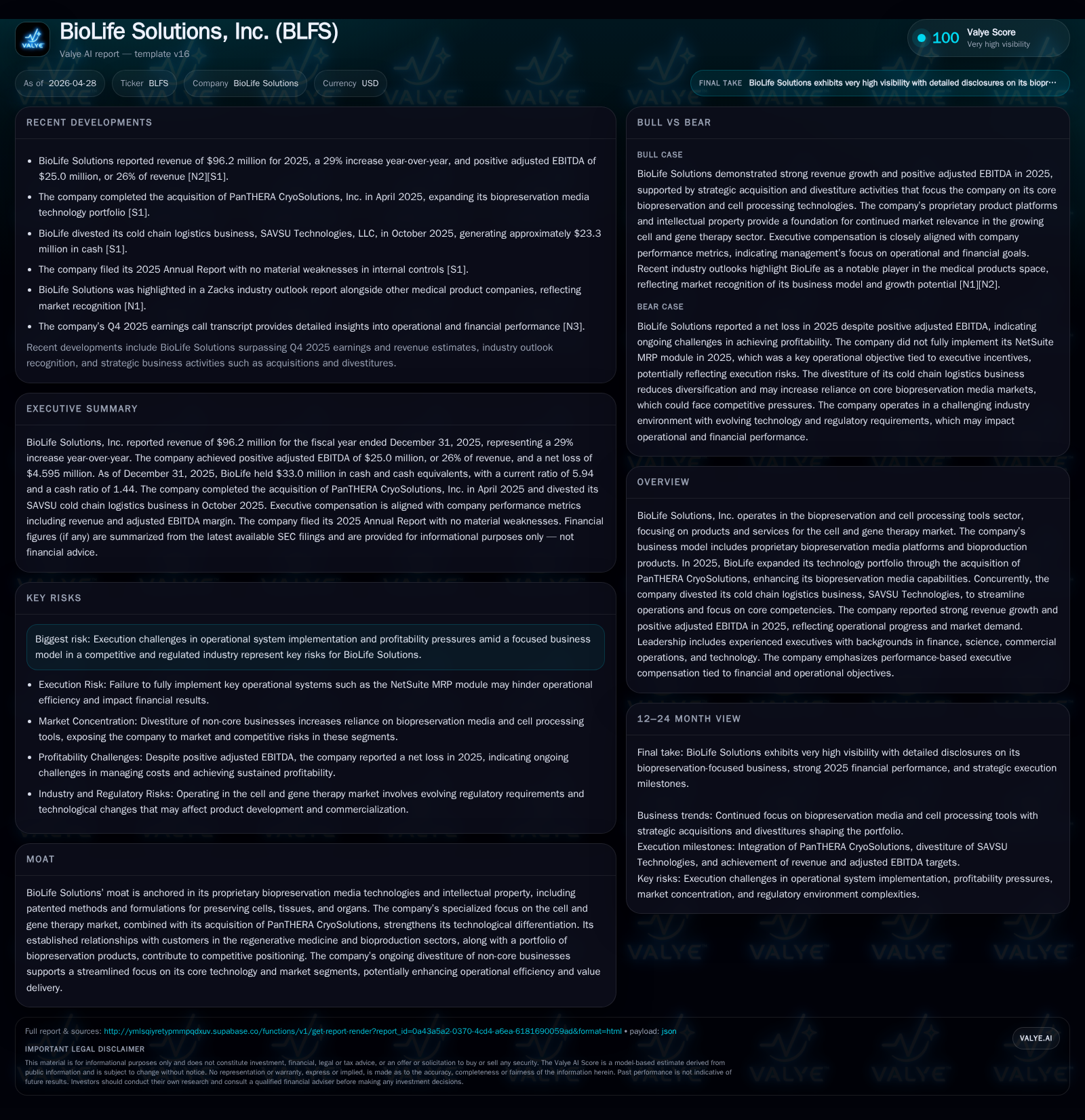
In its latest filings, BioLife Solutions has completed a strategic realignment emphasizing its core competency in proprietary biopreservation media and cell processing products for the cell and gene therapy market. The acquisition of PanTHERA CryoSolutions expanded its biopreservation media capabilities, while the divestiture of SAVSU Technologies streamlined operations to boost efficiency. This focused business model leverages patented technologies and strong customer relationships to capitalize on structural growth opportunities in regenerative medicine, though execution and regulatory risks remain. Solid liquidity and improved adjusted EBITDA provide a platform for disciplined investment and product innovation as the company advances key integration milestones.
Latest Operating Developments Highlight Strategic Focus and Execution Progress
BioLife Solutions’ most recent quarterly disclosure via its November 6, 2025 10-Q establishes a narrative of continuing operational progress within a business model increasingly centered on proprietary biopreservation media and cell processing tools [S2]. The quarter confirmed sustained momentum toward strategic objectives set earlier in the year, with no material changes to risk factors indicating steady execution under prevailing industry conditions. Concurrently, a March 2, 2026 Form 8-K filing updated investors with an investor presentation elaborating on company strategy centered on technology expansion post-acquisition [S3].
The company’s pivotal acquisition of PanTHERA CryoSolutions in April 2025 strengthened BioLife’s portfolio by bringing new advanced biopreservation media technologies into the fold—an enhancement described as opening new opportunities for development within its core cryopreservation segment [S1]. This transaction involved approximately $16 million in combined cash and stock consideration, underscoring the priority BioLife places on securing proprietary technology advantages.
Parallel to this inbound build-up of technology assets was the divestiture of SAVSU Technologies in October 2025—a historical cold chain logistics subsidiary that had less alignment with BioLife’s refocused strategy [S1]. The sale generated approximately $23.3 million in cash proceeds during the fiscal year, which supports a streamlined cost structure enabling reinvestment into core product lines.
Together, these moves signal a decisive portfolio realignment away from lower-margin logistics toward specialized biopreservation media products serving the evolving cell and gene therapy supply chain. Management highlights from filings emphasize strengthening operational efficiency and scaling core business capabilities rather than diversification into non-core adjacent sectors.
Business Model Fundamentals: Proprietary Biopreservation Media Drive Customer Value
BioLife operates primarily by developing, manufacturing, and commercializing proprietary biopreservation media platforms designed to preserve cells, tissues, and organs critical to cell therapy manufacturing and regenerative medicine applications [S1]. These media include patented formulations that optimize cell viability during freezing, thawing, transport, and handling—parameters essential for downstream therapeutic efficacy.
By anchoring product development around intellectual property protected methods and formulas, BioLife fosters high switching costs. Customers engaged in lengthy regulatory qualification processes tend to standardize on reliable preservation media validated within their processes. The addition of PanTHERA’s cryo media technologies further broadens BioLife’s intellectual property portfolio and platform breadth.
Supplementing preservation media are complementary cell processing tools which together create an integrated offering across bioproduction workflows. This combination strengthens customer retention through ecosystem lock-in while addressing pain points in manufacture scale-up for cell therapies—a segment experiencing robust pipeline growth.
Operationally, this model benefits from scalable manufacturing facilities optimized post-SAVSU divestiture with capital freed from logistics functions now directed toward R&D innovation and commercialization capacity expansions [S1].
Competitive Landscape and Industry Positioning in Cell and Gene Therapy Tools
Within the competitive terrain of cell therapy enablers, firms either compete primarily on proprietary technology or on commoditized supply-chain services like logistics or generic storage hardware. BioLife’s emphasis on patented biopreservation media places it closer to technology differentiation than pure-play commodity vendors—a positioning that supports better pricing power and defensibility against disruption.
Furthermore, BioLife’s embeddedness in the regenerative medicine value chain establishes high customer switching costs given the critical role of validated preservation solutions in product consistency. Ongoing customer partnerships combined with expertise-derived service offerings also deepen client relationships beyond transactional supply.
Industry peers include companies focusing solely on cold storage logistics or consumables without integrated IP portfolios. In contrast, BioLife leverages acquisitions such as PanTHERA to consolidate technological leadership. However, scale remains a consideration; larger global competitors could exert pressure based on distribution reach or bundled offerings; BioLife’s focused strategy aims to counter this by excelling at niche specialization where regulatory qualified products command premium value.
Regulatory complexity intrinsic to biological therapeutic manufacturing further constrains new entrants from rapidly scaling comparable product lines due to demanding validation requirements.
Growth Catalysts: Technology Expansion and Market Demand Dynamics
Structural demand tailwinds underpin BioLife’s growth prospects as adoption of cell and gene therapies expands globally across therapeutic areas including oncology, rare diseases, autoimmune disorders, and more [S3]. Each pipeline progression or commercialization event bolsters organic demand for robust preservation solutions that maintain cellular integrity end-to-end.
The PanTHERA acquisition immediately broadens the company’s addressable market via novel cryo-product platforms enabling entry into adjunct segments or broader geographies previously less penetrated [S1]. This addition is expected to catalyze incremental revenue streams beyond legacy product sets.
Operational streamlining after shedding non-core logistics entities allows increased focus on sales channel expansion and enhanced customer support responsiveness—critical factors improving penetration velocity in an intensely competitive market [S3].
Product innovation cycles aligned with patent-protected formulations offer medium-term levers to improve average selling prices through upgraded features meeting evolving client specifications.
Constraints on Growth: Execution Risks and Regulatory Complexity
Externally, regulatory approval processes impose inherent lead times slowing new customer onboarding or geographic expansion due to complex qualification protocols for therapeutic supply-chain components. Pricing flexibility can also be constrained under competitive bidding environments typical when new therapies seek cost-effective supply partners.
Margin pressures may intermittently surface owing to investment required in quality systems compliance alongside rising input costs for biologically sensitive raw materials used in formulation manufacture.
Looking Ahead: Key Milestones and Operational Priorities to Monitor
Investors should prioritize monitoring BioLife’s progress integrating PanTHERA CryoSolutions technologies both technically within R&D pipelines and commercially through go-to-market initiatives noted in disclosures around early 2026 presentations [S3],[S15].
Another critical area involves completion and stabilization of internal IT infrastructure upgrades—particularly full NetSuite MRP module rollouts—that will underpin future operating leverage [S23]. Enhanced reporting capabilities sourced from this platform can drive better inventory management crucial as product volumes scale.
Key upcoming milestones encompass:
- New Biopreservation Media launches expanding differentiated product lines;
- Revenue ramp tied directly to commercial adoption of PanTHERA-derived platforms;
- Expansion into adjacent market segments enabled by broadened technological scope;
- Execution updates post-SAVSU divestiture reflecting reinvestment impact;
- Announcements relating to FDA/EMA regulatory clearances or qualification timelines impacting client take-up.
These milestones can be indexed via quarterly revenue trends reported as well as qualitative disclosures around sales channel maturation presented at investor engagements [S3],[S17].
Financial Overview: Solid Liquidity Supports Focused Investment Strategy
As of December 31, 2025, BioLife held approximately $33 million in cash & equivalents against total debt near $5 million resulting in a net cash position around $28 million—an indicator of strong liquidity supporting continued R&D spending and strategic investments [F1],[S2]. Current assets significantly exceeded current liabilities with a current ratio close to 6x reflecting solid short-term financial flexibility conducive to funding working capital needs as sales volume grows [F1].
The modest absolute operating loss underlines transitional phase as company invests preemptively ahead of scaling revenue streams linked primarily to PanTHERA integration outcomes. Such capital discipline combined with net debt avoidance provides a stable base from which incremental margin expansion can be pursued going forward.
This analysis is based solely on publicly filed SEC documents through April 28, 2026 ([S1], [S2], [S3], etc.) complemented by companyfacts data ([F1]) without any speculative forecasts or investment recommendations. It serves informational purposes describing BioLife Solutions’ current business dynamics within its sector context.
Disclaimer: This is research-only, informational analysis and not investment advice. It may include AI-generated interpretation and general industry context. Always verify important details using primary sources.

Comments