
NRC Health Elevates Recurring Contract Value but Faces Customer Attrition and Liquidity Challenges
Recent quarterly disclosures show all-time highs in NRC Health's recurring contract value amid persistent client attrition and liquidity headwinds.
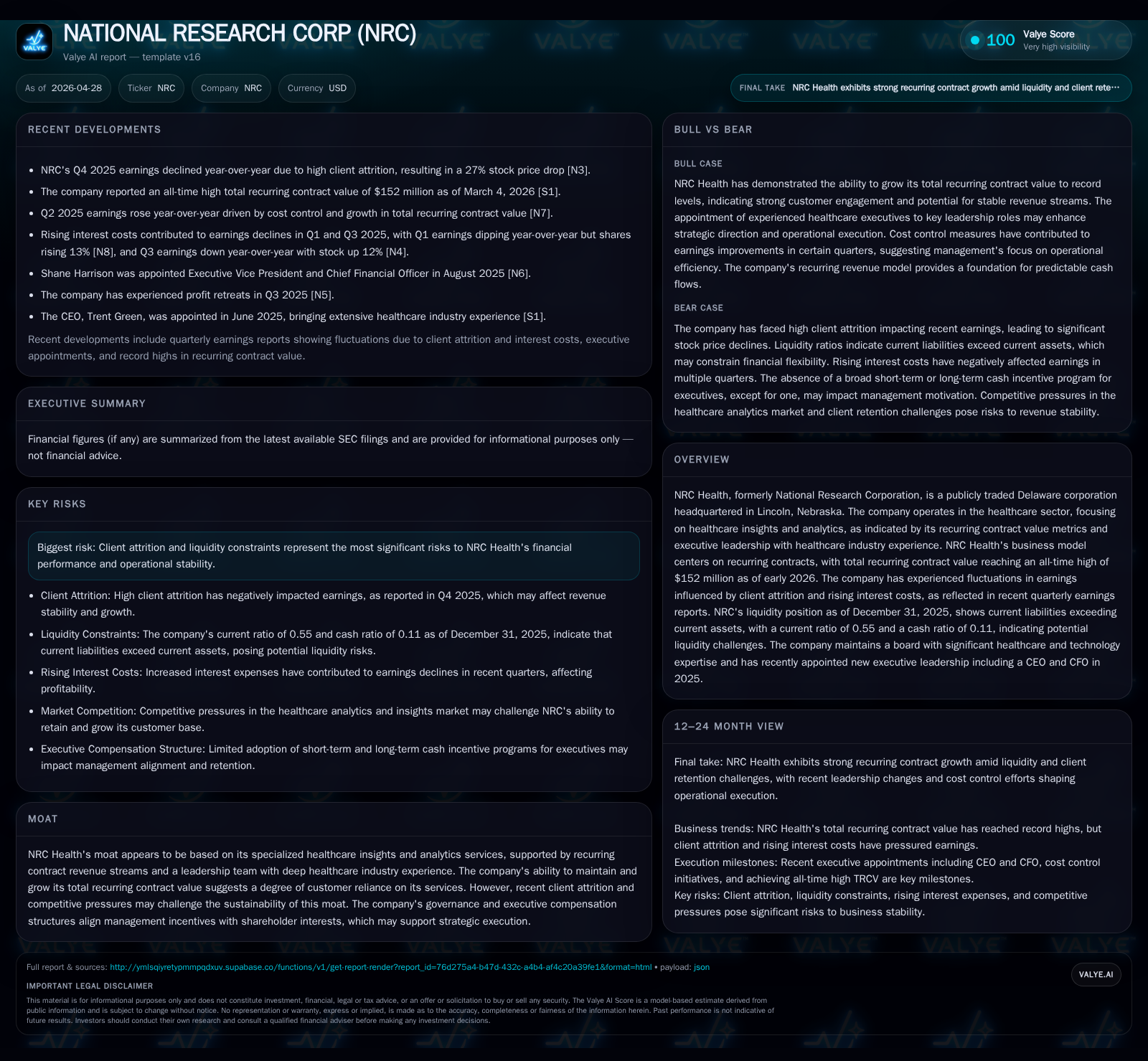
NRC Health reported a record total recurring contract value of approximately $152 million as of early 2026, highlighting strength in its core healthcare analytics subscription model. However, ongoing client attrition and liquidity constraints reflected in key ratios underscore operational risks that could hamper growth sustainability. Executive leadership alignment through significant stock grants further signals a focus on stabilizing performance. The company operates in a competitive healthcare insights market where durable moats are challenged by pricing pressures and churn. Close monitoring of contract renewals and liquidity improvements will be critical going forward.
Latest Quarterly Operating Update: Contract Growth and Attrition Dynamics
NRC Health’s most recent quarterly filing from November 2025 reveals a milestone achievement with its Total Recurring Contract Value (TRCV) surpassing $152 million, marking an all-time high for the company [S2][S23]. This metric underscores the company’s ability to expand its contractual footprint across healthcare providers, emphasizing its entrenched role as a provider of essential patient experience and operational analytics solutions.
Yet, this growth narrative is tempered by ongoing client attrition, which has introduced noticeable volatility into earnings streams [S2]. The duality reflects a scenario common among healthcare analytics firms operating with subscription-based models: while contract acquisition and expansion drive top-line growth, retention challenges impose dampening effects on financial consistency.
Business Model and Core Offerings: Healthcare Insights Driven by Recurring Contracts
NRC Health specializes in delivering comprehensive analytics solutions focused on patient feedback, clinical quality metrics, and safety data tailored specifically for healthcare organizations [S1]. Its revenue base is predominantly recurring, supported by multi-year contracts that provide both predictable cash flows and barriers to customer exit arising from data integration complexities.
The platform blends proprietary survey instruments and benchmarking analytics with consultative support designed to translate data insights into actionable improvements for client health systems. This combination elevates NRC beyond a mere technology vendor towards a strategic partner capable of influencing operational outcomes.
The importance of this model lies in its capacity to foster stickiness: clients embed NRC’s tools deeply within their quality improvement frameworks, increasing switching costs despite noted attrition, which may stem from competitive offers or budgeting pressures during constrained health system financing periods [S1][S2].
Competitive Placement in Healthcare Analytics: Moat Strengths and Vulnerabilities
NRC Health maintains a defensible niche supported by specialized healthcare sector knowledge and longstanding relationships with providers. Its capability to deliver validated patient experience and safety analytics generates reliance that competitors find challenging to replicate quickly.
Nevertheless, the moat exhibits vulnerability as evidenced by client turnover trends affecting recent earnings. Competitors leveraging newer data science methods or lower-cost structures threaten NRC’s grip on incremental market share. Pricing power appears moderate; hospital systems’ budget scrutiny combined with alternative analytics options presses NRC toward value-based pricing strategies rather than premium premiums [S1].
Growth Catalysts: Recurring Contracts, Client Engagement, and Executive Alignment
Key growth drivers include ongoing expansions within existing accounts through upselling advanced analytic modules and cross-selling enhanced engagement tools [S1]. Sales leadership incentives were revised in August 2025 to shift toward annualized targets with potential upward adjustments tied to incremental achievement, reflecting management’s priority on balanced quota attainment over short-term spikes [S1].
Additionally, the strategic decision made mid-2025 to grant fully vested stock awards to CEO Trent Green (500,000 shares) and senior executives seeks to align leadership behavior closely with shareholder interest by providing direct exposure to equity performance risks and rewards [S3][S25]. This governance-driven alignment might incentivize sustained execution focus amidst competitive headwinds.
Risks and Growth Constraints: Customer Attrition and Liquidity Positioning
The most salient risks confronting NRC Health center on attrition impacts coupled with financial flexibility constraints. While the recurring contract book grew to record levels, client departures dilute average contract values leading to margin pressure [S2].
This constraint could limit investment capacity for product innovation or sales expansion without strategic capital actions.
Key Developments in Corporate Governance and Incentives
Beyond sales incentive modifications, governance processes reinforce management accountability amid these operational challenges. The Board’s Strategic Planning Committee undertakes responsibility for periodic portfolio oversight though it did not meet formally in 2025 due to full-Board coverage of such matters [S1].
Material amendments to executive equity awards during Q2 2026 removed repurchase rights initially tied to termination clauses while triggering accelerated compensation expenses totaling roughly $9.4 million—both non-cash charges ($6.5 million) and related tax bonuses ($2.9 million)—to cement alignment immediately rather than over a vesting schedule [S25]. This move reflects urgency in reinforcing executive retention incentives at a critical juncture.
Forward-Looking Considerations: Performance Milestones and Execution Markers
Investors should monitor renewal rates within the TRCV book closely since continued expansion depends not only on new bookings but also on maintaining existing client commitments amid competition. Mid-2026 quarterly earnings progress will reveal if attrition slows or accelerates post-incentive adjustments [N1][S3].
Additionally, any indications of improved liquidity signaling via cash flow generation enhancements or capital raises would serve as positive catalysts given the stretched balance sheet context detailed above.
Overall execution efficacy will largely hinge on sustained sales team performance under the restructured incentive regime along with management’s ability to navigate competitive pressures while progressing strategic priorities outlined by the Board.
This analysis synthesizes publicly filed documents from NRC Health up to April 28, 2026. It focuses strictly on disclosed operational facts without offering investment advice or speculative forecasts. Readers should complement this review with broader industry research for comprehensive perspective.
Disclaimer: This is research-only, informational analysis and not investment advice. It may include AI-generated interpretation and general industry context. Always verify important details using primary sources.

Comments