
Mister Car Wash Advances with Strategic Merger and Leverage Management
The February 2026 merger agreement reshapes ownership dynamics amid operational scale and disciplined financial management.
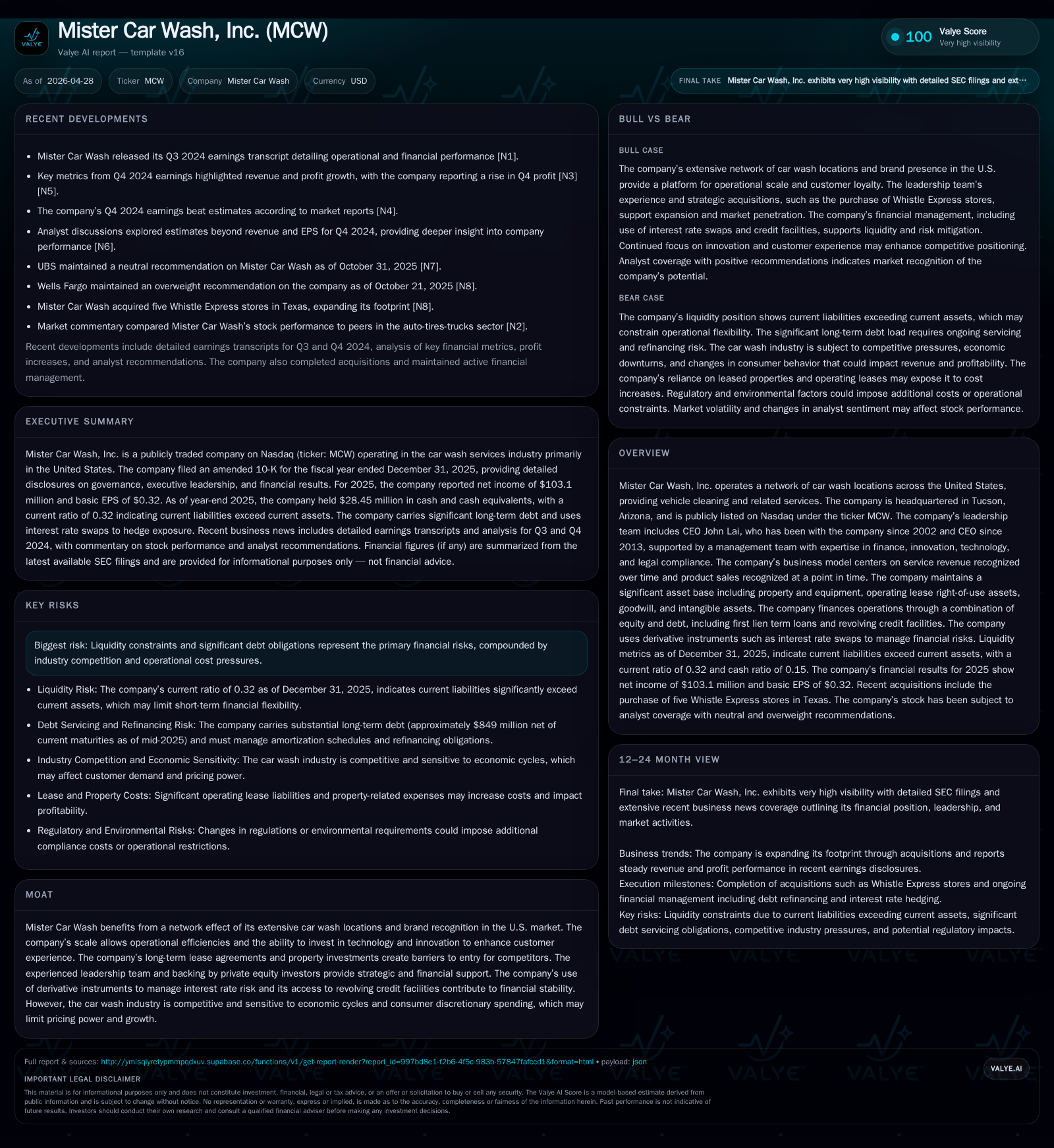
Mister Car Wash, Inc. entered a definitive merger agreement in February 2026, signaling a pivotal governance shift potentially enabling new strategic directions. The company operates a large U.S. network of car wash locations generating recurring service revenue and point-of-sale product sales, underpinned by significant property and intangible assets. Scale advantages support operational efficiencies and competitive barriers, while pricing power remains constrained by industry competition and economic sensitivity. Growth is driven by technology adoption and greenfield development commitments, with financial discipline focused on leverage control and interest rate risk mitigation. Key near-term milestones include merger approvals and integration updates.
February 2026 Merger Agreement: New Ownership and Strategic Implications
On February 17, 2026, Mister Car Wash entered into a Material Definitive Agreement (Merger Agreement) with MCW Parent LP and Boson Merger Sub Inc., marking a significant ownership transition [S3]. Principal stockholders affiliated with LGP funds holding approximately 67% of the company's common stock provided written consent in support prior to execution. This consolidation sets the stage for potential strategic shifts under new governance.
The transaction is characterized as a going-private merger subject to regulatory approvals and shareholder processes [S8]. Such structural changes may enable adjustments in capital allocation or operational strategies away from public market scrutiny. Investors should follow forthcoming filings like Information Statements or Schedule 13E-3 disclosures for detailed implications.
Business Model: Service Revenue Streams, Product Sales, and Asset Base
Mister Car Wash operates an extensive U.S. network generating revenue primarily from vehicle service fees recognized over time alongside point-of-sale product sales recognized at delivery [S1]. This dual revenue recognition approach reflects both recurring customer engagement and ancillary product transactions.
The company’s substantial asset base includes land, buildings, machinery & equipment, operating lease right-of-use assets, goodwill, trademarks, customer relationships, and other intangibles critical to sustaining its geographic footprint [S1]. Managing amortization of these intangible assets alongside operating cash flows is essential to maintaining profitability.
This asset-heavy model relies on location control via ownership or long-term leases that erect barriers for competitors attempting similar density.
National Network Scale Creates Operational Moat
With numerous sites nationwide, Mister Car Wash benefits from scale-driven procurement advantages for chemicals, parts, and equipment unavailable to smaller competitors [S1][F1].
Operationally, scale facilitates standardized processes ensuring consistent quality while enabling investments in digital platforms that enhance customer experience through subscription programs or app-based ordering.
Long-term leases or property ownership lock in strategic location presence that raises capital expenditure hurdles for new entrants seeking comparable urban coverage.
Competitive Dynamics: Pricing Power and Market Sensitivity
Despite scale advantages, the fragmented car wash industry features regional competition that constrains durable pricing power—especially given the discretionary nature of vehicle cleaning services sensitive to economic cycles [S1].
Consumer demand fluctuates with broader economic health; downturns can reduce service volumes impacting top-line stability. Pricing initiatives must therefore balance margin preservation against volume retention risks.
Growth Enablers: Technology Investment and Greenfield Development
Growth strategies focus on technology deployments aimed at improving customer loyalty via convenience-enhancing offerings such as subscription models and contactless payments [S2][S1]. These also generate data analytics to optimize marketing efforts.
Capital commitments related to greenfield developments are evident through accrued obligations tied to land acquisition and construction on newly controlled properties reported in recent filings [S2]. Efficient rollout of these sites is critical to expanding market penetration.
Financial Discipline: Debt Profile, Interest Rate Hedge, Liquidity Position
Mister Car Wash demonstrates financial discipline through amendments expanding revolving credit facility capacity from $150 million to $300 million alongside scheduled quarterly amortization at an annual rate of 1% on first lien term loan principal starting late 2024 [S2].
To mitigate variability in interest expense from variable-rate borrowings totaling approximately $800 million (net debt about $772 million), the company implemented an interest rate swap hedge effective through June 2027 [S2].
Liquidity metrics show a current ratio of approximately 0.32 as of December 31, 2025 ($59.7 million current assets versus $184.8 million current liabilities) balanced by covenant compliance across all debt tests as of September quarter-end [F1][S2].
This profile underscores reliance on operating cash flow generation alongside committed credit facilities to meet obligations while funding growth initiatives.
Risks to Monitor: Leverage Constraints and Market Competition
Leverage is significant given net obligations exceeding three-quarters of a billion dollars compared to modest cash reserves [$28.45 million] at year-end 2025; this creates potential liquidity constraints during severe economic downturns affecting discretionary spending on car wash services [F1].[S1]
Competitive pressures from regional players or disruptive entrants could force price reductions limiting margins further.
Operating cost inflation in chemicals or labor presents additional challenges necessitating tight expense controls within constrained pricing environments.
Key Upcoming Milestones and Investor Watchpoints
Critical near-term focus includes progression toward closing the pending merger subject to regulatory clearances—completion depends on satisfaction of customary conditions post-event announcement in February 2026 [S3].[N1]
Subsequent quarterly reports will shed light on integration synergies or potential restructuring costs along with updates on greenfield project execution.
Disclaimer: This analysis is based solely on publicly available filings cited herein. It does not constitute investment advice.
Disclaimer: This is research-only, informational analysis and not investment advice. It may include AI-generated interpretation and general industry context. Always verify important details using primary sources.

Comments