
Polaris Inc. Rebounds with Strategic Portfolio Shift and Operational Leverage in Q1 2026
Strong Q1 results reflect mix-driven margin expansion, growth across core segments, and a leaner cost structure post-Indian Motorcycle divestiture.
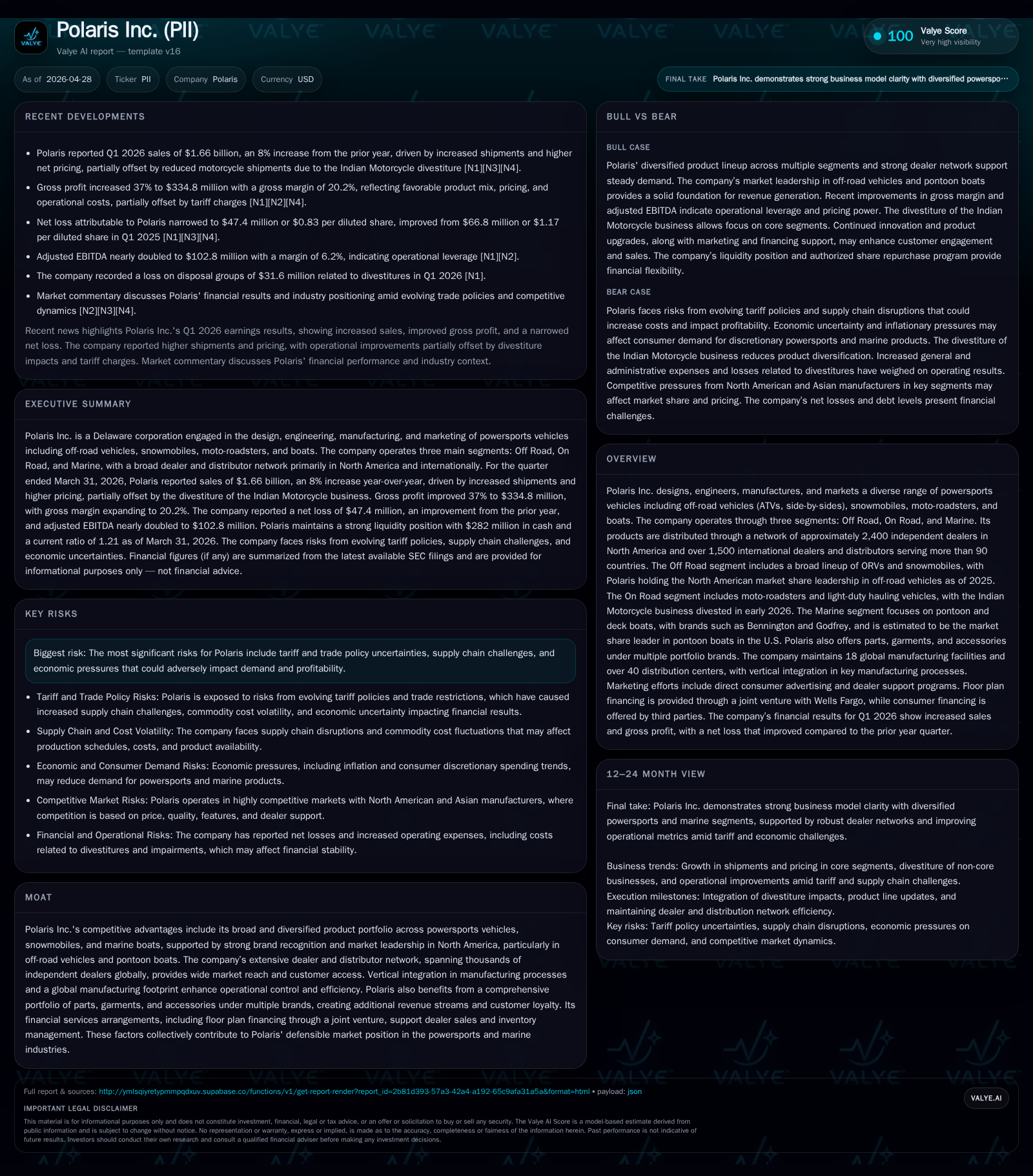
In Q1 2026, Polaris Inc. reported an 8% sales increase led by an outsized 14% growth in its Powersports segment and meaningful advances in Marine and Aixam & Goupil. Gross margins expanded by over 400 basis points driven primarily by favorable product mix, pricing actions, and operational efficiencies despite tariff headwinds. The strategic exit from Indian Motorcycle contributed to elevated corporate expenses but positions the company for improved focus and operational leverage. Polaris’s broad powersports portfolio, complemented by marine boats and electrified vehicle offerings, underpinned by a global dealer network, sustains market leadership amid evolving tariff and supply chain dynamics.
Latest Quarterly Operating Momentum and Strategic Moves
Polaris Inc.'s first quarter results for 2026 reveal a company regaining operational traction aided by strategic portfolio adjustments. Total sales for Q1 rose to $1.659 billion, up 8% year-over-year, propelled predominantly by an impressive 14% increase in the Polaris Powersports segment to nearly $1.42 billion [S2]. The Marine business grew revenues by 9% to $125 million, while the Aixam & Goupil segment also registered a solid 9% lift [S2]. This top-line growth reflects demand resilience across recreational off-road vehicles, marine boats, and light-duty utility segments.
Gross profit margins expanded significantly to 20.2%, a gain of over 400 basis points compared to Q1 last year [S12]. The margin uptick was driven primarily by favorable product mix — likely weighted toward higher-margin side-by-side vehicles — alongside effective net pricing strategies and better operational cost control. Lower finance interest expenses further aided profitability [S12]. However, this was partially offset by incremental tariff charges reflecting ongoing trade policy uncertainties impacting procurement costs [S12], underscoring the volatile cost environment.
Operating expenses grew sharply (+29%) to $390 million in absolute terms and represented a higher percentage of sales at 23.5%. This increase was mainly attributed to elevated general & administrative costs resulting from the loss recorded on the divestiture of Indian Motorcycle earlier in the year and impairment charges related to assets classified as held for sale [S2][S12]. Despite this pressure at corporate overhead level, Polaris demonstrated operational leverage with core business segments performing strongly.
Income from financial services declined 27%, reflecting lower retail credit income tied to reduced dealer inventory levels and interest rate effects [S12]. Interest expense declined modestly due to lower average debt balances [S12]. Overall operating loss narrowed slightly compared to prior year despite these costs.
Core Business Model: Diversified Powersports with Complementary Accessories and Services
Polaris’s business model centers on designing, engineering, manufacturing, and marketing a diversified portfolio of powersports vehicles spanning three segments: Off Road (primarily all-terrain vehicles (ATVs), side-by-sides (UTVs), military/commercial ORVs, snowmobiles), On Road (divested Indian Motorcycle early 2026), and Marine (pontoon/deck boats) [S1]. These products are sold primarily through approximately 2,400 independent North American dealers plus over 1,500 international dealers and distributors spanning more than 90 countries globally [S1].
The Off Road segment remains Polaris’s flagship with broad product lines including popular models such as RZR sport side-by-sides and RANGER utility vehicles that serve both recreational riders and commercial/utility customers on farms or ranches [S1]. Polaris maintains leadership in North American off-road markets as of end-2025 [S1], supported by continuous innovation especially in side-by-sides—a category with structurally strong demand due to utility use cases alongside recreation.
Complementing vehicles is the Parts, Garments & Accessories (PG&A) business that includes well-known brands such as Kolpin (universal-fit accessories), Pro Armor (performance vehicle accessories), Klim (apparel), Trail Tech (electronics), reinforcing customer loyalty via aftermarket ecosystem revenue streams [S1].
Polaris Adventures represents an experiential platform partnering with local outfitters worldwide to create ride experiences leveraging Polaris's vehicle platforms—adding service differentiation [S1]. This broad ecosystem creates customer stickiness beyond vehicle sales.
Manufacturing employs vertical integration strategies yielding quality control benefits while managing supply chains across multiple global locations. This operational footprint enables responsiveness but is sensitive to external disruptions such as tariffs or commodity volatility.
Industry Positioning: Market Share Leadership and Competitive Dynamics
As of 2025 data cited in the latest annual report, Polaris commands market share leadership in North American off-road vehicles—particularly side-by-sides—and maintains a leading position in pontoon boats within its Marine segment [S1]. This entrenched position comes amid competition from established rivals like Can-Am (BRP) in powersports along with new entrants exploring electrification.
The dealer network comprises many multi-line operations that often offer competing brands alongside Polaris products; however some maintain exclusive or fully dedicated Polaris showrooms enhancing brand presence [S1]. This distribution model ensures wide accessibility but also limits pricing power given cross-brand buyer options.
Tariff policy uncertainties remain a key external constraint impacting margins as input costs may fluctuate unpredictably depending on geopolitical developments [S2][S12]. Supply chain issues have eased relative to peak pandemic disruptions but vigilance remains necessary.
Pricing power appears durable within UTV markets where differentiated innovation drives consumer preference; however aftermarket competition tempers elevation potential there. In Marine boating and urban electric vehicle niches (Aixam & Goupil), competitive dynamics are less mature but increasing product sophistication presents opportunity for gaining share.
Key Growth Drivers: Product Innovation, Dealer Network Expansion, and Service Offerings
Innovation remains a critical growth driver for Polaris’s Powersports leadership. Continuous updates especially in sport side-by-side models fuel sustained demand given their utility versatility combined with recreational appeal [S1][N1]. Electrification initiatives within Aixam & Goupil segments target expanding markets abroad that value compact electric multi-purpose vehicles for urban environments—a promising niche gaining traction internationally [S2].
Dealer network strength underpins distribution capability with nearly 4,000 dealers globally providing extensive reach [S1]. Expansion outside North America is ongoing enabling penetration into Europe, Australia, Mexico among others.
Parts & Accessories sales contribute stable aftermarket revenue enhancing overall profitability while fostering customer loyalty.[S1] The Polaris Adventures experiential business extends brand engagement providing differentiated value beyond hardware alone enhances stickiness within end-user communities.[S1]
These factors combine structural tailwinds with clear opportunities for incremental geographic penetration plus exposure to electrification trends.
Growth Constraints: Tariffs, Supply Chain Risks, and Economic Sensitivity
Polaris faces tangible risks from evolving tariff regimes which have imposed additional costs on procured materials—incremental tariff charges directly pressured profitability despite offsetting price increases elsewhere [S2][S12]. The U.S. Supreme Court ruling on IEEPA tariffs adds complexity around refund recoveries creating near-term uncertainty [S20].
While supply chain disruptions have moderated since pandemic lows logistical volatility remains a recurrent challenge requiring supplier diversification efforts.[S12] Labor cost inflation also pressures margins from rising wage demands noted in quarterly disclosures.[S24]
Economic conditions can dampen discretionary spending patterns impacting recreational vehicle purchases; seasonal production smoothing further constraints near-term flexibility.[S1][N2]
The Indian Motorcycle divestiture brought non-recurring losses that inflated corporate expenses during Q1 though streamlines long-term strategic focus.[S2]
What Investors Should Monitor Next: Guidance, Production Trends, and Dealer Inventory
Going forward important indicators include updated company guidance on unit volumes reflecting post-seasonality recovery expectations.[N1] Dealer inventory levels will serve as demand barometers signaling potential moderation or acceleration amid macroeconomic changes.[N2]
Execution on reducing operating expense volatility post-divestiture will be critical for translating revenue growth into sustainable earnings improvement.[N3] Innovation rollout pace especially regarding electrified vehicles offers further growth runway.
Monitoring tariffs landscape developments including any realized refund flows or shifts in sourcing strategies is essential for margin outlook clarity.[S20]
Current Financial Position: Debt Structure, Liquidity, and Capital Allocation
As of March 31, 2026 Polaris had total financing obligations totaling approximately $2.09 billion including senior notes due in 2029 ($500 million at 6.95%) and 2031 ($500 million at 5.60%), complemented by revolving loan ($593.8 million outstanding) and term loan facilities ($468.8 million outstanding) all maturing December 2029 [S10][F1].
The company holds cash & cash equivalents near $282 million resulting in net debt approximating $1.52 billion consistent with modest leverage levels given covenant relief arrangements through June 2026 permitting adjusted ratios allowing financial flexibility during near-term transition periods [S4][F1].
Current ratio stands at roughly 1.21 indicating reasonable liquidity buffers versus short-term liabilities.[F1] Interest expense decreased modestly reflecting prudent debt management amid refinancing activities.[S12]
Though leverage remains elevated relative to historical norms due largely to acquisition financing now partly offset by divestiture proceeds companies appear positioned cautiously but ready for ongoing investment requirements supporting innovation cycles.
Disclaimer: This analysis is based solely on information available through April 28th, 2026 SEC filings and reliable public disclosures without offering investment advice or price targets.
Disclaimer: This is research-only, informational analysis and not investment advice. It may include AI-generated interpretation and general industry context. Always verify important details using primary sources.

Comments