
Sherwin-Williams Advances Growth Through Suvinil Acquisition and Store Expansion in Q1 2026
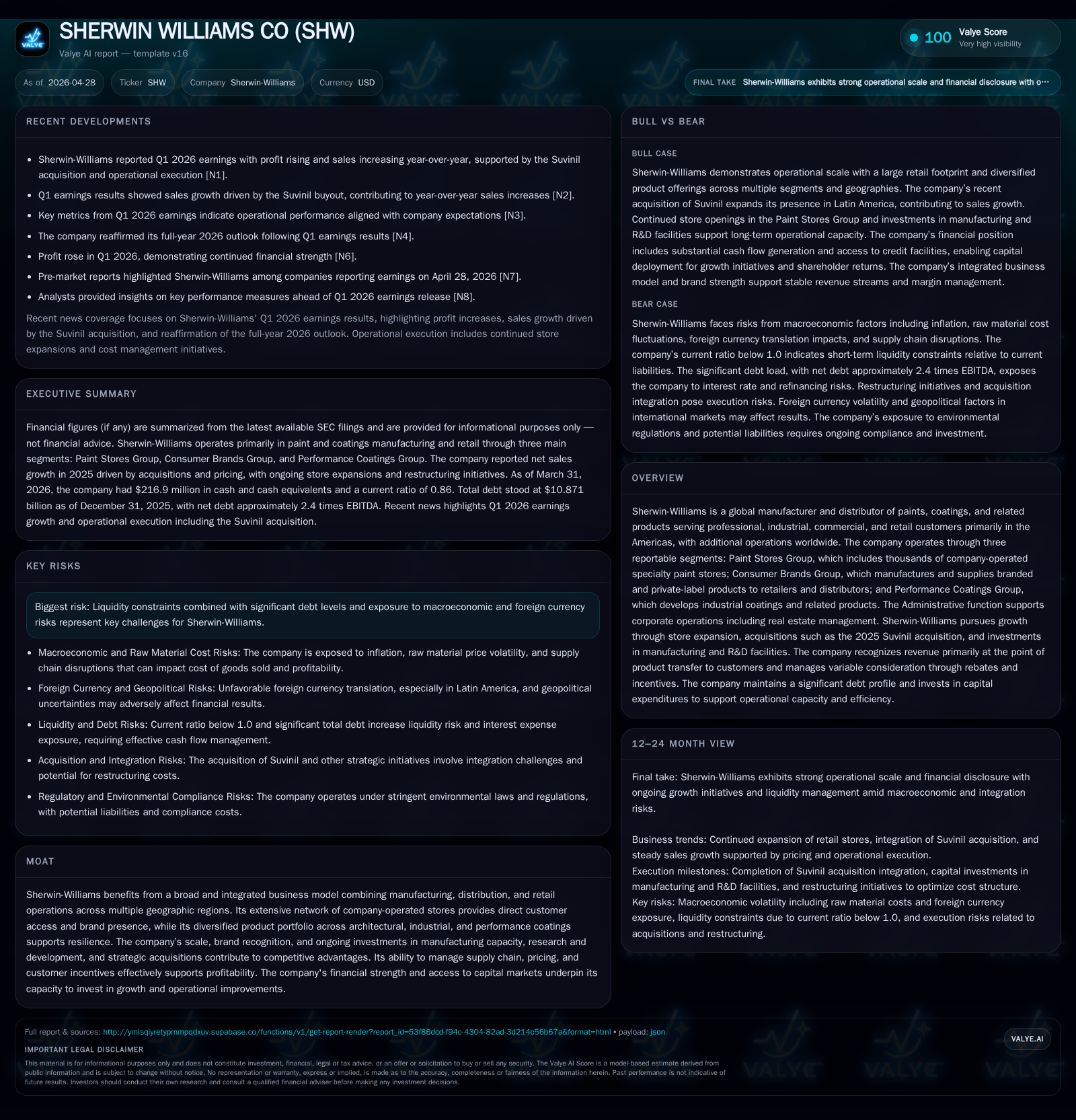
Sherwin-Williams delivered solid first-quarter results fueled by its recent Suvinil acquisition and ongoing Paint Stores Group expansion, reinforcing its integrated coatings business model amid leverage challenges.
In Q1 2026, Sherwin-Williams' revenue growth was notably supported by the Consumer Brands Group's inclusion of the Suvinil acquisition alongside steady expansion in the Paint Stores Group. Despite flat sales in the Performance Coatings segment, the company's broad geographic presence and diversified product portfolio underpin resilient demand. The firm's extensive retail footprint and vertical integration constitute key competitive advantages, while significant net debt and foreign currency headwinds pose growth constraints. Investors should monitor margin stability, integration execution, and sales volume trends as near-term indicators.
Q1 2026 Operational Highlights: Acquisitions and Store Network Strengthen Top Line
Sherwin-Williams commenced fiscal 2026 with a tangible uplift from its October 2025 acquisition of Suvinil, as disclosed in the Q1 10-Q filed April 28, 2026 [S2]. This transaction contributed approximately $165 million in incremental Consumer Brands Group revenue during the quarter despite adverse foreign currency movements stemming from Latin America [N2]. Meanwhile, the Paint Stores Group maintained momentum through disciplined selling price increases yielding mid-single-digit revenue growth on a comparable store basis despite slight volume declines. Notably, during the prior year Sherwin-Williams opened 83 new specialty retail stores versus only three closures for a robust net increase of +80 stores lifting the total to nearly 4,850 locations primarily across U.S., Canada, and Caribbean markets [S1]. This store expansion strategy continues to drive incremental revenues by providing cross-selling opportunities alongside branded paint and coatings offerings.
The Performance Coatings segment recorded flat sales quarter-over-quarter as unfavorable product mix and pricing offsets aligned with stable volumes in industrial coatings markets [S2]. This contrast underscores the cyclical sensitivity unique to industrial demand compared with more resilient architectural/retail channels. Collectively these operational vectors underscore Sherwin-Williams’ differentiated ability to offset macroeconomic headwinds through strategic acquisitions and controlled retail growth.
Sherwin-Williams Business Model: Integrated Manufacturing, Distribution, and Retail
Sherwin-Williams operates a vertically integrated business model organized across three core reportable segments: Paint Stores Group (specialty paint retail stores), Consumer Brands Group (manufactured branded & private-label products sold to retailers/distributors), and Performance Coatings Group (industrial coatings/products) [S1]. This structure enables Sherwin-Williams to capture value at each step of the supply chain—from R&D-driven product development and manufacturing efficiency gains to extensive distribution logistics culminating in direct customer engagement via company-operated stores.
Owning an expansive network of over 4,800 company-operated paint stores constitutes a formidable competitive advantage due to higher switching costs inherent in professional painter relationships and consumer brand loyalty cultivated through quality assurance [S1][F1]. The broad product portfolio addresses diverse end markets—professional contractors requiring high-performance coatings; commercial applications needing customized formulations; and retail consumers seeking trusted interior/exterior paints. Such diversification confers resilience to volatility in any single channel or region.
Moreover, vertical integration allows tight control over pricing dynamics amid raw material cost fluctuations. For instance, the company can implement selling price adjustments at retail alongside manufacturing cost management tactics to preserve gross margins.
Competitive Position and Industry Structure: Scale and Brand Power in Coatings Markets
Within an industry characterized by moderate fragmentation but significant economies of scale benefits, Sherwin-Williams stands out as a dominant player through its dense physical presence predominantly across North America complemented by international expansion notably via Suvinil's Latin America footprint [S1][F1]. This geographic breadth hedges domestic demand cyclicality while capturing higher growth opportunities in emerging markets.
The architectural coatings market benefits from steady demand linked to residential/commercial construction cycles with pricing power sustained through strong brand equity—evidenced by mid-single-digit price realizations without sharp volume erosion in the Paint Stores Group [S2]. In Performance Coatings, margins face pressure from raw material input volatility coupled with evolving environmental regulations mandating reformulations; nonetheless, Sherwin-Williams leverages scale procurement and formulation expertise to maintain operational efficiency.
Supply chain control further enhances competitiveness; owning critical segments of manufacturing mitigates risk of third-party supplier disruptions amid broader industry raw material constraints.
Key Growth Drivers: Store Expansion, Strategic Acquisitions, and Innovation Investment
Sherwin-Williams targets approximately 2% annual organic growth in its specialty store count—a lever evident from recent aggressive opening activity with over eighty net new stores last year alone [S1]. This network growth facilitates deeper market penetration as well as enhanced point-of-sale marketing. Concomitantly, strategic acquisitions like Suvinil provide accelerated access into Latin American markets where branded consumer penetration remains developing.
Capital investment prioritizes expanding manufacturing capacity—particularly for innovative waterborne coating technologies—and augmenting research & development facilities to sustain product leadership especially in performance coatings demanding advanced formulations [S1][S2]. Maintaining premium price positioning on innovation breakthroughs bolsters margin resilience versus commoditized industry peers.
On the Consumer Brands front, rationalizing legacy footprints evidenced by some net store closures (27 fewer stores in Latin America during 2025) balances regional economic realities against overall brand footprint optimization.[S1]
Growth Constraints: Debt Leverage, Currency Exposure, and Regulatory Risks
Despite steady operating progress, Sherwin-Williams contends with tangible financial constraints evidenced by net debt exceeding $9.1 billion at Q1-end with cash levels around $217 million resulting in a conservative current ratio of approximately 0.86 [F1]. While credit facilities have been amended/extended recently providing liquidity flexibility ([S7],[S8]), leverage reflects elevated funding requirements for sizable acquisitions such as Suvinil and capital expenditures supporting expansion initiatives.
Foreign currency headwinds principally arising from Latin American subsidiaries exert pressure on reported earnings translating robust local-currency sales growth into muted consolidated top-line expansion [S2],[N2]. Continued volatility across these markets demands hedging sophistication but cannot fully insulate reported results from macroeconomic shocks.
Furthermore, litigation related to legacy lead pigment usage continues as an unsettled risk with potential contingent liabilities borne from various lawsuits alleging health/environmental damages dating back decades [S4],[S5],[S18]. Although prior rulings have favored Sherwin-Williams culminating in settlements such as California proceedings resolved in 2019 with court approval [S18], ongoing claims involve uncertain exposure requiring vigilant management.
Environmental regulatory compliance remains an ongoing cost driver impacting product formulations especially for industrial coatings mandated to reduce volatile organic compound emissions or address hazardous substance concerns [S4],[S6].
Near-Term Watchlist: Guidance Confirmation, Execution of Integration, Demand Signals
Key near-term milestones include monitoring execution discipline on fully integrating Suvinil operations into Consumer Brands without compromising segment margins or operational cadence ([N4],[S3]). Maintaining Paint Stores segment sales volumes is essential given their outsized contribution to revenues; indicators tied to building activity levels provide early signals on future volume traction.
Fiscal year guidance reaffirmed post-Q1 underpins management confidence though risk factors such as renewed inflationary input pressures or recessionary impulses could introduce volatility ([N4]). Watching price realization trends versus input costs will gauge margin durability amidst competitive dynamics.
Strategic capital expenditure pacing will also warrant attention given moderation expected relative to elevated investments deployed during Suvinil acquisition and global headquarters completion phases ([S19]).
Finally, updates on litigation developments or regulatory changes may influence long-term risk profiles.
Brief Financial Overview: Liquidity and Capital Structure Snapshot
As of March 31, 2026 quarter end, Sherwin-Williams held approximately $217 million cash & equivalents against total debt around $9.3 billion generating net debt north of $9.1 billion which reflects leverage elevated but not beyond covenant thresholds given compliant credit agreements allowing temporary increased ratios post-acquisition (up to 4.25x leverage for four quarters) [F1],[S22]. Current assets cover roughly $6.5 billion against current liabilities exceeding $7.5 billion resulting in a current ratio below parity at about 0.86 signaling tight working capital conditions requiring close management.[F1]
Recent refinancing efforts extended maturities on revolving credit facilities (up to August 2030) preserving liquidity buffers for operational needs and growth initiatives [S7],[S8]. Short-term borrowings largely represent commercial paper usage typical for seasonal fluctuations or acquisition bridge funding.
Capital expenditures are expected below previous year’s elevated levels but remain focused on manufacturing/r&d enhancements plus store network investments ensuring sustained innovation pipeline.[S19]
This financial profile underscores dual imperatives: managing leverage prudently while sustaining investments critical for long-run competitive advantage preservation.
This analysis is based exclusively on publicly available SEC filings dated through April 28, 2026 ([S1]-[S28]) and company-reporting snapshots ([F1]) without speculative projections or investment recommendations. It aims to provide objective insights into Sherwin-Williams' current operating environment within its industry context.
Disclaimer: This is research-only, informational analysis and not investment advice. It may include AI-generated interpretation and general industry context. Always verify important details using primary sources.

Comments