
Capital City Bank Group Strengthens Liquidity and Controls Rising Expenses in Q1 2026
The bank's latest quarter reveals effective liquidity management and heightened risk controls alongside noninterest expense growth tied to pension plan accounting.
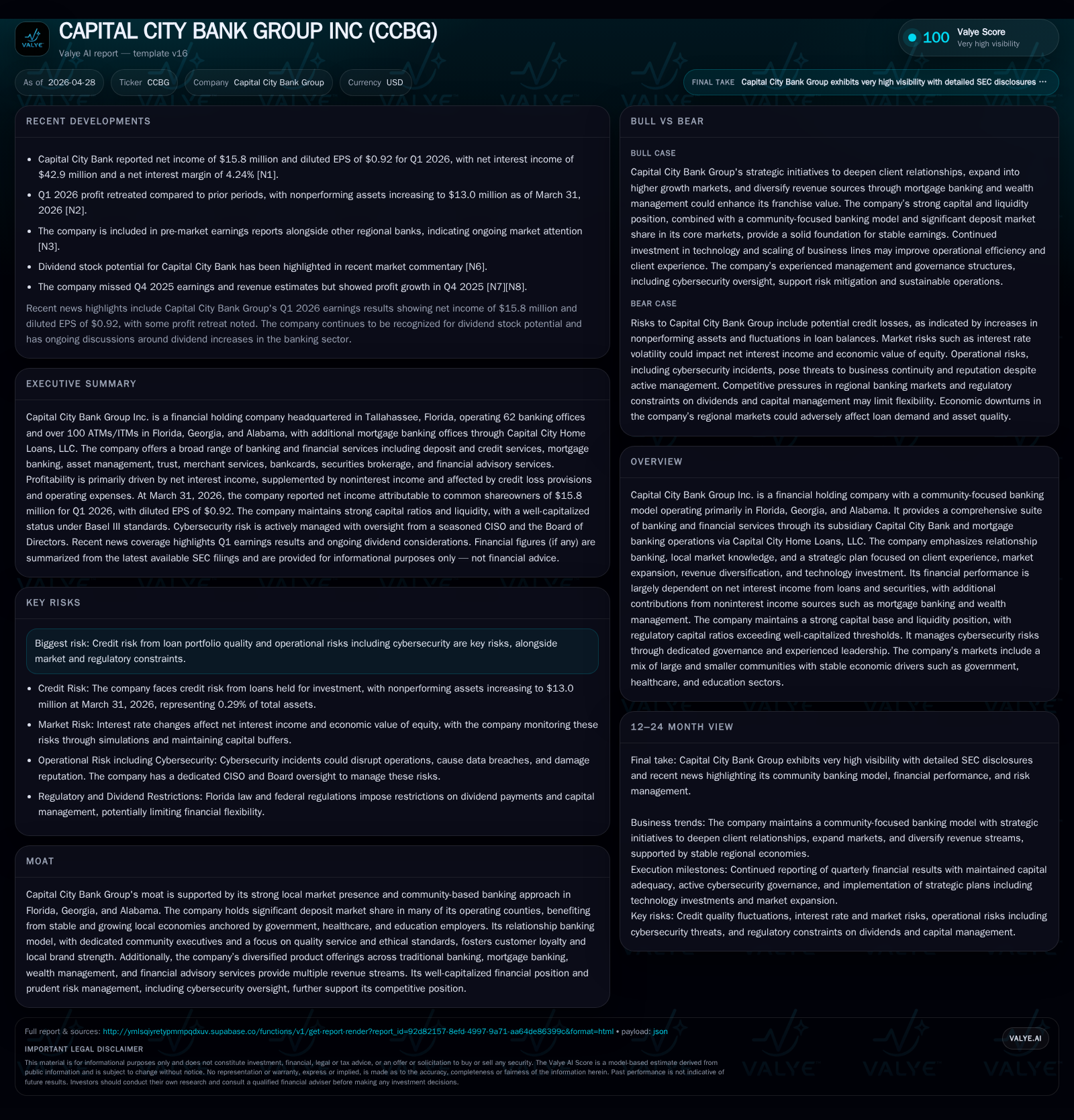
Capital City Bank Group reported a significant increase in investment securities and a refined interest rate risk management policy in Q1 2026, underpinning its community banking franchise across the Southeast. Although noninterest expenses rose notably due to pension settlement timing, the company's liquidity position remains robust with over $1.65 billion available beyond overnight funds. Strategic emphasis on relationship banking, mortgage operations, and technology investments supports a diversified revenue base, while vigilant cybersecurity oversight and regulatory compliance remain critical risks. Moving forward, monitoring loan growth trends and deposit dynamics will be key milestones reflective of Capital City's adaptability within its regional markets.
Q1 2026 Operating Highlights: Expense Trends and Risk Management Focus
In its latest quarterly filing dated April 28, 2026 [S2], Capital City Bank Group disclosed that other noninterest expenses rose to $8.6 million in Q1 2026 — a 15.6% increase compared to Q4 2025 and a sharp 51.7% rise versus Q1 2025. The sequential variance is partly explained by a $1.5 million pension plan settlement gain recognized in the previous quarter but absent this period. This controlled growth in expenses reflects ongoing investment in infrastructure albeit adjusted for timing impacts from pension accounting treatments.
Simultaneously, the company established what it describes as a comprehensive interest rate risk management policy under ALCO's direction. This framework quantifies exposure limits using net interest income at risk measures against hypothetical rate shocks spanning from one day to thirty years maturity [S2]. The embedded controls provide an effective mechanism to manage the economic value of equity (EVE) under varying interest rate environments — EVE remained within prescribed tolerance bands through Q1 despite some sensitivity to falling rate scenarios [S12]. This attention to risk regulation is significant given the historically volatile monetary policy backdrop influencing community bank balance sheets.
Business Model Overview: Relationship-Centric Banking in Southeastern U.S. Markets
Capital City Bank operates primarily through Capital City Bank subsidiary with extensive branch networks (62 full-service offices and over 100 ATMs/ITMs) concentrated in Florida, Georgia, and Alabama [S1], supplemented by mortgage banking activities through Capital City Home Loans LLC with an additional 27 offices in the Southeast. Their business model balances traditional commercial and retail deposit-taking & lending services alongside fee-generating activities such as mortgage origination, wealth management, trust services, merchant services, bankcards, brokerage, financial advisory and insurance offerings.
Profitability hinges chiefly on net interest income derived from their loan portfolio and investment securities holdings plus incremental noninterest income streams from diverse ancillary services [S1]. This diversified revenue base positions the bank well for cyclical fluctuations typical of regional economies by relying not solely on interest margins but also fee-based revenue which offers insulation during compressed margin periods.
The strategic emphases outlined in their annual report include deepening client relationships via local market knowledge, enhancing digital access channels, expanding into adjacent markets within their Southeastern footprint, revenue diversification efforts through cross-selling platforms, and sustained technological upgrades to improve client service efficiency.
Competitive Positioning: Local Market Strengths and Diversified Revenue Streams
Capital City Bank's moat is driven principally by its entrenched position as a community-oriented institution serving growing local economies anchored predominantly by government entities, healthcare providers, and educational institutions across Florida, Georgia, and Alabama. The approach involves personalized relationship banking staffed with dedicated community executives fostering strong brand loyalty.
This local dominance translates into meaningful deposit market share within operating counties securing stable low-cost funding levels compared to peer pricing dynamics. Complementing this core is a broad product suite ranging from conventional loans and deposits to wealth management & mortgage banking – affording multiple fee income avenues which enhance resilience against fluctuations in any single business line.
Such differentiation matters especially since pricing power depends heavily on deposit composition and concentration risks common among regional banks; Capital City mitigates these via diversified depositor bases combined with prudent lending portfolios.
Liquidity and Capital Strategy: Ample Reserves and Investment Portfolio as Flexibility Sources
Liquidity metrics reported for March 31, 2026 demonstrate considerable capacity with approximately $1.651 billion accessible through various instruments excluding an overnight funds balance of $425 million [S2], [S4]. This broad liquidity encompasses federal fund purchase lines, Federal Home Loan Bank borrowings, Federal Reserve Discount Window access facilities, and brokered deposits.
Quarterly-contingent liquidity stress testing is rigorously conducted with findings routinely presented to ALCO as well as the Board—testifying to proactive risk governance [S4]. Notably, Capital City's investment portfolio expanded by $113.1 million (11.2%) QoQ reaching $1.119 billion representing over a quarter (27.4%) of average earning assets—a strategic reservoir for liquidity or collateral leverage options if required [S2].
The bank views this securities portfolio — primarily composed of U.S. Treasury notes, governmental agency debt, municipal bonds and corporate issuers — as flexible capital capable of being pledged or sold to meet funding needs without disruption [S2]. This balance between loan asset growth support versus liquid securities deployment indicates attentive capital allocation reflecting both opportunity cost considerations and regulatory compliance.
Growth Drivers: Technology Investments, Market Expansion, and Mortgage Banking
Capital City's multi-pronged growth strategy foregrounds enhanced client experience facilitated by digital innovation alongside measured expansion within contiguous Southeast U.S. markets [S1],. Technology investments center on extending secure multichannel capabilities for retail/commercial clients enabling seamless transactions while providing infrastructure for scaling mortgage operations.
Mortgage banking represents an important growth vector with increased offices supplementing origination volumes that feed both fee income streams and cross-sell opportunities into other banking products (i.e., deposit accounts or advisory services). This complements core banking loans sustaining net interest margins under competitive stress.
Importantly however growth remains regionally tethered reflecting competitive intensity in southeastern urban centers but supported structurally by stable employment sectors that underpin demand for credit products. Revenue diversification reduces reliance solely on cyclical loan spreads thus tempering earnings volatility introduced by economic cycles.
Risks and Constraints: Credit Exposure, Cybersecurity Oversight, and Regulatory Environment
Key identifiable risks include credit impairments relating to loan portfolio quality—which can fluctuate with regional economic conditions—and operational risks like cybersecurity threats diligently overseen by a CISO-led Corporate Security Department with standardized protocols around incident response & vulnerability assessments [S1]. The CISO regularly updates senior leadership including the Board reflecting institutional priority given cybersecurity a critical enterprise risk emphasizing resilience.
Regulatory pressures also impose constraints notably via dividend payout limitations contingent upon sustaining adequate capital ratios consistent with Basel III standards [S1], impacting flexible capital allocation decisions amid evolving macroprudential policies.
Legal contingencies exist but management has assessed no material unresolved litigation likely to affect consolidated financials materially [S1]. Overall prudent risk governance aligned with comprehensive contingency planning undergirds ongoing operational stability despite external uncertainties.
Forward-Looking Indicators: Upcoming Milestones and Market Signals to Monitor
Investors should track subsequent quarterly filings covering margin evolution amid ongoing rate volatility as well as loan-to-investment portfolio shifts clarifying strategic direction between yield optimization vs liquidity provisioning [S2], [S3]. Deposit trends remain crucial early indicators reflecting underlying local economic health or intensified competition pressure points prompting fund cost adjustments.
Additionally monitoring implementation outcomes from technology upgrades aimed at expanding client acquisition & retention will elucidate trajectory towards revenue diversification goals. Capital expenditure plans around new office constructions projected near $10 million underscore commitment to physical presence enhancement supporting franchise growth [S9].
Successful alignment of these operational metrics will serve as useful barometers indicating execution discipline against stated multi-year objectives.
Financial Snapshot: Supporting Metrics from Latest Quarterly Filing
At March 31, 2026 capital city possesses substantial liquidity headroom exceeding $1.65 billion beyond the already liquid overnight funds totaling $425 million contributing positively towards funding flexibility amidst macro uncertainties [S2], [S4]. Investment securities appreciating over +11% QoQ signify deliberate repositioning favoring cash flow stability or collateral utility rather than less liquid loan extensions alone.
Average short-term borrowings registered modest growth linked primarily to mortgage warehouse facility activity essential for loan sales execution maintaining capital-efficient off-balance sheet channels [S9]. Incremental noninterest expense increases are acknowledged yet partially attributable to pension accounting timing effects underlining expense control vigilance amidst reinvestment cycles.
This financial posture supports capacity for measured expansion initiatives without compromising regulatory compliance or capital cushions — critical considerations given sector volatility faced by regional financial institutions currently.
This analysis reflects information publicly disclosed through April 28, 2026 filings without speculative forecasts or investment recommendations. All statistical references are drawn directly from SEC periodic reports or contemporaneous company disclosures unless otherwise noted.
Disclaimer: This is research-only, informational analysis and not investment advice. It may include AI-generated interpretation and general industry context. Always verify important details using primary sources.

Comments