
CMS Energy’s Strategic Advances Bolster Clean Energy and Grid Modernization
CMS Energy's latest quarterly update highlights expanded customer affordability efforts, regulatory-driven clean energy initiatives, and a robust infrastructure investment strategy within Michigan's regulated utility market.
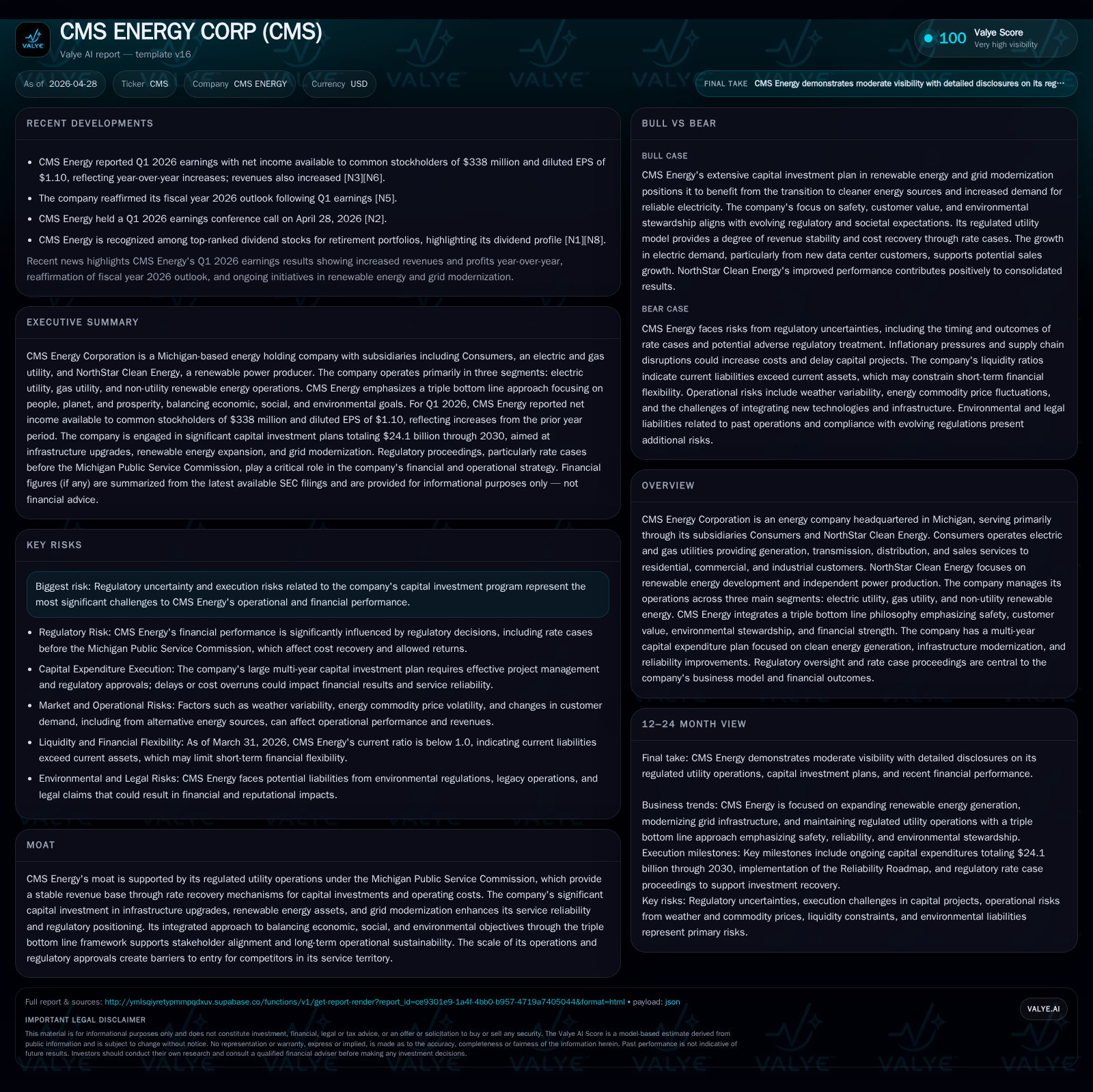
In Q1 2026, CMS Energy reinforced its commitment to affordable, clean, and reliable energy with enhanced customer assistance programs and new regulatory standards for energy storage and distributed generation. The company's integrated business model combines regulated electric and gas utilities alongside growing non-utility renewable energy operations, providing stable cash flow amid ambitious capital investments in grid modernization and clean power. CMS Energy benefits from a durable competitive moat rooted in state regulatory oversight and infrastructure scale, but must navigate execution risks tied to evolving regulations and large-scale capital deployment. Key near-term indicators include rate case proceedings, renewable portfolio expansion metrics, and adherence to the newly established energy storage plan deadlines.
Q1 2026 Operational Highlights: Advancing the Triple Bottom Line
CMS Energy’s first quarter 2026 filing (10-Q dated April 28) underscores operational progress meeting the company’s triple bottom line mandate of people, planet, and prosperity. Key developments include connecting more than 140,000 customers to $60 million in targeted energy-bill assistance programs designed to promote affordability amid broader socioeconomic challenges. In parallel, Consumers Energy facilitated access to over $100 million in statewide aid for 2026 distribution through legislative and regulatory channels [S2].
Regulatory-backed incentives were enhanced for energy efficiency programs alongside favorable returns earned on newly executed clean or renewable Power Purchase Agreements (PPAs), signaling a strategic tilt toward sustainable resource acquisition. The company also introduced an industry-first energy storage standard requiring Michigan electric utilities to file compliant plans by 2029 aiming to achieve a robust statewide target of 2,500 MW of storage capacity. This move aligns with growing policy momentum around grid flexibility and renewable integration at scale [S2]. Additionally, Consumers Energy witnessed an expansion of the statutory cap on distributed generation resources from previous limits up to now encompassing 10% of the utility’s five-year average peak load. This broader DG allowance fosters customer-side solar growth within the regulated footprint by legally enabling more expansive deployment under the Public Acts governing Michigan utilities [S2]. These developments reflect a broad-based strategy tightly integrated with state policy objectives facilitating decarbonization while maintaining grid reliability.
Core Business Model and Product Offering: Utility and Renewables Fusion
CMS Energy's business model centers on a synergistic blend of regulated utility operations via its Consumers subsidiary combined with independent renewable power production through NorthStar Clean Energy. Consumers operates both electric and gas utilities serving residential, commercial, and industrial customers predominantly within Michigan. Revenue streams derive primarily from regulated rates approved by the Michigan Public Service Commission (MPSC) which incorporate mechanisms such as Power Supply Cost Recovery (PSCR) adjustments ensuring cost pass-through plus returns on prudently incurred capital investments [S1][S2].
On the non-regulated front, NorthStar Clean Energy develops and operates renewable projects including solar and wind generation supported through long-term PPAs guaranteeing cash flow visibility albeit with typical project development risks. This segment taps into growing commercial demand coupled with decarbonization imperatives favoring clean independent power producers. The regulated segments provide steady cash flow shielded from commodity price volatility while NorthStar supplements growth through asset additions responsive to market conditions.
This hybrid structure enables CMS to balance predictable income from regulated utilities with growth upside stemming from renewables expansion amid tightening environmental regulations. The integration of distributed generation provisions further supports forward-looking transitions allowing customers indirect participation in clean energy creation.
Competitive Moat Rooted in Regulatory Oversight and Infrastructure Scale
CMS Energy’s competitive moat is anchored by its status as a regulated utility under MPSC jurisdiction that guarantees authorized rates are sufficient to recover operating costs plus earn allowed returns on invested capital. This regulatory framework creates high barriers for new entrants given substantial capital requirements and comprehensive rate case scrutiny.
Moreover, CMS’s continuous investment in modernizing transmission and distribution infrastructure enhances system reliability—a critical factor given increasing weather-related disruptions industrywide. Its embedded triple bottom line philosophy ensures not only economic viability but also robust alignment with social equity goals and environmental stewardship enhancing stakeholder trust.
These elements contribute to substantial switching costs and customer retention benefits as well as reinforcing political goodwill requisite for successful future rate cases or renewables approvals. In contrast with deregulated or lightly regulated peers outside its footprint who face greater margin pressure from competition or wholesale market exposure, CMS’s secure operating domain underpinned by statutes makes it structurally defensive yet open to measured growth opportunities within established regulatory corridors.
Industry Context: Regulatory Environment and Technological Tailwinds
CMS operates within a complex regulatory environment shaped by both state-level mandates like the Clean Energy Plan enshrined through Michigan legislation as well as federal frameworks such as the Resource Conservation and Recovery Act (RCRA). Compliance with these regulations mandates continued investments in emission reductions, waste management protocols across generation assets, and adherence to evolving air quality standards.
Technological tailwinds include rapid advances in battery storage economics facilitating implementation of mandated storage targets due by 2029. The broadening Distributed Generation cap to 10% further encourages rooftop solar installation growth catalyzing shifts in load profiles thus necessitating investments in grid sophistication such as advanced metering infrastructure (AMI) deployments covered under Consumers’ five-year Reliability Roadmap filed with MPSC.
Retail Open Access policies allow certain large customers choice among competitive electric suppliers; however, CMS retains strong incumbency within most segments limiting material migration outside regulated tariffs since rate adjustments generally favor balanced cost recovery protecting incumbent utilities.
Supply chain considerations represent an increasing factor given global constraints impacting delivery timelines for transformers, smart grid equipment, power electronics essential for integrating variable renewables effectively [S2][S1].
Growth Drivers: Capital Investment in Clean Energy and Grid Investments
CMS is executing a multi-year capital expenditure framework aimed at expanding renewable capacity via NorthStar Clean Energy projects sanctioned through favorable PPAs coupled with aggressive reforms in distribution infrastructure modernization encapsulated by Consumers’ Reliability Roadmap initiative [N1][S2][S1].
These investments align with quantifiable milestones including achieving statutory energy storage targets within prescribed timelines (plans due to regulators by 2029), expanding DG resource capacity up to legal caps increasingly embraced by residential rooftop solar adopters, and deploying demand-side management (DSM) incentives driving efficiency gains that minimize capacity strain—all critical in mitigating potential penalties associated with lagging DSM adoption.
The strategic focus on clean PPAs not only meets renewable portfolio standards but serves as a hedge against fossil fuel price volatility while supporting corporate decarbonization goals increasingly demanded by institutional consumers. Grid reliability expenditures also underpin sustained service quality crucial for customer satisfaction amidst rising frequency of extreme weather events impacting Midwestern utilities.
Potential Constraints: Regulatory Risk and Execution Challenges
Regulatory risk remains a dominant concern due primarily to uncertainties around timely approval of rate cases that determine allowed returns impacting cash flow sufficient for funding capital outlays without excessive borrowing costs. Unexpected delays or reductions could pressure net income in forthcoming periods.
Execution risk encompasses challenges related to managing simultaneous large-scale projects amid supply chain bottlenecks (notably semiconductors for smart grid devices), skilled labor shortages slowing construction timelines, escalating material inflation compressing capital efficiency ratios beyond budgeted projections.
Additionally relevant are potential shifts in legislative priorities altering incentive structures or imposing added compliance burdens which could elevate operational expenditure or depress tariff revenue structures absent corresponding adjustments by regulators [S1].
The balancing act between accelerating decarbonization ambitions while safeguarding affordability constitutes an ongoing strategic tightrope for CMS hence emphasizing transparent stakeholder engagement processes as vital mitigation mechanisms.
Forward-Looking Indicators: Guidance, Policy Milestones, and Webcast Insights
Upcoming milestones warrant close observation including the progress schedule of MPSC’s review of Consumers’ pending rate cases potentially setting adjusted tariffs effective later this year impacting revenue trajectory.
Compliance submissions addressing the newly enacted statewide energy storage mandate represent critical timeline markers with planning efforts required for filing comprehensive approaches by calendar year-end deadlines reflecting technology procurement strategies accounting for expected battery manufacturer lead times.
The NorthStar Clean Energy segment is expected to provide quarterly indications of asset additions or PPA wrap-ups that serve as forward proxies for securing future cash flow streams supportive of CMS’s diversification strategy into renewables development.
Management’s webcast commentary accompanying Q1 earnings release reaffirmed fiscal year guidance consistent with prior outlooks emphasizing prudent capex allocation calibrated against rigorous operational execution disciplines reinforcing investor confidence despite sector cyclicality linked to weather variability or regulatory outcomes [S3][N1][N2].
Financial Snapshot: Liquidity, Debt Structure, and Capital Expenditure Profile
CMS Energy maintains liquidity of approximately $175 million in cash & equivalents as of March 31, 2026 providing working capital flexibility supporting near-term operating needs [F1][S2]. Total debt stood near $18.9 billion at end-2025 yielding an approximate net debt position of $18.76 billion when netted against cash balances reflecting a leverage profile typical for large-cap regulated utilities investing heavily in infrastructure renewal [F1].
Current asset levels at $3.03 billion versus liabilities at around $3.59 billion produce a current ratio below one (0.84), indicative of relatively tight working capital conditions warranting ongoing monitoring especially factoring seasonal liquidity fluctuations common across utility sectors [F1].
Capital expenditures remain elevated inline with announced multi-year plans focused on renewables buildout alongside grid modernization consistent with stated strategic imperatives detailed earlier ensuring financial resources align closely with forward operational priorities without excessive reliance on incremental external financing beyond scheduled issuances analyzed within disclosures.
This analysis synthesizes publicly available information from recent SEC filings including CMS Energy's Q1 2026 Form 10-Q dated April 28, 2026 ([S2]), its Annual Form 10-K dated February 10, 2026 ([S1]), related event filings ([S3]), complemented by news transcripts ([N1], [N2]). All financial figures adhere strictly to documented disclosures; no speculative estimates have been applied.
Disclaimer: This is research-only, informational analysis and not investment advice. It may include AI-generated interpretation and general industry context. Always verify important details using primary sources.

Comments