
Hilton Worldwide Extends Global Reach with Strong Q1 Performance and Loyalty Growth
Hilton reported better-than-expected Q1 2026 results, driven by robust RevPAR growth and expansion of its loyalty program, underpinning resilience in an evolving hospitality landscape.
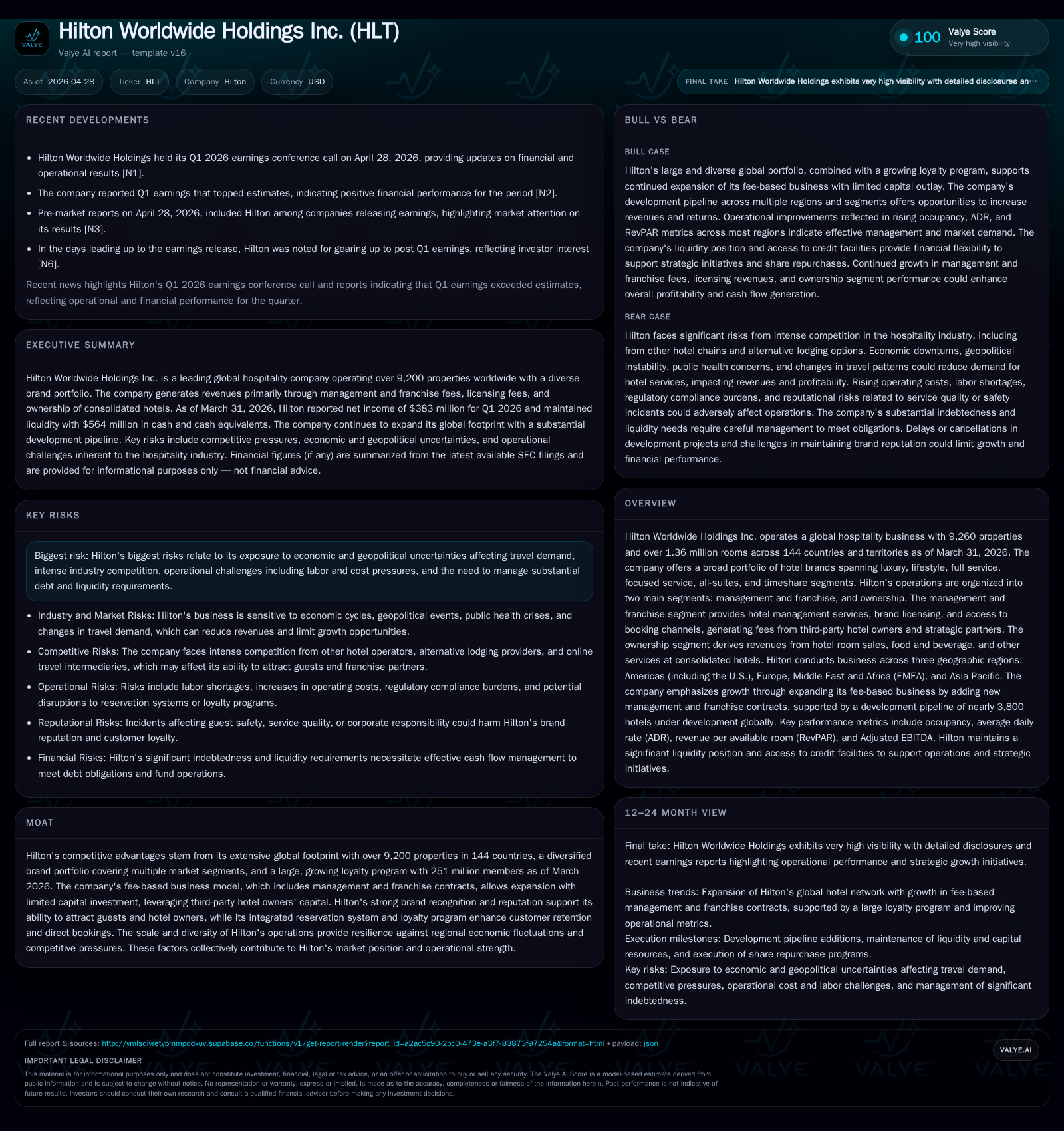
Hilton Worldwide Holdings Inc. demonstrated operational strength in Q1 2026 with system-wide RevPAR increasing 3.6% fueled by geographic and segment diversification. The company’s asset-light fee-based management and franchising business continues to drive high-margin revenue growth, complemented by expanding loyalty membership, now at 251 million worldwide. Despite macroeconomic headwinds including inflationary cost pressures and geopolitical risks, Hilton's extensive global footprint, diverse brand portfolio, and large development pipeline position it for durable growth. Financially, Hilton maintains significant scale but faces leverage challenges with $12.45 billion total debt alongside $564 million in cash at quarter-end.
Q1 2026 Operating Highlights: Revenue Growth and Profitability Drivers
Hilton Worldwide’s first-quarter 2026 performance showcased operational momentum across key metrics that outpaced expectations. System-wide RevPAR rose 3.6%, supported broadly by all regions except some softness in Middle East & Africa due to geopolitical instability [S2][S24]. The U.S. market recorded a 3.4% RevPAR improvement driven by healthy occupancy gains (68.7%, +1.3 pts) and moderate rate hikes (+1.4%) benefiting from domestic leisure travel timing effects like earlier spring breaks [S24]. Meanwhile, Europe posted a notable 6.9% RevPAR increase buoyed by inbound travel for special events such as the Winter Olympics [S24]. Asia Pacific also rebounded with a 4.7% rise enhanced by recovery in China’s business travel segment [S24].
Management and franchise fee revenues grew double digits (11.4%) chiefly on increased franchise fees from net hotel additions and higher termination fees—these fees carry higher margin profiles relative to ownership segment revenues [S22]. Total management fees expanded about 7%, reflecting the continued shift towards asset-light growth via franchising and management agreements [S22]. This trend aligns with Hilton’s strategy emphasizing scalable fee income streams amid tighter capital markets.
Hilton’s Business Model: Dual Segments Fueling Fee-Based Expansion
Hilton operates via two principal segments: (i) management and franchise services; (ii) ownership of select consolidated hotels [S2][S1]. The management and franchise segment generates revenue chiefly through contracts with third-party owners who finance property assets while accessing Hilton's brand names, booking systems, marketing infrastructure, and loyalty platforms [S1]. Fees include base management fees based on room revenues, incentive fees linked to profitability targets, franchise licensing fees, as well as strategic partner income such as co-branded credit card alliances [S2][S1]. This segment benefits from an asset-light structure fostering scalability since much capital investment burden rests on hotel owners rather than Hilton itself.
The ownership segment contributes revenues directly from room sales, food/beverage services, and other hotel operations at owned or leased properties but remains smaller in scale relative to the fee-driven segment [S2][S1]. Ownership exposes Hilton to greater operating leverage but also higher capital intensity.
This dual model offers resilience: growing fee-based revenues underpin stable margins while ownership operations provide controlled exposure to direct hospitality demand swings.
Global Portfolio and Brand Segmentation: Coverage Across Market Tiers
As of March 31, 2026, Hilton managed a vast global footprint of approximately 9,260 properties encompassing over 1.36 million rooms distributed across 144 countries [S2][F1]. Its brand portfolio spans luxury (e.g., Waldorf Astoria), lifestyle (Canopy), full-service (Hilton Hotels & Resorts), focused service (Hampton), all-suites (Homewood Suites), plus timeshare offerings—covering broad market segments that cater to diverse customer preferences worldwide [S1][S2].
Geographically, the Americas contain roughly two-thirds of system rooms dominated by the U.S., which accounts for about 64% of global room supply [S2][S19]. EMEA includes mature European markets plus Middle East & Africa where volatility currently suppresses performance slightly [S24][S19]. Asia Pacific features meaningful emerging travel demand with increasing hotel additions supporting rising inbound tourism especially in India and Australia [S19][S24].
This breadth diversifies earnings risks related to regional economic fluctuations or localized shocks.
Competitive Dynamics Within Hospitality: Market Positioning and Barriers
Hilton’s competitive strengths stem from significant scale advantages: over nine thousand properties secure broad market reach while brand equity sustains pricing power amid intense competition from peers including Marriott, Hyatt, Accor, and IHG [S1][S2]. Its loyalty program—Hilton Honors—encompasses an impressive total membership of approximately 251 million as of Q1 2026, up nearly 15% year-over-year [S2]. This sizable member base fosters guest retention incentives combined with direct booking advantages reducing distribution costs versus OTAs.
Integrated reservation systems streamline guest experiences while contractual relationships with franchised owners embed the platform deeply into the value chain creating switching costs for both property owners and customers alike [S1][S2]. The balance between fee-only contracts permits rapid network expansion while limiting Hilton’s capital expenditure risk relative to fully owned models common historically in hospitality.
Pricing power is challenged periodically by inflationary pressures on labor, energy and supplies alongside leisure/business travel variability especially post-pandemic shifts favoring virtual meetings impacting corporate travel volumes long term — these factors require vigilant margin control despite robust top-line trends.
Growth Catalysts: Loyalty Program, Development Pipeline, and Geographic Penetration
Key drivers fueling Hilton's growth trajectory include:
- Loyalty Program Expansion: With membership growing to 251 million users within a year (15% surge), the program scales Hilton's capacity for repeat bookings and personalized marketing—a critical moat against competitors [S2].
- Robust Development Pipeline: Over 3,700 hotels encompassing roughly 520,500 rooms are under development worldwide including many outside the U.S., signaling strong international penetration ambitions [S1][S2]. Nearly all pipeline units are expected under management/franchise contracts upon opening highlighting continued asset-light new supply growth.
- Geographic Diversification: Expansion outside mature American markets into emerging Asia Pacific countries fuels structural demand upside amid rising middle-class travelers seeking branded accommodations.
Challenges persist in development execution with inflationary cost pressures causing some delays in hotel openings; however long-term network effects combined with ancillary revenue streams bolster incremental free cash flow generation potential.
Risks and Headwinds: Economic Pressures, Competition, and Capital Costs
Despite promising fundamentals several risks temper outlooks:
- Economic Sensitivity: Fluctuating business travel recovery trajectories influenced by hybrid work norms can depress demand volatility given corporate travel represents a significant mix component [S1].
- Inflationary Input Costs: Rising wages along with energy price surges escalate operating expenses at both franchised locations (impacting operator margins) and owned hotels directly reducing profitability elasticity.
- Capital Market Conditions for Owners: Tightening credit environments may constrain third-party owners’ ability to finance new developments or renovations thereby slowing franchise growth pace.
- Competition Intensity: Rival chains compete aggressively on price promotions targeting similar customer demographics pressuring average daily rates gains amidst cost inflation scenarios.
- Leverage Exposure: Substantial indebtedness (~$12.45B total debt) elevates financial risk particularly if adverse market shocks curtail cash flow generation temporarily impacting servicing capacity [F1].
What Investors Should Monitor Next: Guidance, Milestones, and Execution Signals
Looking ahead key investor focus areas include:
- Management guidance updates on RevPAR trends expected mid-to-late calendar quarters reflecting changing macroenvironment dynamics [N2][S2].
- Progress on accelerating addition of hotels into system pipeline especially internationally demonstrating maintenance of structural expansion strategy effectiveness.
- Updates around Hilton Honors member engagement metrics which signal quality of consumer loyalty ecosystems driving long-term direct bookings share capture vs intermediaries.
- Operational efficiencies evidenced through cost containment initiatives offsetting inflation impacts on labor/energy inputs maintaining margin stability.
These milestones collectively will shed light on the durability of recent operating strength amid external uncertainties.
Current Financial Profile: Liquidity, Debt, and Capital Management
At March 31, 2026 quarter-end Hilton held approximately $564 million in cash and equivalents against total debt of about $12.45 billion, resulting in a net debt position near $11.89 billion and a current ratio of approximately 0.61, indicating a limited short-term liquidity buffer relative to current liabilities [F1].
Operating cash flows remain solid—$618 million generated during Q1—primarily driven by escalating fee-based revenues from franchised hotels which have lower capital requirements than ownership segments [S9][S10][S22]. Share repurchase activity continues actively supported by available liquidity though moderated from historical levels consistent with prudent balance sheet targeting [S7][N1].
Capital expenditures are primarily directed towards selective renovations and digital capabilities supporting branding/reservation tech enhancements underpinning future fee income [S10].
Overall financial posture balances stable cash flow generation against meaningful absolute indebtedness; maintaining access to credit markets remains essential for sustaining strategic flexibility.
Disclaimer: This is research-only, informational analysis and not investment advice. It may include AI-generated interpretation and general industry context. Always verify important details using primary sources.

Comments