
SuperCom Ltd Boosts IoT Sales by 6% Despite 25% Drop in e-Gov Revenue in 2025
The company’s 1% overall revenue growth was driven by IoT expansion in Europe and the US, offsetting manufacturing challenges and operational losses in its e-Gov segment.
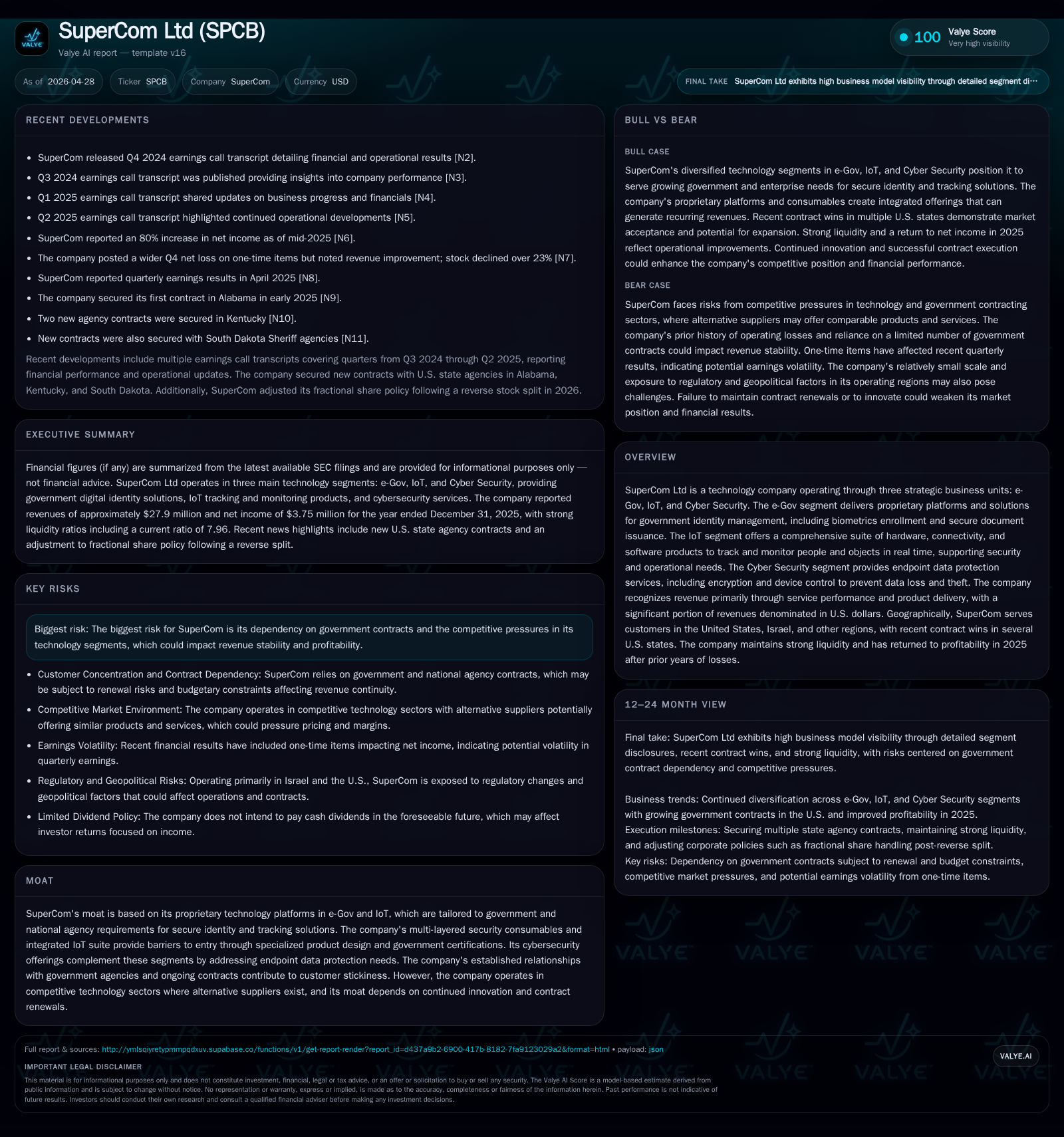
In its latest annual filing, SuperCom Ltd showcased revenue growth driven largely by its IoT segment’s strong performance, offsetting a notable decline in e-Gov segment revenues linked to manufacturing challenges. The company’s business model revolves around proprietary identity management, IoT tracking solutions, and cybersecurity services predominantly for government clients, leveraging multi-year contracts and specialized products with significant barriers to entry. SuperCom’s competitive positioning is anchored on government certifications and technology integration across its three units, but it faces risks related to geopolitical tensions impacting market access and intense sector competition. Going forward, execution on U.S. market expansion initiatives and contract renewals will be critical growth levers.
Recent Operating Update
SuperCom Ltd's latest Form 20-F filing dated April 28, 2026 [S1] aligns with its interim disclosures from September 26, 2025 [S2], offering the most comprehensive snapshot into its operational progress through YE 2025. The company reported total revenues of approximately $27.9 million, up marginally by about 1% from $27.6 million in the prior year [F1]. This topline stability masks divergent trends across its core segments: the IoT business expanded revenues by 6%, reaching $25.4 million mainly due to European market growth, while revenues from the e-Gov segment contracted sharply by about 25% to $1.15 million — a significant operational setback attributable to manufacturing failures affecting recurring revenue streams from long-term government contracts [S1]. Cyber Security revenues remained relatively small at around $0.82 million but represent an essential strategic pillar [S21].
This mix reflects SuperCom’s pivot toward leveraging its IoT solutions as a primary growth driver amid lingering disruptions from geopolitical issues impacting access to key markets in Asia and Europe. Management disclosed that due to the Seven Fronts War involving Israel, operations faced difficulties such as employee military service obligations, restricted travel, disrupted supply chains, heightened antisemitism, and dampened customer engagement across some regions [S1]. Consequently, there was a strategic focus on expanding U.S.-tailored products alongside US sales force investments as part of mitigation efforts [S1].
Business Model and Strategic Positioning
SuperCom is structured into three synergistic strategic business units: e-Government (e-Gov), Internet of Things (IoT), and Cyber Security [S21]. The e-Gov segment provides governments with secure biometric enrollment platforms, identity management systems, document personalization technologies (such as multi-ID systems), and border control solutions through proprietary software like Magna_DL, Magna_VL, Magna_Passport, and Magna_ID [S1]. These solutions cater heavily to national agencies' stringent security regulations necessitating certified platforms with customization for sovereign needs.
The IoT segment offers integrated hardware-software solutions focused on real-time tracking and monitoring of people and objects crucial for security-sensitive environments—this includes hybrid connectivity devices paired with software suites enabling detection of unauthorized movement or access [S1][S21]. Its all-in-one turnkey offerings combined with tailored service agreements create higher switching costs and embed the company deeply within client operations.
Cyber Security complements these two units via endpoint data protection capabilities encompassing content discovery tools, encryption methodologies, port/device control software designed to prevent data leaks or theft within enterprise environments [S21].
Revenue generation primarily comes from product sales—especially perpetual licenses transferring intellectual property rights upfront—and accompanying service provisions aligned with project implementations [S1]. The company recognizes most revenues in US dollars given its customer base heavily concentrated outside Israel including the US and parts of Europe [S1][S24].
Crucially, SuperCom’s moat rests on specialized technology certified for governmental use alongside established long-term contracts creating barriers against commoditized competition. However, it faces pressure from alternative suppliers in all segments necessitating ongoing R&D investment—which stood at approximately $3.9 million in 2025—to sustain innovation pipelines particularly in IoT-related enhancements [S10][F1].
Industry Structure and Competitive Landscape
Operating at the intersection of government IT infrastructure solutions, security hardware/software integration, and emerging IoT modalities positions SuperCom within competitive yet fragmented markets requiring credentialed expertise and compliance adherence.
For e-Gov services globally there are few players able to provide multidimensional secure ID systems compliant with evolving biometric standards; here SuperCom’s legacy SmartID acquisition provides differentiated capabilities although manufacturing reliability issues recently affected its standing [S1]. Meanwhile IoT market expansion taps broader secular trends toward real-time asset/person tracking but demands scalability along with cyber-secure endpoints—domains crowded by multinational tech incumbents plus smaller niche innovators. SuperCom attempts defense via full-stack offerings aiding customer lock-in.
Cyber Security remains a highly competitive sector populated by firms specializing either at network layers or endpoint protection; SuperCom’s niche is protection focused chiefly on endpoint device & port control integrated into multi-layer defense frameworks currently leveraged within existing client bases rather than mass-market penetration [S21].
Geopolitics impose additional complexity given Israel’s contested regional setting affecting perception risks outside core markets. Seasonal spikes in antisemitic incidents have tangible impacts on brand reputation particularly in Europe/Asia limiting field operations temporarily [S1].
Growth Drivers
The principal driver is expanding demand for secure identification solutions amid growing digital ID government mandates worldwide coupled with rising interest in integrated IoT tracking in public safety contexts.
SuperCom's IoT revenue growth (6% increase YoY) indicates traction from geographic expansion—mainly into European zones—and success tailoring offerings for North American clients after re-focusing international sales efforts post-2023 regional difficulties. This suggests structural adoption of hybrid hardware/software custom suites as governments bolster surveillance & asset monitoring infrastructures.
Cyber Security unit offers medium-term potential through upselling cybersecurity add-ons bundled with existing accounts seeking endpoint security upgrades—a trend bolstered by increasing global cyber threat levels.
Conversely recent setbacks exposing vulnerabilities on manufacturing reliability within the e-Gov business underscore execution risks potentially delaying contract renewals or new awards reducing recurring revenue predictability here.
Management continues investing in R&D ($3.9M) focusing especially on improving offerings across IoT & Cyber Security verticals aiming to sustain technological relevance while also expanding direct sales presence notably in US markets given local demand growth prospects aided by supportive policy environments favoring homeland security expenditures [S10][N3].
Growth Constraints
Challenges include dependency on a small set of large government customers exposing revenue volatility to political cycles or contract delays exacerbated by ongoing regional hostilities impacting sales channels.[S1]
Manufacturing failures affecting retroactive recognition of multiyear contracts illustrate operational risk that could impact margins or lead time competitiveness particularly against global OEM suppliers who can invest heavily in supply chain robustness.
Negative operating cash flows (-$5.49M) despite profitability at net income level reveal latent financial stress linked partly to restructuring costs or capex spending ($0.88M down from prior years) reflecting transition phases.[F1]
Intense competition across all tech verticals means pricing pressures may emerge without commensurate feature differentiation unless innovations are continuous.
Geopolitical tensions remain an unpredictable headwind; temporary shift away from European/Asian engagements reduces market diversity and limits pipeline development outside North America.
What To Watch Next
- Progress metrics regarding US market penetration through newly developed tailored IoT product suites designed specifically for American regulatory framework.
- Contract renewal cadence especially within troubled e-Gov vertical where client retention after manufacturing setbacks will be closely scrutinized.
- Ongoing R&D outcomes related to Cyber Security enhancements which could yield incremental cross-selling opportunities within installed base.
- Operational cost trends aligned with restructuring efforts impacting cash flow trajectory.
- Any further debt refinancings or equity raises given recent history of debt-to-equity conversions shifting capital structure effectively until December 2028 maturity dates.[S3][F1]
- Macro-political developments relevant to Israeli businesses potentially affecting cross-border operations indirectly impacting pipeline visibility.
Financial Profile Summary
Historical performance (annual)
Capital returns and efficiency (annual)
From a financial standpoint per FY2025 results summarized in the annual filing:
- Revenue rose slightly to about $27.9 million from $27.6 million prior year; product sales contributed roughly $21.45 million versus services adding approximately $6.44 million reflecting stable business mix balance [F1][S13].
- Gross profit increased significantly due largely to improved cost controls or product mix shifts totaling $15.4 million compared to $13.4 million year prior [F1].
- Operating income loss narrowed to -$0.32 million versus -$0.78 million previously marking progress toward break-even operational footing though still not firmly positive [F1].
- Net income was positive at roughly $3.75 million supported by non-operating gains including debt-to-equity conversions enhancing bottom-line results dramatically compared with prior years’ losses [F1].
- Cash & equivalents stood strong at near $9.8 million with minimal total debt (~$0.12 million as last reported end-2024), yielding an extremely healthy current ratio of almost 8x underscoring liquidity sufficiency [F1][S2].
- Operating cash flows remain negative at -$5.49 million driven partly by working capital changes or ramped spending patterns amid growth initiatives [F1][S22].
- Capital expenditures pulled back moderately signaling matured capex cycle possibly supporting margin improvements ahead [F1].
- Equity expanded substantially reflecting capital raises including debt conversions boosting balance sheet strength above $43 million providing runway for operational reinvestment or strategic flexibility [F1].[S7]
Overall financial evidence points toward a company progressing steadily out of loss phases yet still navigating cash flow headwinds attributable mainly to segmental volatility and strategic repositioning costs.
This analysis synthesizes SuperCom Ltd's latest public disclosures without forecasting or investment recommendations; it aims purely to clarify fundamental operational dynamics shaping its current corporate standing and prospective challenges/opportunities based on available data sources cited throughout.
Disclaimer: This is research-only, informational analysis and not investment advice. It may include AI-generated interpretation and general industry context. Always verify important details using primary sources.

Comments