
Armstrong World Industries Expands with Strategic Acquisition Despite Q1 Earnings Miss
AWI's recent acquisition of Eventscape augments its architectural specialties portfolio amid a challenging Q1 earnings performance.
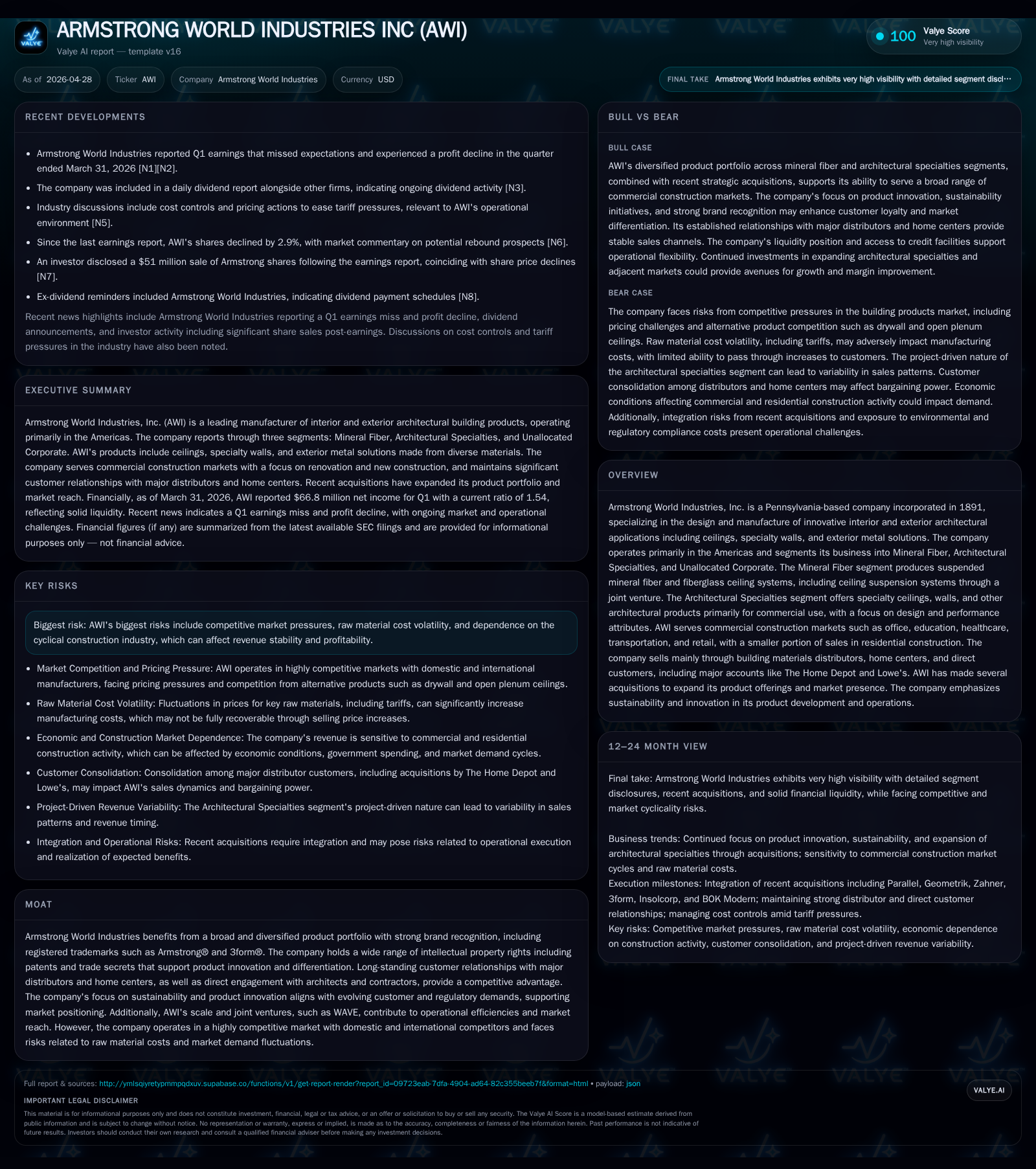
In Q1 2026, Armstrong World Industries (AWI) acquired Eventscape for $64.6 million, bolstering its Architectural Specialties segment with expanded product design and installation capabilities. The quarter featured an earnings miss influenced by margin pressure and a higher effective tax rate, partially offset by strategic investments and solid balance sheet liquidity. AWI’s business model leverages two main segments—Mineral Fiber and Architectural Specialties—serving primarily commercial construction markets through various channels including distributors and direct customers. Growth is driven by acquisitions, product innovation focused on sustainability, and enhanced market reach, while risks persist from raw material cost volatility, cyclical construction demand, and competition. Key near-term focus areas include successful integration of Eventscape and monitoring commercial construction activity.
Latest Quarterly Developments and Strategic Implications
Armstrong World Industries’ Q1 2026 filing [S2] reveals a pivotal acquisition: the purchase of Eventscape for $64.6 million in cash net of acquired cash plus contingent consideration up to $7.5 million payable by 2030 based on performance targets. Eventscape's unique offering lies in the design, manufacture, and installation of specialized ceilings, walls, and facade solutions across diverse materials. This deal aligns with AWI’s strategy to deepen its Architectural Specialties segment portfolio through innovative architectural products that appeal to commercial construction clients.
Despite this strategic move, AWI reported an earnings miss relative to estimates in Q1 [N1], attributed primarily to margin compression from higher costs alongside a notable rise in the effective tax rate due to expiring federal investment tax credits recognized in the prior year [S2]. The company’s cash position stands at $79.8 million against total debt of roughly $410.6 million as of the quarter end [F1], yielding a current ratio of approximately 1.54 that indicates stable near-term liquidity.
These developments underscore AWI’s dual challenge: absorbing acquisition-related expenses while navigating cost pressures in a cyclical commercial construction environment. Meanwhile, Eventscape’s inclusion is expected to contribute progressively to revenue diversification and higher-margin specialty projects within Architectural Specialties.
Business Model: Diverse Architectural Solutions and Customer Access
AWI operates mainly via two reportable segments: Mineral Fiber and Architectural Specialties [S1], supplemented by Unallocated Corporate functions responsible for corporate overheads and investments such as its stake in Overcast Innovations.
The Mineral Fiber segment focuses on suspended mineral fiber ceilings and fiberglass ceiling systems known for acoustical control, fire protection ratings, energy efficiency gains via proprietary products like Templok®, and health/sustainability attributes appealing to discerning customers. A key element is the ceiling suspension system (grid) production managed through the joint venture Worthington Armstrong Venture (WAVE), which not only supports internal systems but also generates equity earnings [S1]. This vertical integration enhances AWI’s control over quality and cost.
Architectural Specialties encompasses a broad range of premium ceiling designs, specialty walls, exterior metal solutions—including extruded aluminum from recent Parallel acquisition—and materials like architectural resin/glass from the 3form acquisition [S1]. Products are predominantly project-driven for commercial settings (offices, education centers) with sales channels comprising direct contractors and resellers. Emphasis on product innovation enables customization per client specifications, fostering stickiness within architect/contractor relationships.
Customer access benefits from longstanding distributor partnerships (notably large home centers) combined with growing direct architectural firm engagement [S20]. This hybrid distribution model supports AWI’s ability to influence early project specifications while ensuring logistic reach.
Competitive Landscape and Industry Dynamics
AWI operates in a fragmented yet highly competitive building products industry that includes both domestic manufacturers specializing in mineral fiber ceilings or metal exterior facades as well as global suppliers offering resin/glass specialty walls [S18]. Price wars occur primarily due to construction cyclicality where procurement managers push for cost savings amid fluctuating project activity.
AWI differentiates itself through proven brand equity in Armstrong® ceiling tiles alongside innovative products under recognized trademarks like 3form®, backed by an extensive intellectual property portfolio including patents protecting acoustic designs and manufacturing processes. The WAVE joint venture strengthens operational scale for ceiling suspension grids essential to integrated ceiling systems.
Sustainability credentials form another competitive frontier as regulatory regimes progressively mandate energy-efficient building materials; AWI has invested heavily here through Sustain® product lines demonstrating reduced embodied carbon footprints [S1]. However, maintaining pricing power is challenged by input cost inflation for raw minerals/fiberglass/metals often passed partially onto customers depending on project budgets.
Growth Drivers: Product Innovation, Sustainability, and Channel Penetration
Organic growth stems from AWI’s ongoing product innovation efforts focusing on acoustic control solutions like Total Acoustics® tiles combining sound absorption properties with aesthetic versatility [S22]. Sustained R&D investment enables differentiated materials usage across mineral fiber compositions or novel resin-glass composites enhancing design potential—key selling points for architects charged with functional yet visually compelling interiors.
The architectural specialties pipeline benefits substantially from bolt-on acquisitions including Parallel’s extruded aluminum components expanding exterior metal capabilities along with Geometrik’s wood acoustical panels targeting prestige projects [S22]. These curated deals not only increase total addressable market but also create cross-selling synergies across existing distribution channels.
Channel strategies have sharpened with deeper penetration into contractor direct accounts alongside distributor relationships evidenced by consistent sales growth across both segments observed in the latest filings [S21]. On sustainability fronts, meeting evolving client demands via certified low-emission products anticipates stricter legislation enhancing future demand resiliency.
Risks and Growth Constraints: Raw Materials, Cyclicality, and Competitive Pressure
Key risk exposures remain notably tied to volatile raw material inputs including fiberglass fibers sourced globally subject to supply chain disruptions or commodity price swings impacting margins, compounded by metals prices affecting architectural specialties’ extruded aluminum lines. While some cost inflation can be offset through pricing adjustments, cyclical downturns compress project pipelines diluting bargaining power.
Construction industry cyclicality is pronounced for AWI given its heavy exposure to commercial sectors whose capital expenditures are tied closely to macroeconomic conditions such as GDP growth rates or office vacancy levels [S9]. Downturns can lead to volume contractions that adversely affect fixed cost absorption.
Additionally, unrecognized tax benefit uncertainties flagged in Q1 filings indicate potential variability in future effective tax loads which could sway net profitability unexpectedly [S2]. Competitive pressures may intensify as global entrants pursue market share with aggressive pricing or technological innovations requiring continuous investment from AWI.
Key Near-Term Milestones and Execution Watchpoints
Investors should monitor integration progress on Eventscape especially realization of expected synergy targets throughout 2026–2030 given contingent consideration linked to performance metrics by 2030 [S2]. Upcoming quarterly earning releases will provide further clarity on margin trajectories post-acquisition plus effects from cost containment initiatives implemented after Q1 softness.
Market demand signals such as Architecture Billings Index trends or new commercial construction starts data will serve as bellwethers for volume momentum feeding into Mineral Fiber sales volumes. Sustainability-oriented product adoption rates from major customers can validate differentiation efficacy driving premium pricing ability.
Execution of pricing actions amid input cost inflation remains crucial alongside continuous expansion into high-growth sub-sectors within architectural specialties through further targeted acquisitions or organic product breakthroughs.
Concise Financial Snapshot
As of March 31, 2026 end-of-quarter metrics show AWI holds $79.8 million in cash plus equivalents versus $262.1 million in current liabilities providing comfortable short-term liquidity reflected in a current ratio of about 1.54 [F1]. Total debt stood at $410.6 million at December 31 close with net debt approximated at $330.8 million after cash offsets [F1].
The rise in the Q1 effective tax rate due to non-recurrence of prior investment tax credits has weighed on net income performance along with compressed gross margins impacted by raw material costs heating up [S2]. Nevertheless, strong equity earnings mainly from WAVE joint venture activities continue contributing positively albeit slightly offsetting overall operating profitability declines seen this quarter [S14].
Capital expenditure plans remain moderate at roughly $100–110 million annually but will require careful prioritization alongside integration capex requirements going forward [S4].
Disclaimer: This is research-only, informational analysis and not investment advice. It may include AI-generated interpretation and general industry context. Always verify important details using primary sources.

Comments