
HUHUTECH Raises $3.9M to Fund Growth Amid Declining Margins and Heavy Operating Losses
The company’s recent capital raise aims to support working capital needs as it grapples with margin pressure and expanding but loss-making system integration operations.
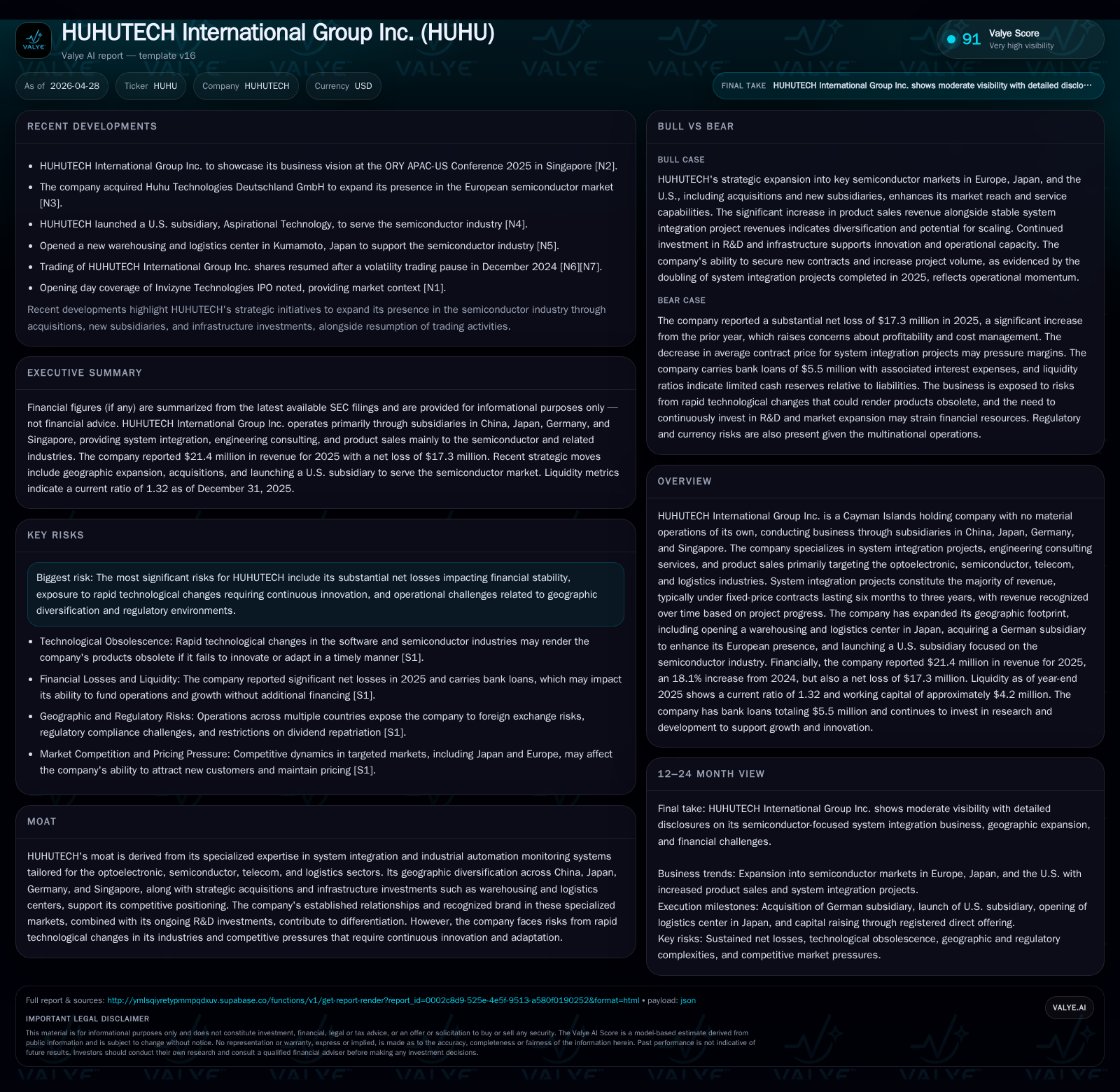
In its latest quarterly filing, HUHUTECH International Group Inc. secured gross proceeds totaling approximately $3.9 million from a registered direct offering to bolster working capital. Despite revenue growth to $21.4 million in 2025 driven by an expanded project base across China, Japan, Germany, and Singapore, the company reported a significant net loss of $17.3 million, weighed down by increasing operating expenses and compressed margins in its core system integration projects. HUHUTECH’s diversified geographic footprint and specialized expertise in optoelectronic, semiconductor, telecom, and logistics sectors underpin its competitive position, but it faces challenges such as rapid technology evolution, intense price competition, and regulatory hurdles for cash repatriation. The company’s path to growth depends on stabilizing profit margins through operational efficiency, managing R&D investments prudently, and executing on its expansion initiatives.
Recent Operating Update
In its latest quarterly report filed April 7, 2026 ([S2]), HUHUTECH International Group disclosed completion of a major capital raise via a registered direct offering totaling approximately $3.9 million gross proceeds before expenses of about $81,430. As of the filing date, the company had received approximately $500,000 with the remainder expected by mid-April 2026. The proceeds are earmarked primarily for working capital and general corporate purposes. This equity infusion addresses liquidity needs amidst the company's ongoing operating losses and financing requirements.
Business Model
HUHUTECH operates as a Cayman Islands holding company with no direct operations; instead it conducts business through subsidiaries located principally in China (HUHU China), Japan (HUHU Japan), Germany (HUHU Deutschland), Singapore, and a recently launched unit focused on the U.S. semiconductor industry ([S1]). The core business revolves around system integration projects encompassing design and implementation of integrated facility management systems and industrial automation monitoring solutions tailored mainly for the optoelectronic, semiconductor, telecom, and logistics sectors.
Approximately three quarters of revenue arises from these system integration projects undertaken typically under fixed-price contracts lasting between six months and three years. Revenue recognition follows the percentage-of-completion method based on project progress estimates which require significant judgment on total costs (materials, labor, indirects). This approach carries inherent estimation risk since contract costs can be revised monthly ([S17]).
Aside from integration services (77.6% revenue share in fiscal 2025), product sales have grown markedly representing 21.4% of revenue as equipment sales tied to projects accelerate. Engineering consulting services constitute a smaller portion (~1%) ([S1]).
Cross-selling complementary services within existing client accounts alongside broadening geographic presence represent strategic levers for customer acquisition and retention ([S3]). The company’s first-class construction enterprise qualification in China similarly supports brand credibility.
Industry Structure & Competitive Position
HUHUTECH is positioned within highly specialized industrial automation markets selling integrated systems that enable efficient facility management tailored to demanding segments like semiconductors and telecom infrastructure—sectors characterized by rapid technological evolution and sensitivity to downtime.
Its moat emerges from technical expertise embedded in complex system design and execution capabilities unique to these verticals combined with an increasingly global footprint — bolstered by strategic acquisitions (notably the German subsidiary) and investments such as warehousing/logistics centers in Japan ([N1],[S1]).
The fragmented nature of industrial system integrators requires continuous innovation alongside tailored solutions for diverse client needs across jurisdictions; here, HUHU differentiates itself by leveraging multi-country operational scale while managing regulatory complexities especially in PRC ([S12]).
However, industry pressures manifest in accelerating technological shifts compelling ongoing R&D investment to avoid obsolescence and intense pricing competition evident from declining average contract values ([S11],[S18]). This competitive dynamic compresses margins placing premium on execution discipline.
Growth Drivers & Constraints
The primary growth driver remains increasing volume of system integration contracts—a metric that doubled from 143 projects completed in fiscal 2024 to 284 in fiscal 2025 ([S11]). Expanding into Europe via acquisition complements this growth trajectory alongside establishing a U.S.-focused subsidiary targeting semiconductors—a high-growth sector demanding advanced automation solutions.
To support this expansion sustainably requires optimized margin management given gross margin erosion from elevated outsourced engineering costs (gross margin down from 37% to ~35% on system integration) and competitive pricing necessitating discounts ([S18]). Product sales offer higher-margin potential but presently remain a smaller portion outside overall revenues.
Cross-selling opportunities within existing customers present moderate upside as does deeper market penetration through enhanced brand recognition—crucial given potential reputational risk should quality or innovation falter ([S3]).
The company’s decision to scale back R&D spend sharply in FY25 from $2.9M to approx $0.9M likely reflects cost control efforts amid financial constraints but may impact long-term innovation capacity crucial in software-embedded industrial automation ([S16]).
A significant structural constraint derives from PRC regulatory environment restricting dividend repatriation due to mandatory reserve fund allocations limiting upstream cash flows critical for corporate liquidity at parent level ([S8],[S12]). Currency conversion controls also complicate international fund transfers affecting capital allocation flexibility.
Additionally, ongoing net losses exceeding $17 million signal persistent profitability challenges necessitating focus on operational efficiencies going forward ([F1]).
What To Watch Next
- Completion timing and net proceeds receipt from the registered direct offering which will influence near-term liquidity.
- Trajectory of gross margin recovery through reduced outsourcing or improved pricing power amidst intensifying competition.
- Evolution of the average contract size metric that halved between FY24-25—whether reflecting structural demand shifts or temporary mix effects.
- R&D expenditure trends indicating balance between innovation imperative versus cost discipline.
- Execution progress on geographic expansion targets including Japan logistics center utilization levels and German subsidiary integration.
- Regulatory updates impacting cross-border cash flow freedoms especially dividends upstreaming from PRC entities.
- Operational KPIs such as backlog growth or renewal rates which would signal sustainable demand pipeline.
- Management’s ability to address disclosed material weakness relating to GAAP accounting personnel affecting financial reporting robustness ([S11]).
Financial Snapshot Summary
For fiscal year ended December 31, 2025:
- Revenue: Approximately $21.4 million showing consistent growth [F1]
- Net Loss: Approximately $17.3 million driven largely by soaring general & admin expenses [F1]
- Gross Margin: Contracted slightly to ~33% amid rising outsourcing costs [S18]
- Total Debt: Around $2.15 million with current ratio of roughly 1.32 indicating moderate liquidity cushion [F1]
- Cash Flow: Operations generated positive cash flow ~$2.9 million despite net loss reflecting working capital movements [S15]
- R&D expense reduced significantly as part of cost containment efforts (down ~69%) [S16]
The sizeable operating loss juxtaposed with modest debt points towards an acute need for enhanced profitability measures going forward.
Disclaimer: This analysis is informational only based on available filings as of April 2026; it does not constitute investment advice or recommendations.
Disclaimer: This is research-only, informational analysis and not investment advice. It may include AI-generated interpretation and general industry context. Always verify important details using primary sources.

Comments