
Apellis Pharmaceuticals Advances With Biogen Merger and Commercial Momentum
Apellis’s 2026 merger agreement with Biogen, tied to SYFOVRE sales milestones, reshapes near-term valuation while core products drive growing commercial revenues.
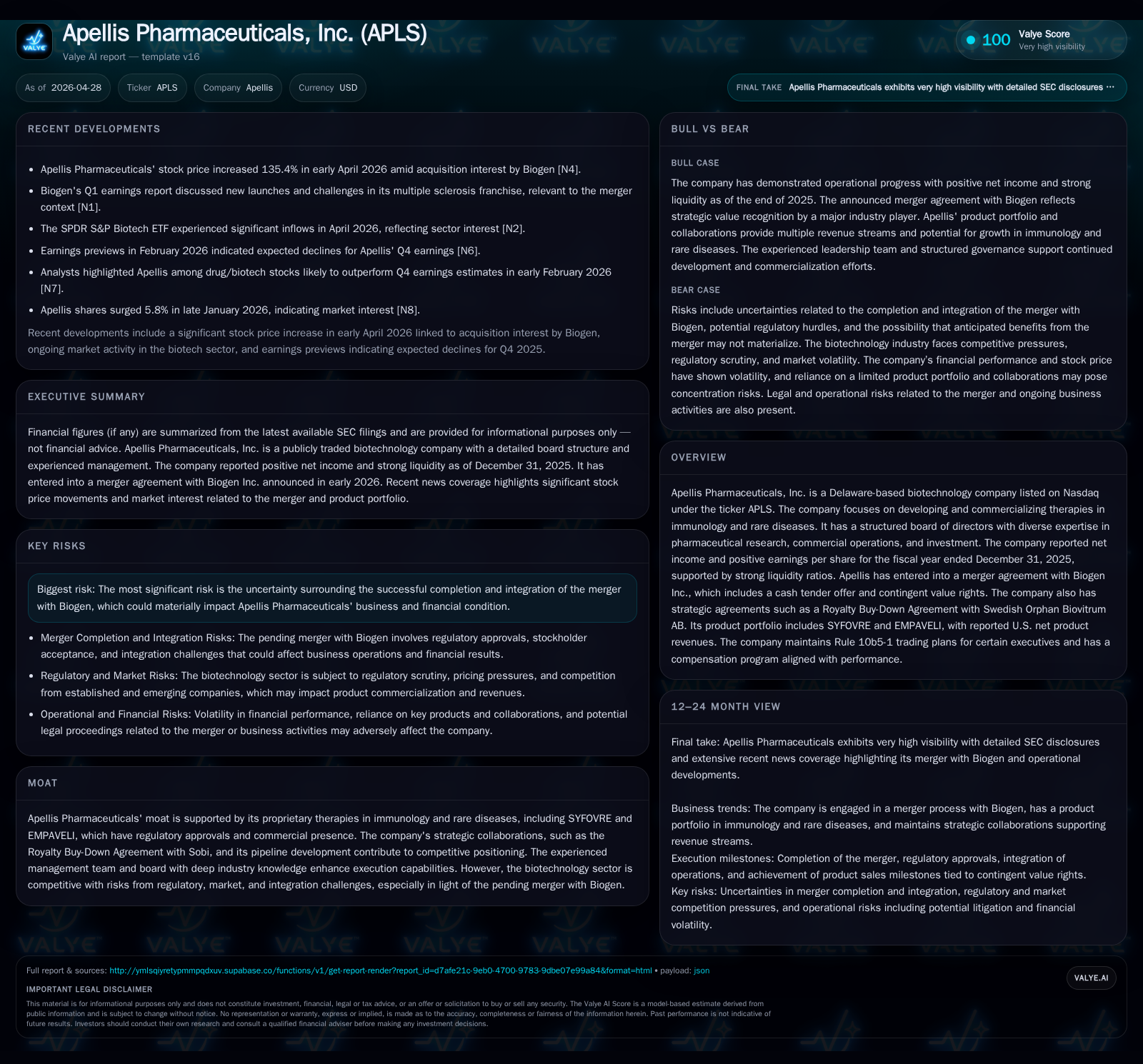
In March 2026, Apellis Pharmaceuticals inked a definitive merger agreement with Biogen that includes a $41 per share cash tender offer plus contingent value rights (CVRs) linked to ambitious SYFOVRE net sales targets through 2031. This deal materially recalibrates Apellis’s risk-reward profile by attaching milestone-driven payments to SYFOVRE commercialization success. Apellis’s business model centers on complement-modulating therapies in immunology and rare diseases, anchored by approved products SYFOVRE and EMPAVELI. The company benefits from strategic agreements such as the royalty buy-down pact with Sobi, bolstering gross-to-net economics. Industry competition remains active, yet Apellis’s established presence and pipeline development continue to support growth prospects. Financially, strong liquidity and positive operating income as of year-end 2025 provide runway for integration and ongoing R&D.
Recent Operating Developments: Merger Agreement and CVR Milestones
In a defining event on March 31, 2026, Apellis Pharmaceuticals entered into an Agreement and Plan of Merger with Biogen Inc., wherein Biogen will acquire Apellis through a tender offer priced at $41 per share in cash plus non-transferable contingent value rights (CVRs) [S3][S20]. These CVRs entitle holders to milestone-driven cash payments up to an aggregate of $4.00 per share conditioned on achieving specified annual net sales thresholds of SYFOVRE® and related products between the years 2027 and 2031.
Specifically, CVRs payout $2.00 per right when annual net sales reach $1.5 billion during any calendar year from 2027 to 2030 (Net Sales Milestone 1), or alternatively pay another $2.00 per right upon hitting $2 billion in annual net sales during any calendar year from 2027 through 2031 (Net Sales Milestone 2). If Milestone 1 is not met before the end of 2030 but Milestone 2 is achieved in 2031, that triggers a doubled payment of $4.00 per CVR [S3][S24]. This linkage between payments and product sales explicitly shifts shareholder value toward successful commercialization execution.
This deal structure fundamentally changes the near-term risk/reward paradigm for Apellis stakeholders by tying substantial upside to future SYFOVRE growth paths while providing immediate liquidity via the upfront cash consideration. The Company Board unanimously approved the merger terms considering these tradeoffs aligned with stockholder interests [S21][S26].
Apellis's Business Model: Proprietary Therapies in Immunology and Rare Diseases
Apellis operates as a clinical-stage biotechnology firm focusing on complement-mediated diseases within immunology and rare genetic conditions. Its revenue stream derives primarily from two FDA-approved therapies: SYFOVRE® (pegcetacoplan) targeting geographic atrophy secondary to age-related macular degeneration via targeted complement C3 inhibition, and EMPAVELI® (pegcetacoplan injection) indicated for paroxysmal nocturnal hemoglobinuria (PNH) [S1][S2].
These proprietary agents leverage a novel mechanism distinct from traditional terminal complement inhibition approaches — intercepting at the central C3 node offers broader immune modulation potential which differentiates Apellis competitively. The company’s revenue generation comprises direct product sales largely within the U.S., alongside royalties supported by licensing arrangements such as the Royalty Buy-Down Agreement signed with Swedish Orphan Biovitrum AB (known as Sobi) in mid-2025 that effectively reduces royalty expenses related to SYFOVRE’s commercialization footprint [S2].
Payer reimbursement negotiations have been critical given specialty pricing dynamics inherent in rare disease treatments; the nature of complement pathway modulation combined with unmet patient needs fosters durable pricing power despite existing healthcare cost scrutiny [S1].
Product Portfolio Deep Dive: SYFOVRE and EMPAVELI Fundamentals
SYFOVRE has carved out a pivotal role in treating geographic atrophy, a debilitating retinal disorder lacking alternative approved therapies until its recent arrival. Its clinical profile demonstrates meaningful slowing of disease progression supported by robust trial data. EMPAVELI addresses PNH patients who have limited treatment options beyond intravenous infusion therapies; its subcutaneous format combined with complement C3 blockade offers positioning advantages regarding administration convenience.
U.S. net product revenues for these assets have exhibited upward trajectories across recent reporting periods, signaling improving market penetration [S2][S6]. The two drugs benefit from regulatory exclusivity periods extending differentiation timelines versus potential biosimilars or next-gen entrants.
However, rare disease markets inherently face patient pool size constraints which cap volumetric growth ceilings—a structural ceiling offset partially by ongoing label expansions under clinical evaluation designed to broaden eligible populations over time [S1]. Switching costs are moderate; prescribers align strongly once established due to drug efficacy profiles but must manage complex payer authorization workflows inherent in specialty therapeutics.
Industry Context: Competitive Dynamics and Strategic Collaborations
Within biotechnology targeting immunological pathways, Apellis competes amidst peers advancing complement inhibitors at various cascade points and alternative immunomodulators targeting overlapping indications. Regulatory hurdles remain sizable given safety vigilance around immune pathway manipulation; FDA approvals weigh heavily on rigorous clinical demonstration of both efficacy and tolerability.
Reimbursement pressure is acute as payers seek cost-effectiveness evidence amid specialty drug price scrutiny. Strategic collaborations—such as that with Sobi focused on royalty structures—help de-risk revenue variability while conserving capital for innovation initiatives [S2].
Biotech incumbents increasingly pursue mergers or licensing deals to scale pipelines across immunology niches; here Apellis's pending merger with Biogen aligns with this ecosystem trend fostering cross-fertilization between product portfolios [N3]. Capacity constraints at manufacturing or distribution levels do not currently present material bottlenecks but warrant monitoring post-integration.
Growth Drivers Spanning Product Launches, Pipeline Development, and Market Expansion
Key levers driving Apellis’s growth trajectory center on:
- Expanding indications for SYFOVRE beyond current geographic atrophy labeling potentially into earlier AMD stages or other complement-mediated retinal conditions;
- Pipeline assets progressing through clinical stages aimed at broader immuno-inflammatory disorders exploiting complement biology;
- Integration synergies unlocked post-merger expected to enhance R&D productivity and accelerate commercial rollout leveraging Biogen’s established infrastructure;
- Geographic expansion especially outside U.S., contingent on regulatory approvals;
- Continued optimization of payer contracts enabled by volume increases reducing gross-to-net dilution mechanisms.
Realization of these drivers will be critical for meeting CVR milestone thresholds embedded in the merger agreement highlighting quantifiable KPIs tightly linked to valuation outcomes [S1][S3][N3].
Risks Surrounding Merger Completion, Regulatory Factors, and Competitive Pressure
The prominent risks revolve around uncertainty in achieving timely regulatory clearances required to close the merger by September 30, 2026, coupled with practical challenges tied to integrating two complex biopharma organizations without disrupting ongoing business momentum [S4][S16].
Additionally, the highly conditional nature of CVR payouts—dependent on reaching aggressive SYFOVRE annual net sales levels—exposes residual valuation risks should commercial penetration falter versus expectations.
Broader biotech industry volatility stems from patent cliffs ahead for some competitors potentially intensifying landscape rivalry; also intrinsic sector sensitivity to shifting policy environments concerning drug pricing introduces further execution risk layers [S5].
Legal contingencies including shareholder litigation related to transaction terms remain possible sources of cost uncertainty during closing periods.
Looking Ahead: Key Milestones, Integration Watchpoints, and CVR Payment Triggers
Near-term investor focus will converge on several measurable events:
- Completion of tender offer subject to stockholder vote,
- Fulfillment of customary closing conditions including antitrust clearance,
- Annual monitoring from calendar year 2027 onwards of SYFOVRE net sales metrics triggering staged CVR payouts through potentially as late as calendar year 2031,
- Integration milestones including retention of key executives and consolidation of commercial functions,
- Pipeline advancement updates providing signals for medium-term franchise expansion prospects.
These upcoming checkpoints furnish concrete markers tracking whether Apellis’s commercial strategy aligns well enough with Biogen’s platform ambitions to justify deal premium realization over time [S3][N3].
Financial Snapshot: Balance Sheet Strength Underpinning Strategic Options
Financially, as of December 31, 2025—representing the most recent audited fiscal year close—Apellis reported robust liquidity levels amounting to approximately $466 million in cash and equivalents against roughly $102 million in total debt reported end Q1 2024 (latest available debt figure) leaving a strong net cash position near $364 million on balance sheet fundamentals [F1].
The current ratio exceeding three times emphasizes short-term asset coverage over liabilities imparting confidence in operational funding flexibility which will be essential navigating near-term M&A execution costs alongside continued R&D investment commitments post-close [F1].
This analysis synthesizes SEC filings up through April 28, 2026 alongside recent market news providing an integrated perspective focused strictly on factual disclosures without offering investment advice.
Disclaimer: This is research-only, informational analysis and not investment advice. It may include AI-generated interpretation and general industry context. Always verify important details using primary sources.

Comments