
Burning Rock Biotech Details Q4 2025 Progress and Strategic Position in Oncology Testing
Latest quarterly results show incremental financial improvements amid ongoing R&D investments in cancer detection technologies.
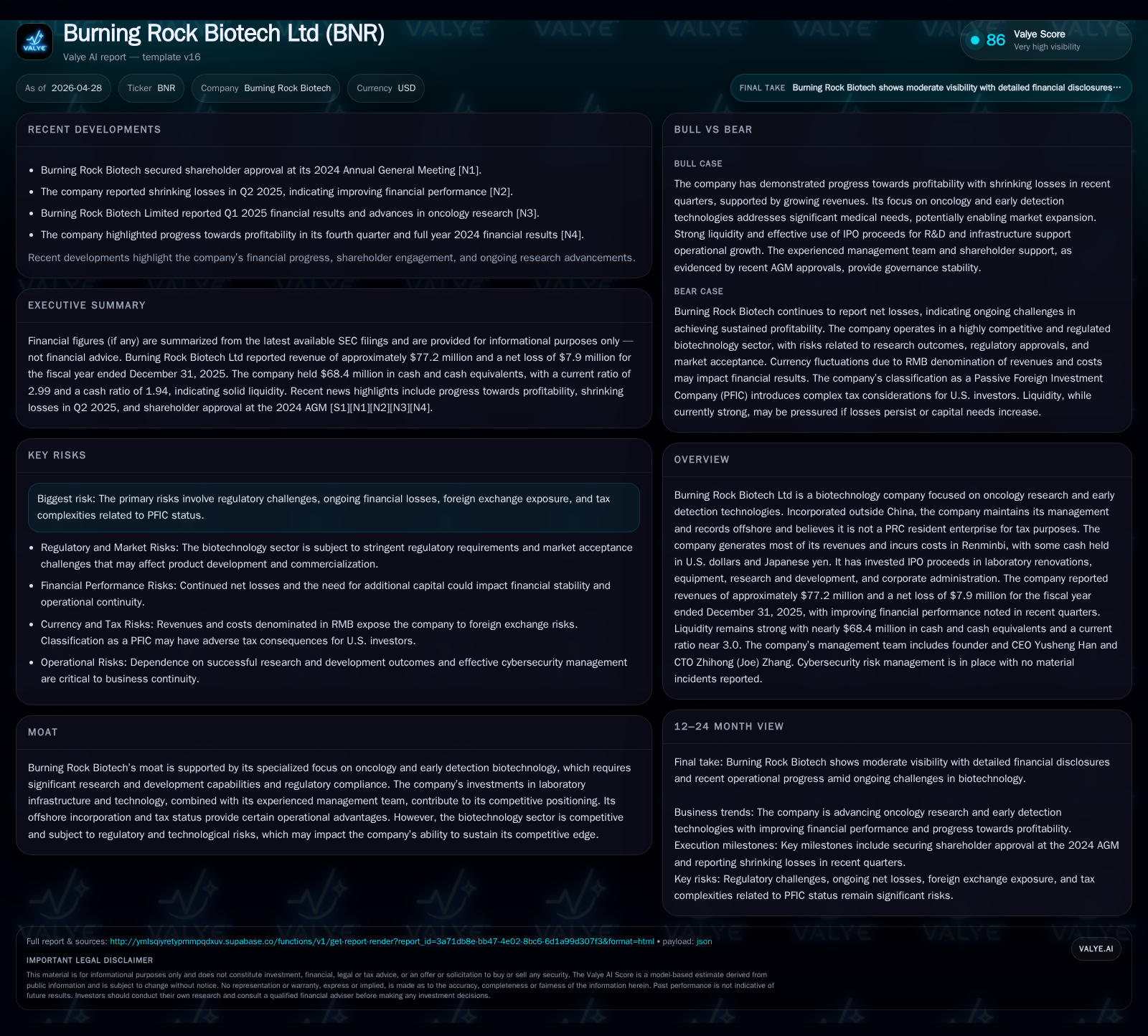
Burning Rock Biotech reported $77.2 million in revenue for fiscal year 2025, narrowing net losses to $7.9 million as of year-end. The company’s operational momentum is underscored by strong liquidity with nearly $68.4 million cash reserves, supporting ongoing investment in proprietary oncology molecular diagnostics. Incorporation offshore combined with China-based operations creates tax and regulatory complexity but also competitive leverage. Looking forward, the company’s growth opportunities hinge on expanding cancer screening adoption in China, regulatory approvals, and technological differentiation within a highly contested biotechnology landscape.
Recent Quarterly Performance and Operating Highlights
Burning Rock Biotech’s latest SEC Form 6-K filing dated March 13, 2026 (covering Q4 2025 and full-year results) reveals continued progress in financial performance alongside strengthened operational footing [S2]. The company posted approximately $77.2 million in revenue for fiscal year ending December 31, 2025 [F1], while trimming its net loss to $7.9 million [F1]. This marks a material improvement relative to prior years characterized by wider losses.
Liquidity stands out as a key asset; with cash and cash equivalents totaling about $68.4 million as of year-end [F1], Burning Rock maintains a robust current ratio near 3.0 [F1], signaling ample short-term coverage against liabilities. Such financial health supports ongoing investments into laboratory upgrades, equipment procurement, and research activities—essential components underpinning its technologically intensive business model.
The firm operates through an offshore corporate structure registered outside mainland China but executes substantial day-to-day operations on Chinese soil [S1]. This cross-border arrangement amplifies operational complexity but confers certain tax efficiencies when carefully managed.
Business Model and Core Technology Assets
Burning Rock generates revenue predominantly from specialized molecular diagnostics targeting oncology applications, including early detection assays that assess genetic biomarkers for cancer risk stratification [S1]. Its offering is tightly aligned with increasing medical emphasis on precision oncology and population health screening in China—a market undergoing rapid transformation driven by government initiatives to enhance cancer diagnosis accessibility.
The company’s moat centers on its proprietary laboratory infrastructure located primarily within China’s International Bio Island in Guangzhou, combining advanced sequencing equipment and bioinformatics capabilities customized for oncology biomarker panels [S1]. Significant capital has been allocated from IPO proceeds toward modernizing these facilities and scaling analytical throughput [S1].
Management expertise further reinforces competitive positioning: founder Yusheng Han brings nearly two decades of life sciences experience coupled with strategic venture capital insight—the type of cross-functional knowledge essential to shepherd complex biotech ventures through development cycles while interfacing with regulators and healthcare institutions [S1].
However, Burning Rock must continually navigate the dual pressures of maintaining cutting-edge technology while meeting stringent regulatory compliance standards inherent to Chinese clinical diagnostics.
Competitive Environment in Oncology Biotechnology
The oncology molecular diagnostics sector is characterized by accelerated innovation cycles but daunting regulatory hurdles, particularly within PRC jurisdictions where certification processes have intensified [S1]. Competitors typically include domestic startups backed by venture capitalist funding alongside international conglomerates expanding their footprint via partnerships or localized R&D efforts.
Pricing remains moderately pressured due to healthcare reimbursement policies and widespread cost sensitivity among institutional customers such as hospitals and clinics that constitute primary demand sources [S1]. Yet switching costs are elevated given the technical complexity of assays and entrenched lab processes—favoring suppliers who establish validated test accuracy and reproducibility first.
Continuous capacity expansion through machinery upgrades is necessary to accommodate increasing sample volumes spurred by rising cancer awareness [S1]. Burning Rock’s investment trajectory aligns with this trend but must weigh capex intensity against expected incremental returns amid fast-moving technological obsolescence risks.
Drivers of Growth and Potential Constraints
Growth catalysts are tied closely to China's expanding national cancer screening programs augmented by public-private collaborations targeting earlier detection frameworks [N1][S1]. These initiatives drive volume increases across clinic networks seeking reliable molecular diagnostic providers.
Additionally, Burning Rock can enhance gross margins through scale economies as fixed R&D outlays get amortized over larger test volumes while shifting product mix toward higher-value biomarker panels embedded within standard care pathways [S1].
Constraints arise from possible policy shifts affecting payment models or modifications in regulatory approval timelines—which historically have introduced lags between product development completion and commercial rollout [S1]. Moreover, the firm faces foreign exchange volatility risks stemming from its RMB revenue base juxtaposed against USD- or JPY-denominated cash holdings [S1][F1].
Tax complexities linked to Passive Foreign Investment Company (PFIC) status create additional compliance burdens affecting investor perceptions especially among U.S.-based holders [S1]. This should be factored into risk assessments surrounding potential shareholder returns.
Governance, Risk Factors, and Regulatory Landscape
Burning Rock’s governance structure features a blend of executive leadership deeply versed in biotechnology (CEO Yusheng Han) together with directors possessing extensive investment banking, venture capital, and engineering backgrounds such as Feng Deng who contributes over two decades’ experience spanning TMT sectors into healthcare investments [S1].
Risk disclosures emphasize regulatory uncertainty—manifested as evolving testing approval requirements—and financial losses sustained during continued expansion phases [S1]. Exchange rate fluctuations represent a non-trivial risk given Renminbi's managed float policy influencing the real value of multinational transactions conducted simultaneously in U.S. dollars and Japanese yen [S1][F1].
Cybersecurity measures have been institutionalized reflecting the sensitive nature of client data involved in clinical genomics workflows; oversight is centralized under dedicated teams reporting regularly to the audit committee which mitigates material threat exposures effectively as per annual disclosures [S8].
Near-Term Operational Milestones and Market Signals
Looking ahead, investors should monitor quarterly revenue progression against evolving operating expenses as signals of approaching operating leverage attainment [S2][N1]. The recent shareholder meeting secured approval reinforcing confidence in strategic direction centered on ramping test volume capacity alongside pipeline product development [N1].
Key milestones likely include receiving expanded diagnostic product registrations mandated under PRC health authority regimes—a prerequisite for commercial deployment throughout broader hospital systems—and forming strategic alliances extending distribution reach across key Tier-2/3 cities where untapped demand remains significant [N1][S2].
Technology adoption rates within oncology biomarker testing will also serve as a barometer of market acceptance versus competing platforms from global rivals entering via indirect routes such as licensing or joint ventures.
Financial Snapshot: Liquidity, Profitability, and Capital Structure
The balance sheet remains sound headed into 2026: Operating losses have narrowed without compromising investment commitments—net income improved but remained negative at approximately -$7.9 million for fiscal 2025 [F1]. Total debt stands nominally low around $243 thousand suggesting minimal leverage burden relative to cash reserves exceeding $68 million—a comfortable liquidity buffer for near-term R&D expenditures and fixed asset enhancements [F1].
A current ratio near 3 suggests effective working capital management capable of absorbing short-term financial shocks or unexpected expenditures tied to regulatory delays or clinical study costs [F1]. Tight control over credit risk evident from diversified accounts receivable underpins prudent fiscal stewardship typical among emerging public biotechs focusing on scaling sustainably before profitability inflection.
Continued monitoring of foreign exchange impact on reported earnings will be necessary given RMB depreciation trends during late 2025 potentially offsetting nominal gains realized via revenue growth when consolidated into USD reporting currency frameworks.
This analysis is based on public filings including the March 2026 Form 6-K interim report covering Q4/ FY2025 results (the primary anchor), supplemented by the April 28, 2026 Form 20-F annual filing providing structural context about business model details, governance, risk factors, competition dynamics, and tax considerations. It aims solely to provide an informed industry perspective without offering investment advice.
Disclaimer: This is research-only, informational analysis and not investment advice. It may include AI-generated interpretation and general industry context. Always verify important details using primary sources.

Comments