
Hillman Solutions Corp. Drives Expansion through Acquisitions while Managing Competitive Headwinds
Hillman Solutions’ latest quarterly report reveals a challenging margin environment but highlights strategic growth through targeted acquisitions.
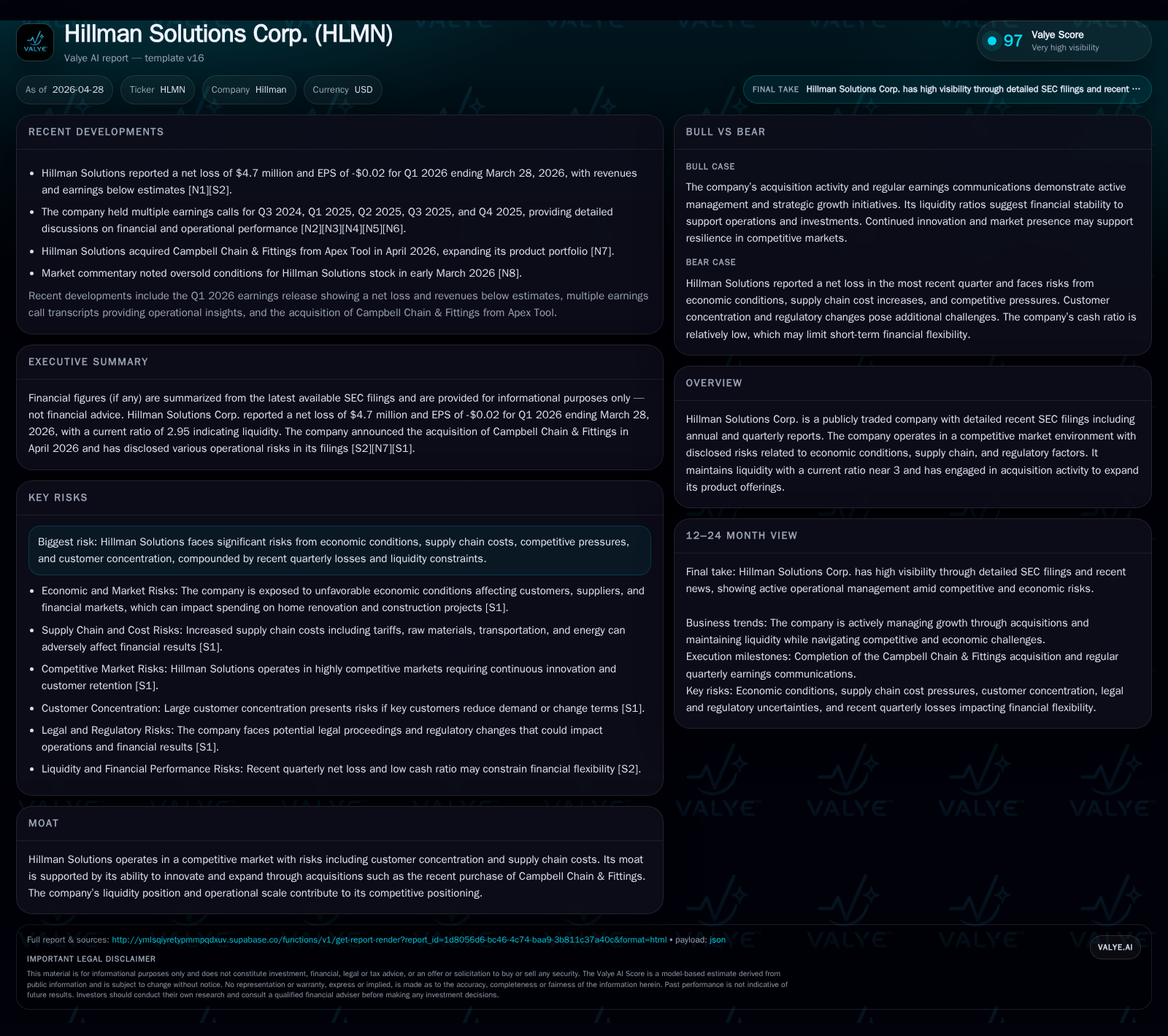
Hillman Solutions Corp.'s Q1 2026 results underscore margin pressure and a revenue shortfall amid inflationary and supply chain challenges. The company continues to pursue growth via acquisitions, notably the recent Campbell Chain & Fittings deal, enhancing product diversification and market reach. Despite headwinds from customer concentration and input cost inflation, Hillman’s liquidity remains solid with a current ratio near 3. Market watchers should focus on integration progress and margin recovery timelines as key execution milestones.
Q1 2026 Operational Highlights and Latest Filing Implications
Hillman Solutions Corp.’s Q1 2026 performance, detailed in the April 28 quarterly filing ([S2]) and reinforced by the April 27 event report ([S3]), signals a challenging near-term operating environment. Reported revenue fell short of analyst estimates ([N1]), primarily driven by sustained supply chain cost inflation which eroded gross margins despite ongoing efforts to manage pricing and procurement. Margin contraction was further pressured by increased freight, raw materials, and energy expenses.
Moreover, customer concentration risks surfaced prominently in disclosures, underscoring exposure to demand fluctuations from a limited set of large accounts ([S4]). However, the quarter also marks a strategic inflection point with Hillman's recent acquisition of Campbell Chain & Fittings finalized earlier in Q1 ([N7]), aiming to diversify the product portfolio beyond traditional fasteners into complementary industrial hardware segments. This acquisition expanded the company's addressable market but introduces integration complexity amid existing margin headwinds.
Business Model and Product Offering: Industrial Hardware and Related Services
As outlined in the latest annual report ([S1]), Hillman's core business model hinges on manufacturing and distributing hardware components such as fasteners, keys, hooks, chains, and related accessories predominantly for retail hardware outlets, lumber yards, home centers, and distributors. Its value proposition extends beyond mere product sales; it incorporates bundled services like inventory management solutions that provide just-in-time replenishment tailored to customer shelf space constraints—an approach designed to increase switching costs and deepen customer relationships.
This blend of physical hardware with integrated service offerings helps stabilize recurring revenue streams against cyclical demand shifts in home renovation and construction markets. The company’s unit economics benefit from scale purchasing power but are vulnerable to raw material volatility common to metal-based products.
Competitive Landscape and Industry Dynamics Affecting Hillman Solutions
Hillman operates within a fragmented industrial hardware industry marked by intense competition from both branded manufacturers and private-label suppliers ([S4]). Pricing dynamics are constrained by commoditized product offerings coupled with downward pressure from large retail chains negotiating aggressively on cost. Compounding this are persistent global supply-chain disruptions inflating sourcing and logistics costs—including tariffs on steel and specialized metals—which compress margins ([S17]).
Regulatory requirements around product safety standards pose additional operational complexity, necessitating compliance investments yet offering limited differentiation opportunities ([S4]). This competitive milieu limits Hillman's pricing power despite incremental product innovations.
Drivers Supporting Growth: Acquisitions, Innovation, and Market Penetration
Management identifies acquisition strategy as a pillar for growth diversification — exemplified by acquiring Campbell Chain & Fittings in early 2026 ([N7],[S3]). This move augments Hillman's offering scope into higher-margin industrial fastening segments complementary to its legacy business. The acquisition potentially unlocks cross-selling synergies with existing customers while broadening geographic reach.
Innovation initiatives target product quality enhancement and service delivery improvements to bolster Hillman's moat in a commoditized sector ([S1]). New proprietary packaging designs aiming at ease-of-use demonstrate efforts at incremental differentiation that could improve shelf turnover rates for customers.
Together, these maneuvers support an expansion roadmap focused on penetrating deeper into existing channels while capturing adjacent spaces within broader industrial hardware markets.
Constraints to Expansion: Margin Pressure, Customer Concentration, and Supply Chain Costs
Margin degradation stands out as the principal constraint determined by the latest filings; elevated raw materials prices combined with freight surcharges have been difficult to fully offset through price increases due to competitive sensitivities ([S2],[N1]). This dynamic reflects structural input cost inflation rather than solely cyclical pressures.
The company's revenue base shows significant dependence on a handful of large customers whose purchasing decisions can disproportionately affect sales volumes ([S4]). Such concentration adds volatility especially during economic slowdowns affecting home improvement or commercial construction activities.
Macroeconomic uncertainty—including interest rate fluctuations constraining spending—further weighs on demand for Hillman’s end products despite steady replacement needs inherent in maintenance sectors.
What to Watch: Upcoming Milestones, Guidance Updates, and Execution Risks
Key near-term milestones include integration progress of the Campbell Chain & Fittings acquisition with anticipated synergy capture timelines yet unspecified in detail ([S3]). Management commentary calls for operational discipline aimed at margin recovery but stops short of firm guidance adjustments beyond cautious outlooks amid inflation persistence ([N1],[S2]).
Execution risks involve managing elevated debt load relative to earnings amid tightening liquidity conditions if operating losses widen or cash flow generation weakens. The company's ability to maintain stable customer relationships while advancing innovation programs will be critical signals of resilience.
Market participants should track future quarterly releases for updates on cost-control effectiveness, pricing power trends, and any revisions to acquisition-related earnings contributions.
Summary Financial Snapshot: Liquidity, Leverage, and Profitability Considerations
Financially, Hillman sustains a healthy liquidity position evidenced by a current ratio near 2.95 as of end-March 2026 ([F1]), supported by $28 million in cash against $227 million in current liabilities—providing operating flexibility in managing working capital demands. However, total debt remains substantial at approximately $668 million with net debt exceeding $640 million when accounting for cash reserves ([F1]).
Profitability suffered this quarter due to margin compression though prior twelve-month operating income totaled $114 million indicating underlying operational scale potential under normalized cost structures ([F1]). The leverage backdrop underscores the necessity for effective capital allocation toward deleveraging once margin headwinds abate.
Liquidity appears sufficient for near-term obligations but elevates importance of reliable earnings recovery alongside disciplined balance sheet management as foundational pillars moving forward.[S2]
This analysis is based solely on publicly available SEC filings dated through April 28, 2026, related news reports up to April 27, 2026, and does not constitute investment advice or recommendations. All financial metrics reflect disclosed figures without extrapolation beyond those presented.
Disclaimer: This is research-only, informational analysis and not investment advice. It may include AI-generated interpretation and general industry context. Always verify important details using primary sources.

Comments