
Chemed Corp Reports Q1 2026 Revenue Growth Offset by Margin Pressure in Hospice and Plumbing Services
Chemed's latest quarter reveals operational momentum tempered by profitability challenges in its dual-segment business model.
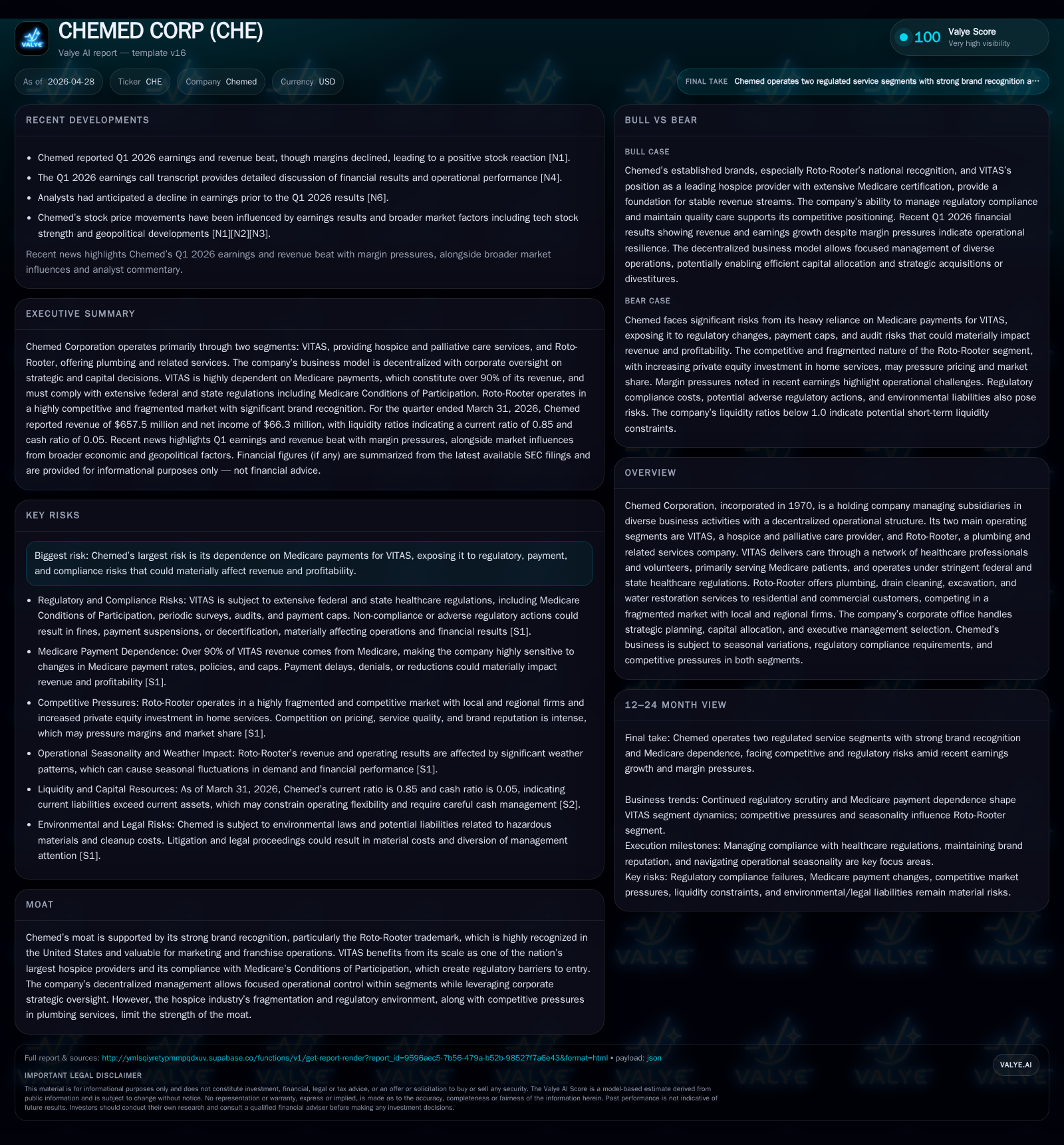
In its first quarter of 2026, Chemed Corporation delivered revenue growth driven by both its VITAS hospice care and Roto-Rooter plumbing services segments, maintaining leadership in highly regulated and fragmented industries. However, margin compression due to higher operating costs in hospice care and competitive pricing pressures in plumbing tempered earnings gains. The company’s decentralized structure supports focused management but leaves growth reliant on regulatory navigation, skilled labor retention, and efficient service delivery. Ongoing Medicare reimbursement risk and intense competition present persistent constraints. Monitoring VITAS’s compliance with Medicare rules and Roto-Rooter's ability to innovate customer service remain critical for Chemed’s trajectory.
Recent Operating Update
Chemed Corporation’s Q1 2026 Form 10-Q filing dated April 28, 2026 [S2] revealed continued revenue growth across its two main businesses — VITAS Healthcare (hospice and palliative care) and Roto-Rooter (plumbing and related services). The company reported a revenue beat alongside an earnings beat in its April 23 press release [S3], notwithstanding margin compression primarily due to increased operating costs borne by the VITAS segment amid heightened labor expenses and regulatory compliance demands. Despite these cost pressures, the top-line strength reflected persistent demand for end-of-life care services coupled with steady activity in plumbing service calls. Investors noted this revenue beat but registered caution as margins declined [N1].
This quarter’s results underscore an operating environment characterized by growth constrained by rising costs — a theme consistent with past quarters where labor intensiveness and regulatory complexity weigh on operating leverage.
Business Model
Chemed functions as a holding company with two major operating subsidiaries: VITAS Healthcare and Roto-Rooter. These divisions operate largely autonomously under Chemed's decentralized management model [S1][S21]. The corporate office focuses on strategic planning, capital allocation decisions, executive leadership placement, and financial oversight.
VITAS Segment
VITAS provides hospice and palliative care primarily to Medicare beneficiaries through a multifaceted professional network including physicians, nurses, social workers, clergy, aides, and volunteers [S1]. Its business model depends heavily on reimbursements under Medicare's Conditions of Participation. This federally regulated framework imposes stringent eligibility criteria for patients as well as compliance protocols that serve as significant entry barriers against new competitors but also elevate operational risk.
The segment benefits from demographic tailwinds—aging U.S. populations are increasing demand for end-of-life care—and from a nationwide footprint that positions VITAS as one of the largest providers. Yet growth is capped by the fragmentation of the industry at large and periodic adjustments to Medicare caps on per-beneficiary payments [S25]. Plus, exposure to false claim litigations or compliance missteps pose substantial legal risks [S25][S28].
Roto-Rooter Segment
Roto-Rooter operates in a highly fragmented residential and commercial plumbing industry [S1][S28]. It offers plumbing repairs, drain cleaning, excavation, water restoration among other services through both company-owned locations and franchises. The brand is widely recognized with trademarks dating back to 1935 that support marketing efforts [S11]. Competition remains intense given numerous small local players and emerging private equity consolidators investing aggressively in home services.
The division differentiates itself through brand recognition, comprehensive service offerings including emergency call availability, service guarantees, extensive training programs emphasizing safety and human resources best practices [S1]. However, margin pressures arise from rising wage costs for skilled technicians alongside increasing advertising expense due to evolving digital platforms where SEO algorithms shift how customers seek services [S28]. Regulatory compliance around franchising laws further complicates operations.
Industry Structure and Competitive Position
Both segments operate in markets defined by high regulatory oversight but distinct competitive dynamics.
Hospice Care (VITAS): Heavy federal regulation creates significant hurdles for entry especially given Medicaid/Medicare reliance. While VITAS enjoys scale advantages that facilitate operational efficiencies and compliance infrastructure investments, competitors include non-profits and health systems that may have deeper resources or local ties. Fragmentation persists because state laws limit for-profit entities’ market expansion tactics such as acquisitions or conversions of non-profits [S1][S25].
Plumbing Services (Roto-Rooter): This segment contends with low entry barriers leading to numerous independently operated local companies competing primarily on price and responsiveness [S1][S28]. Franchisees face statutory protections limiting franchisor control over terminations or renewals adding complexity to network management. Private equity-backed consolidators have intensified competition recently.
Chemed's strength lies not just in brand equity—particularly Roto-Rooter's national recognition—but also in the disciplined decentralized management permitting agile segment-level decision making paired with centralized capital deployment favoring high-return initiatives.
Growth Drivers and Constraints
Drivers:
- Aging U.S. demographics provide structural growth impetus for hospice care needs within Medicare’s beneficiary base.
- Steady to growing demand for plumbing repairs driven by an aging housing stock plus commercial buildings requiring maintenance.
- Expansion opportunities via targeted franchise acquisitions or geographic fills subject to regulatory approvals.
- Operational improvements through enhanced training protocols at Roto-Rooter aimed at boosting workforce productivity.
Constraints:
- Regulatory environments cap episodic hospice reimbursement limiting scalable volume-driven profit leaps.
- Exposure to government investigations or False Claims Act litigation imposes cost burdens with potential reputational impacts.
- Intense competition in plumbing necessitating continued marketing spend increases whilst controlling price erosion.
- Tight labor markets constrain hiring skilled technicians essential for service quality maintenance.
- Working capital pressure evidenced by current ratio below one (~0.85) implies liquidity management challenges especially given payroll-intensive operations [F1].
What to Watch Next
Key execution milestones include:
- Tracking updates from CMS regarding adjustments to hospice payment caps or eligibility criteria which affect VITAS's revenues directly.
- Monitoring franchise growth pace at Roto-Rooter along with same-store sales trends indicating pricing power or volume shifts.
- Employee retention metrics particularly technician turnover rates reflecting operational stability.
- Compliance developments related to healthcare fraud controls impacting ongoing liability risks for VITAS.
- Quarterly margin trends post Q1 margin headwinds signaling ability to manage rising cost base effectively.[N4][N5]
Financial Profile Context (Latest Quarter)
As of March 31, 2026 the company reported cash & equivalents of approximately $16.9 million against current liabilities of approximately $321 million resulting in a current ratio near 0.85; indicative of working capital tightness requiring prudent cash flow management [F1]. Total debt remains around $187 million giving an estimated net debt roughly $170 million after accounting for cash balances [F1]. This leverage level is manageable but underscores the need for stable operating cash flows given limited liquidity cushion. Income statement highlights from latest annual data show revenue near $2.53 billion with operating income crossing $338 million supporting steady profitability albeit challenged by cost pressures [F1].
The financial mix reflects mature steady-state operations with capital expenditures modest relative to overall asset base; investment focused more on acquisitions or service enhancements than on fixed asset expansions [S1].
Conclusion
Chemed Corporation maintains competitive positions at the intersection of healthcare services delivery through VITAS and consumer home services via Roto-Rooter, balancing secular growth drivers against regulation-induced constraints and rising input costs. Its dual-segment model offers diversification benefits yet demands vigilant operational execution given external exposures—from evolving Medicare policy risks to labor market tightness impacting service delivery quality. With recent quarterly results showing top-line resilience offset partially by margin pressures, future value hinges on adept regulatory navigation, workforce sustainability, franchise scaling execution, and cost discipline strategies amid intensifying competition.
This analysis is based on publicly filed SEC documents as of April 28, 2026 [S1][S2][S3] supplemented by verified news reports [N1][N4][N5] aligned with companyfacts financial snapshot dated March 31, 2026 [F1]. This report does not constitute investment advice but aims to provide an informed view on Chemed Corporation’s operational posture within its industry context.
Disclaimer: This is research-only, informational analysis and not investment advice. It may include AI-generated interpretation and general industry context. Always verify important details using primary sources.

Comments