
Kimberly-Clark’s Strategic Transformation and Kenvue Acquisition Drive Growth Amid Supply Chain Challenges
Q1 2026 results showcase operational progress with organic growth, supply chain investments, and continued execution on strategic initiatives.
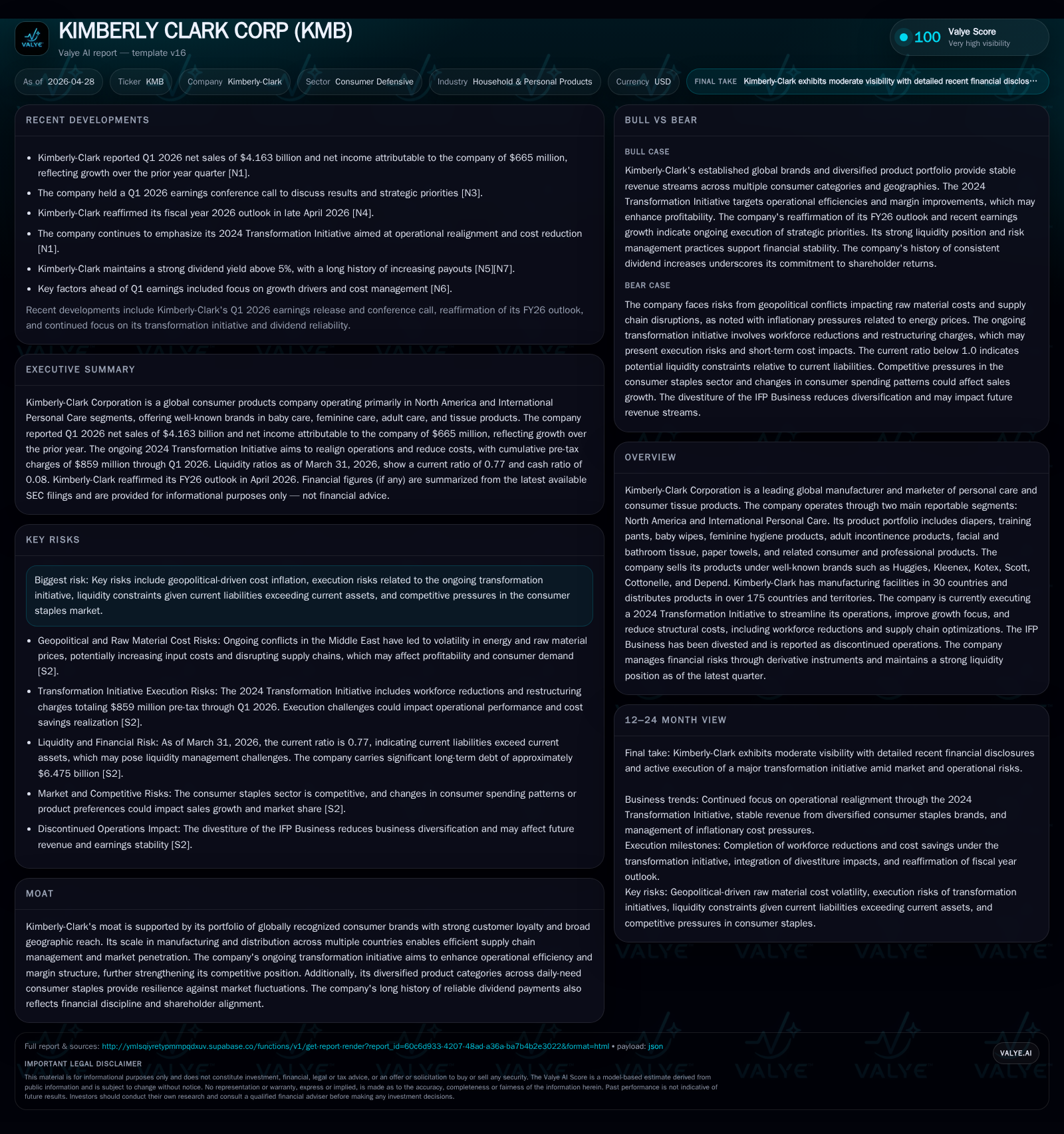
Kimberly-Clark Corporation reported a 2.7% increase in net sales for Q1 2026, driven primarily by organic volume growth and favorable currency impacts despite divestitures and business exits. The company remains actively engaged in a multi-year Transformation Initiative aimed at streamlining operations and improving margin structure while preparing for the pending acquisition of Kenvue, Inc., set to close in the second half of 2026. Supply chain volatility and commodity price risks linked to geopolitical tensions continue to challenge cost management but are partially offset through hedging and productivity measures. Kimberly-Clark’s competitive strength rests on its globally recognized brands and geographic reach, with growth focused on innovation and market adaptation across key product categories.
Recent Operating Update: Q1 2026 Highlights
Kimberly-Clark's latest quarterly filing (10-Q dated April 28, 2026) underscores steady operational momentum during a complex macroeconomic backdrop [S2]. The company posted net sales of approximately $4.16 billion for the first quarter ended March 31, 2026, marking a 2.7% increase year-over-year. This growth originated primarily from organic volume gains of about 2.6%, complemented by favorable currency translation effects totaling around +2%. However, these positives were partly offset by divestitures and business exits including the strategic exit from the US private label diaper business as part of its ongoing transformation [S15].
Operating profit improved significantly by roughly 19%, reaching $753 million despite absorption of charges related to its transformative restructuring program and acquisition activities tied to Kenvue [S15]. The company benefited from productivity savings close to $115 million and an insurance settlement gain that contributed positively to operating income [S15]. Gross margin contracted slightly by about 40 basis points primarily due to transformation-related depreciation charges and supply chain investments that increased cost structure complexity [S15].
The ongoing geopolitical conflict in the Middle East has introduced cost volatility through disruptions in energy supplies affecting petroleum-based raw materials. Kimberly-Clark estimates incremental input cost pressure near $200 million for the rest of 2026 if oil prices sustain at approximately $100 per barrel [S2]. The firm employs commodity forward contracts and swap instruments as hedges to manage this risk exposure [S19].
Additionally, Kimberly-Clark continues post-closing preparations for the sale of a controlling stake in its International Family Care & Professional (IFP) segment to Suzano S.A., expected mid-2026 subject to regulatory approvals [S18], transitioning remaining operations toward its two principal reportable segments: North America (NA) and International Personal Care (IPC) [S11]. This shift reflects a leaner portfolio focus to support strategic priorities.
Business Model Overview
Kimberly-Clark operates as a global leader in personal care and tissue products manufacturing with a diversified portfolio comprising diapers (Huggies), baby wipes, feminine hygiene (Kotex), adult incontinence products (Depend), facial tissues (Kleenex), bathroom tissue (Scott), paper towels (Cottonelle), and professional-use products [S1]. Revenue generation stems largely from mass consumer purchases aligned with daily needs across developed and emerging markets.
The company's strategic strength lies in leveraging trusted brands backed by extensive global distribution networks spanning over 175 countries [S1]. This geographic breadth enables penetration into both mature markets like North America—where category maturity demands innovation-led growth—and high-growth international regions emphasizing volume expansion.
Kimberly-Clark monetizes through multi-channel sales comprising retail partnerships, direct-to-consumer channels where applicable, and professional sales platforms. Price realization is supported by brand premium positioning though subject to competitive pressures that necessitate active category management.
The firm's supply chain scale provides efficiency advantages but requires ongoing investment especially under volatile raw material pricing environments driven by geopolitical factors affecting petroleum derivatives [S2,S19]. Managing input costs is critical; thus hedging programs covering commodities like pulp and chemicals are entrenched within operations.
Industry Structure and Competitive Position
Operating within Consumer Defensive – Household & Personal Products segments — Kimberly-Clark competes alongside Procter & Gamble, Johnson & Johnson (until Kenvue separation), Essity AB, and Georgia-Pacific among others. Barriers include brand equity requirements, supply chain scale economies, regulatory compliance for health/safety standards, and retail channel access.
Kimberly-Clark's moat is reinforced by globally recognized brands with entrenched customer loyalty coupled with broad geographic reach facilitating resilience against localized disruptions or demand shifts. Its ongoing transformation initiative aims to enhance operational agility via supply chain optimization and margin improvement initiatives targeted at maintaining leadership amid intensifying competitive dynamics.
The sale-and-joint-venture approach for the IFP segment represents a structural pivot allowing capital redeployment into higher-growth product lines or geographic expansion opportunities while retaining strategic participation via minority equity stakes [S18,S21]. Pending acquisition of Kenvue promises complementary portfolio expansion in global consumer health—with synergies expected from R&D integration and market access cross-leverage [S16].
Growth Drivers and Constraints
Drivers:
- Organic Volume Growth: New product innovations leveraging science-backed proprietary technologies aim to capture unmet consumer needs addressing hygiene trends post-pandemic recovery cycles [S11].
- Transformation Initiative Productivity: The targeted $3 billion gross productivity savings through integrated margin management by end-2026 provide funds for reinvestment while trimming structural costs such as workforce realignment (~4%-5%) [S9,S24].
- Kenvue Acquisition: Expected closing mid-2026 could deliver accretive scale benefits across consumer health categories expanding revenue base beyond traditional hygiene/tissue products [S16].
- Emerging Market Expansion: Particularly within IPC segment where rising disposable incomes drive demand for premium product tiers fueling volume growth potentials.
Constraints:
- Commodity Inflation Risks: Escalating input costs linked to oil price volatility impose margin pressures requiring disciplined pricing strategies balanced against potential volume sensitivity [S2,S19].
- Supply Chain Complexity: Investments needed to adapt supply chain robustness during geopolitical disruptions risk short-term margin dilution even as they build long-term competitiveness [S15,S19].
- Liquidity Profile: Current assets stood at about $5.29 billion versus current liabilities exceeding $6.9 billion resulting in a current ratio of roughly 0.77, reflecting typical working capital structures including extended supplier payment terms supported through supplier finance programs [F1].
- Execution Risks: The multi-year nature of the transformation presents timing uncertainties around realization of targeted savings versus expenses incurred during restructuring phases [S9,S24].
- Competitive Market Dynamics: Intense retailer negotiations impact pricing power while private label competitors exert downward price pressure especially in commoditized product categories.
What to Watch Next
Investors should monitor several operational milestones shaping Kimberly-Clark's trajectory:
- IFP Joint Venture Closing: Successful completion around mid-2026 will alter segment reporting composition while potentially unlocking capital proceeds (~$1.7B) fueling deleveraging or further strategic moves [S18,S21].
- Kenvue Acquisition Closing & Integration Progress: Regulatory approval status across jurisdictions remains key followed by smooth operational assimilation critical to realizing anticipated synergies.[S16]
- Transformation Initiative Updates: Quarterly disclosures on workforce reductions progress, supply chain integration milestones, realized versus forecasted productivity savings provide tangible readouts on strategy execution effectiveness.[S9,S24]
- Commodity Price Movements & Hedging Effectiveness: Fluctuations in oil prices impacting raw material inflation will influence gross margins; derivative instrument valuations warrant close observation.[S19]
- Currency Fluctuations: As a multinational entity with significant international revenues, foreign exchange volatility affects topline as well as hedged earnings components.[S8,S17]
- Consumer Demand Signals: Volume trends within core product lines particularly Baby & Child Care, Family Care categories reflect broader economic consumption patterns influencing organic sales growth sustainability.[S28]
Financial Profile Snapshot (Q1 Ending March 31, 2026)
Balance sheet liquidity reflects mixed dynamics with cash & equivalents standing at approximately $542 million juxtaposed against total debt nearing $6.48 billion leading to a net debt position around $5.93 billion based on available current data [F1]. Current assets stood at about $5.29 billion versus current liabilities exceeding $6.9 billion resulting in a current ratio of roughly 0.77, reflecting typical working capital structures including extended supplier payment terms supported through supplier finance programs [F1].
Capex outflows reached an elevated level ($424 million) during Q1 reflecting investments aligned with modernization efforts under transformation initiatives contrasted against prior-year period spend patterns [S27,S28]. Notable post-closing refinancing or debt management actions tied to capital event outcomes such as Kenvue acquisition funding or IFP transaction proceeds could materially influence credit metrics going forward [S16,S19].
This analysis synthesizes publicly disclosed information up to April 28, 2026; it does not constitute investment advice or recommendations regarding Kimberly-Clark Corporation securities.
Disclaimer: This is research-only, informational analysis and not investment advice. It may include AI-generated interpretation and general industry context. Always verify important details using primary sources.

Comments