
Kohl's Corp Balances Store Optimization with Digital Expansion under Capital Discipline
Kohl's navigates a mixed 2025 retail environment by focusing on inventory management, digital growth, and capital allocation.
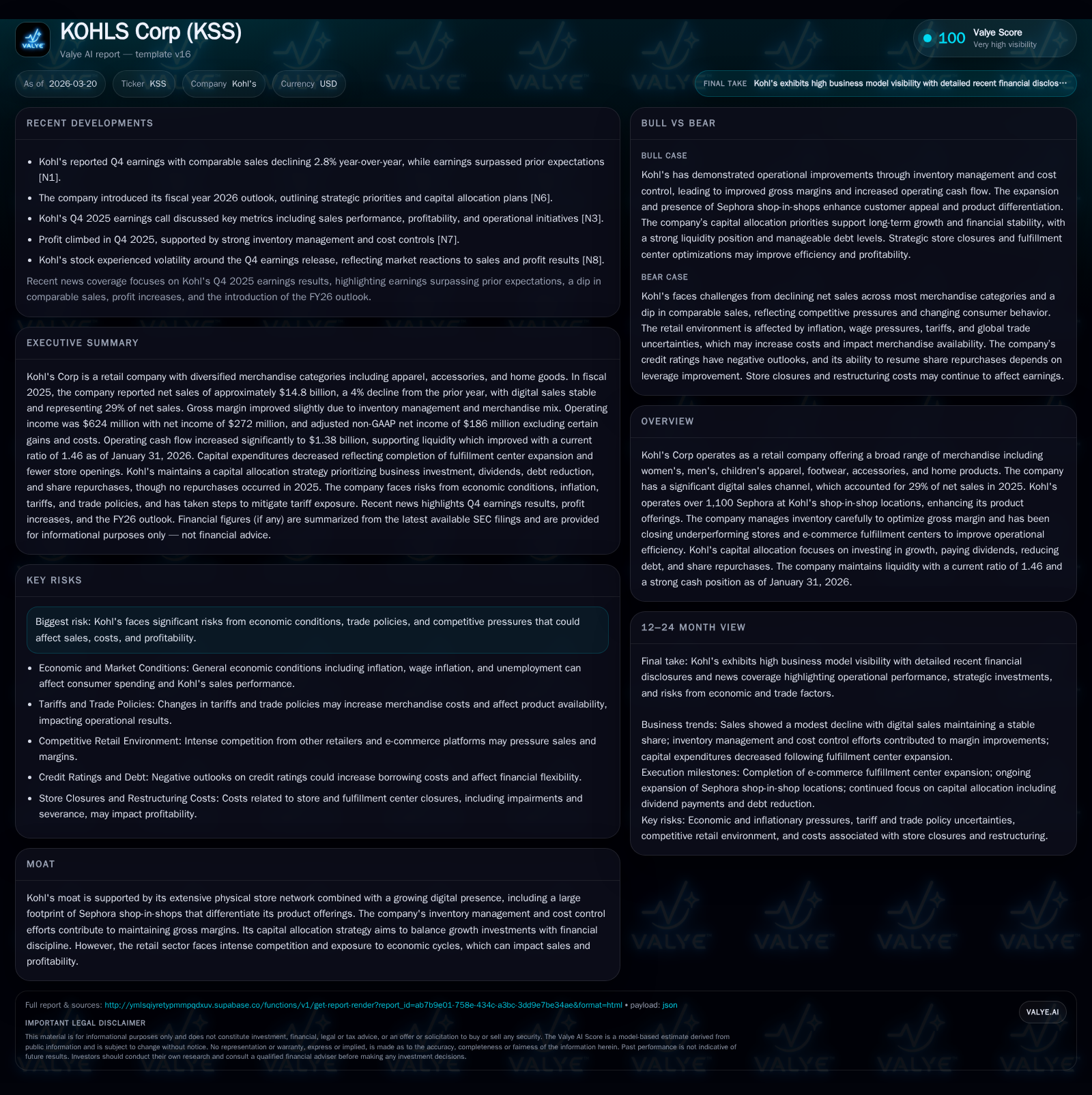
Kohl's Corp reported a 4% decline in net sales for 2025 driven by lower transaction volumes across most product categories except accessories. The company increased gross margins through tighter inventory control and reduced clearance markdowns while maintaining digital sales penetration at 29%. Operating income rose 44% year-over-year, buoyed by operational efficiencies and a legal settlement gain. Kohl's continues its capital discipline with substantial operating cash flow generation, dividend payments, measured debt reduction, and no share repurchases in 2025. Going forward, the company plans to invest $350–400 million in strategic initiatives including omnichannel enhancements while balancing debt levels amid recent credit rating downgrades.
Historical Performance and Drivers
Kohl's Corp delivered net sales of approximately $14.8 billion in fiscal year 2025, marking a decline of around 4% from the prior year [$S1]. This contraction was primarily driven by an estimated 4% decrease in transaction volume across most merchandise lines except Accessories, which grew about 2%. Sales declines were observed in Women's (-5.7%), Men's (-4.8%), Home (-4.3%), Children's (-6.5%), and Footwear (-6.9%) categories [$S1]. The relatively resilient performance of Accessories—including Kohl's partnership with Sephora—reflects strength in this differentiated segment.
Despite top-line pressures, Kohl's improved its gross margin modestly by approximately 34 basis points to 37.5%, largely attributable to enhanced inventory management practices, more favorable merchandise mix, and moderation of shrinkage levels [$S1]. Notably, the company reduced its inventory holdings by about 7%, accompanied by an 8% decrease in receipts against the prior year, reducing clearance markdown needs and stabilizing margin erosion.
SG&A expenses decreased by roughly $219 million (4.1%), driven by lower store labor costs, marketing savings, and distribution efficiencies. However, as a percent of revenue SG&A slightly deleveraged by about five basis points due to certain fixed cost elements [$S1]. The company's operating income rebounded strongly to $624 million in 2025—a rise of over 44% from the prior year's $433 million—and net income more than doubled to $272 million from $109 million [$F1]. This profitability surge was boosted significantly by a non-recurring legal settlement gain of $129 million related to credit card interchange fees [$S8][$S22]. Adjusted net income excluding such one-offs remained firm but less sharply improved.
Digital Penetration and Omnichannel Integration
Kohl's digital sales channel held steady year-over-year at approximately 29% of net sales in fiscal 2025 versus 28% the year before [$S1]. The retailer counts all sales initiated online—including mobile apps and omnichannel transactions fulfilled through physical stores—to assess digital penetration. This platform stability indicates solid consumer engagement despite broader transactional softness.
A major differentiator for Kohl’s is its exclusive partnership with Sephora beauty shops within stores. By year-end 2025, Kohl's operated over 1,100 Sephora shop-in-shops (855 full-size locations averaging roughly 2,500 sq ft each and nearly 300 smaller formats), which continue to contribute positive momentum particularly within Accessories merchandise category [$S1][$S17][$F1]. The combined offline-online strategy leverages Sephora’s strong brand equity and enhances Kohl’s appeal against competitors.
Capital Allocation and Financial Liquidity
Kohl's demonstrated disciplined capital allocation during fiscal year 2025. Significant operating cash flow improvements supported dividends ($56 million paid representing around $0.50 per share annually) and enabled strategic debt reductions without returning cash via stock buybacks—in fact share repurchases were paused ($0 spent on buybacks) owing to leverage concerns [$F1][$S6][$S10][$S11].
Operating cash flow nearly doubled from $648 million to circa $1.38 billion year-over-year, driven partly by higher net income and efficient working capital management including inventory control [$F1][$S10]. Adjusted free cash flow — defined as operating cash flow less capital expenditures plus or minus financing adjustments — reached an estimated $935 million in FY25 compared with only about $104 million the prior year [$F1][$S7].
Capital expenditures were scaled down about 20% year-on-year from $466 million to approximately $372 million reflecting completion of major projects like the Etna e-commerce fulfillment center expansion along with curbed new store openings and restrained Sephora rollout capital commitments [$F1][$S8][$S19]. Looking ahead into fiscal year 2026 Kohl's plans strategic investments between $350 million-$400 million focused on omnichannel capabilities enhancements including technology upgrades and store experience modernization [$N10][$S6][$S25].
The company also made meaningful strides on deleveraging its balance sheet amid elevated debt costs following credit rating downgrades across Moody’s (from Ba3 down to B2) and S&P (from BB- down to B+) during calendar year ’25 which increased coupon rates notably especially on long-term senior secured notes [$S4][$S6]. Debt maturity management included repaying maturing notes ($353 million matured) as well as open market repurchases totaling about $87 million principal amount. Revolving credit facilities were paid down fully by January ’26 ($0 borrowings outstanding) strengthening liquidity whilst maintaining compliance with all financial covenants ($1.46 current ratio up from ~1.08 prior year) [$S4][$S21].
Risks and Sector Context
Kohl’s remains exposed to macroeconomic fluctuations impacting consumer discretionary spending patterns—particularly given its mid-tier department store positioning—which can result in transactional softness as reflected in the recent declining comparable sales trend [-2.8% comparable sales dip reported for Q4] despite overall earnings beats [$N1][$N3]. Inflationary pressures influencing sourcing costs are managed via diversified supplier networks but tariff uncertainty remains a potential cost headwind given ongoing U.S. trade policy volatility[$S16][$S26]. Competitive pressures are intense with both traditional brick-and-mortar peers investing heavily in digital channels plus heightened competition from pure-play e-commerce platforms pressuring margin structures.
Inventory shrinkage control combined with vendor markdown support programs continue as key operational levers aiding gross margin preservation—these detailed unit economics practices reflect mature retail execution typical among top-tier department stores using retail inventory method assumptions for valuation adjustments ($11m impairment charges related mostly to store closures raised minimal noise) [$S9][$S14].
What To Watch / Outlook Considerations
While explicit guidance is limited for fiscal ’26 beyond stated investment ranges and dividend policies, investor focus should monitor:
- Comparable sales trajectory post-Q4 softness—especially any signs of transactional recovery or further softness impacting merchandise categories beyond Accessories.
- Progress on digital/omnichannel innovation rollouts particularly evolving integration with Sephora’s product offering footprint.
- Capital expenditure pacing relative to evolving strategic priorities versus leverage improvement commitments.
- Credit market conditions influencing refinancing flexibility given recent corporate ratings downgrade.
- Execution risks related to store portfolio optimization including closed E-Commerce fulfillment centers’ impact on last-mile delivery economics.
- Margin sustainability amid inflation pressures balanced against vendor allowances and shrink management effectiveness.
Annual Financial Summary Table
Historical performance (annual)
| FY | Net ($mm) | CFO ($mm) | OpInc ($mm) | Capex ($mm) | Net YoY |
|---|---|---|---|---|---|
| 2025 | 272 | 1380 | 624 | 372 | +149.5% |
| 2024 | 109 | 648 | 433 | 466 | -65.6% |
| 2023 | 317 | 1168 | 717 | 577 | +1768.4% |
| 2022 | -19 | 282 | 246 | 826 |
Source: SEC companyfacts cache [F1].
Capital returns and efficiency (annual)
| FY | Div ($mm) | Buybacks ($mm) | FCF ($mm) |
|---|---|---|---|
| 2025 | 56 | 1008 | |
| 2024 | 222 | 0 | 182 |
| 2023 | 220 | 658 | 591 |
| 2022 | 239 | 658 | -544 |
Source: SEC companyfacts cache [F1].
Conclusion
Kohl’s Corp has demonstrated notable improvement in profitability and cash generation during a challenging retail environment marked by declining sales volumes yet disciplined expense control along with strategic capital allocation focused on deleveraging its balance sheet amid a weaker credit profile. The retailer leverages its hybrid physical-digital model augmented by Sephora partnerships as a moat element while managing operational efficiency through inventory discipline and store rationalizations.
However, sustainability of growth still hinges on navigating competitive pressures from pure e-commerce rivals as well as macroeconomic uncertainties that could suppress discretionary spending further. Monitoring how Kohl’s invests planned reasonably sized capital budgets towards omnichannel capability upgrades will be key alongside its ability to stabilize comparable sales trends toward sustainable profitability increments.
This analysis does not constitute investment advice or recommendations but aims to provide a grounded summary of Kohl’s recent financial performance, strategic initiatives, risk factors, and areas for ongoing observation based on publicly filed disclosures through early calendar year ’26.
This report is prepared solely for informational purposes based on available public data including SEC filings [F1], news sources [N#], and regulatory disclosures [S#] without offering any buy/sell/hold opinions.
Disclaimer: This is research-only, informational analysis and not investment advice. It may include AI-generated interpretation and general industry context. Always verify important details using primary sources.

Comments