
Kyntra Bio’s Rollercoaster Revenue and Drug Development Hurdles
Significant revenue swings and persistent operational losses underscore Kyntra Bio's complex journey through biopharmaceutical innovation and commercialization.
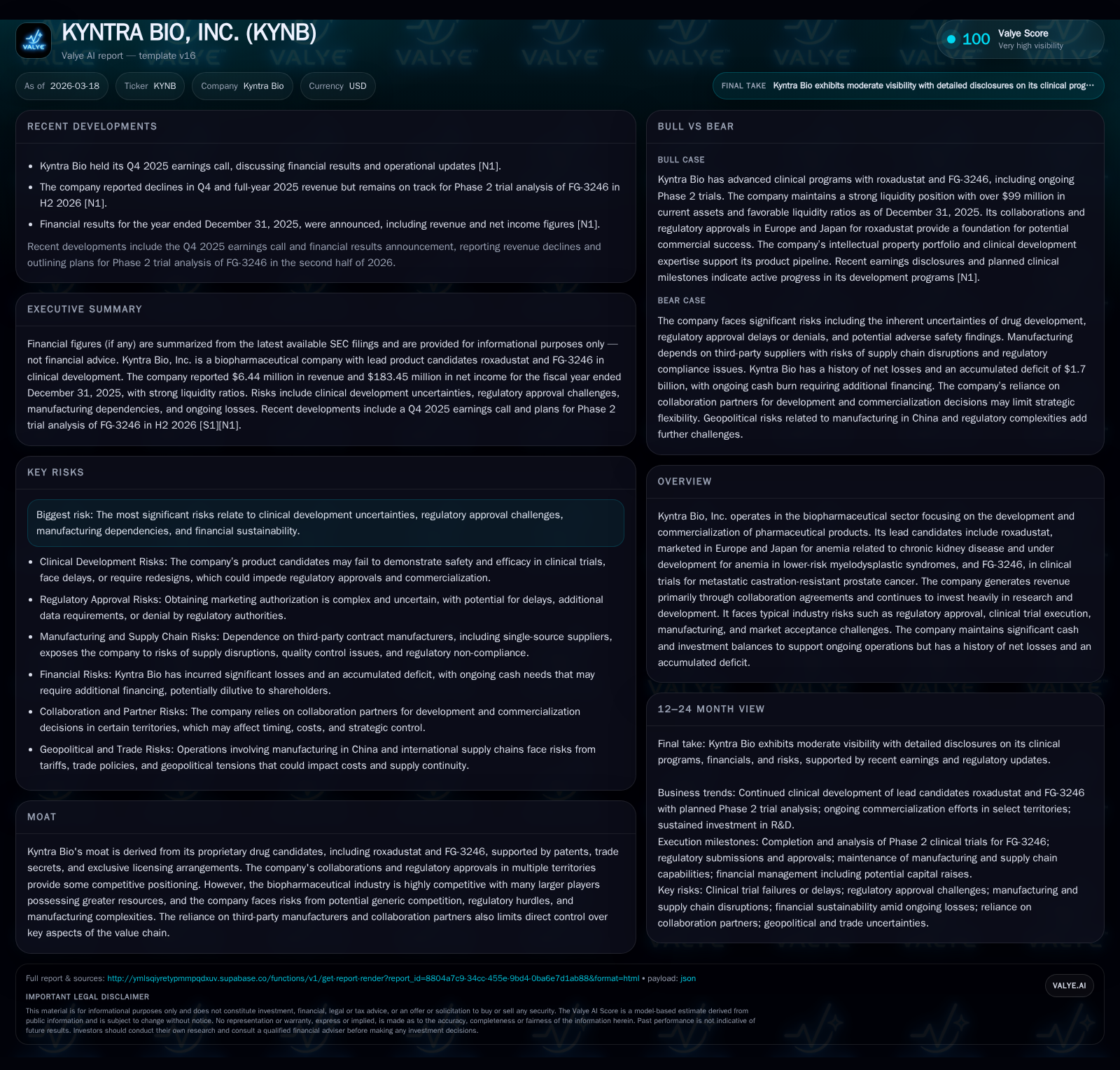
Kyntra Bio, Inc. has experienced dramatic volatility in revenues from fiscal year 2022 through 2025, largely fueled by the commercial progress of its lead drug roxadustat in Europe and Japan and advancing oncology pipeline candidate FG-3246. Despite a steep revenue contraction of over 78% in FY25, operating losses have notably narrowed, culminating in an unexpected net income positivity driven by non-operating gains. Key growth drivers hinge on regulatory approvals for roxadustat's indication expansion into myelodysplastic syndromes and pivotal Phase 2 trial data for FG-3246 expected by late 2026. Yet, the company faces formidable clinical development, regulatory compliance, manufacturing dependencies, and financial sustainability risks common in small biopharma. Maintaining patent exclusivity and managing collaboration partnerships remain critical to its competitive moat.
Ebb and Flow: Revenue Volatility from FY2022 to FY2025
Kyntra Bio's financial trajectory from FY2022 through FY2025 showcases pronounced swings reflecting the uncertainties inherent in biopharmaceutical commercialization combined with milestone-driven collaborations. Annual revenue at $140.7 million in FY22 was steady relative to FY23 ($147.8 million), supported primarily by royalties and milestone payments relating to roxadustat.[F1] However, this top line sharply contracted beginning FY24 ($29.6 million), followed by a staggering drop to just $6.44 million in FY25 — a decline of approximately 78.3% year-over-year.[F1] Such a precipitous drop underscores dependency on collaboration arrangements wherein income recognition can be lumpy.
Operating losses meanwhile improved materially from -$301 million (FY22) to -$281.8 million (FY23) then narrowed further to -$150.4 million in FY24 before reducing roughly 70% again to -$45.9 million in FY25.[F1] This indicates intensified efforts toward expense management particularly post-FY23 clinical trial scale-downs or restructuring measures following limited commercial scale-up.
Perhaps most remarkable is the net income inflection from consistent deep losses ($-293.7M in FY22, $-284.2M in FY23, $-47.6M in FY24) flipping to an unexpected positive $183.5 million in FY25.[F1] Given operating losses remain negative, this net positivity plausibly stems from non-operating events such as asset sales or tax credits as no operational turnaround is evidenced.
Historical performance (annual)
| FY | Rev ($mm) | Net ($mm) | CFO ($mm) | OpInc ($mm) | Rev YoY | Net YoY |
|---|---|---|---|---|---|---|
| 2025 | 6 | 183 | -5 | -46 | -78.3% | +485.6% |
| 2024 | 30 | -48 | -138 | -150 | -80.0% | +83.3% |
| 2023 | 148 | -284 | -315 | -282 | +5.0% | +3.2% |
| 2022 | 141 | -294 | -146 | -301 |
Source: SEC companyfacts cache [F1].
Capital returns and efficiency (annual)
| FY | FCF ($mm) | ROE% |
|---|---|---|
| 2025 | -5 | -610.7 |
| 2024 | -138 | 21.1 |
| 2023 | -318 | 139.2 |
| 2022 | -150 | 1369.2 |
Source: SEC companyfacts cache [F1].
Numbers reflect reported fiscal year-end values; net income reversal signals impact of one-off financial items rather than core profitability[F1].
Key Growth Drivers: Roxadustat’s Market Penetration and FG-3246 Pipeline Advances
Roxadustat constitutes Kyntra Bio's primary commercial asset with established approval for anemia linked to chronic kidney disease across European and Japanese markets.[S1][N1] The drug’s approved indications provide recurring revenue streams via royalties from collaboration partners controlling regional commercialization.
Simultaneously underway is roxadustat’s indication expansion targeting anemia associated with lower-risk myelodysplastic syndromes (MDS). This strategic extension aims at leveraging existing regulatory frameworks to broaden patient populations served,[N1][S1] a classic 'indication expansion' effort critical for sustainable top-line momentum given the finite longevity of initial CKD anemia rights.
Complementing this is the oncology pipeline candidate FG-3246 designed for metastatic castration-resistant prostate cancer (mCRPC).[N1] It operates alongside PET imaging agent FG-3180 facilitating more precise therapeutic monitoring.[S1]
The company is targeting a Phase 2 clinical trial readout for FG-3246 within the second half of calendar year 2026—an anticipated milestone potentially catalyzing valuation reappraisals depending on demonstration of clinical endpoints encompassing efficacy signals and manageable safety profiles.[N1][N2]
Notably authoritative is that roxadustat's development decisions remain partially controlled by external collaborators who may influence timelines or resource prioritization leading to delays or amplified costs,[S1] evidencing typical risk-sharing dynamics within pharma partnering models.
Regulatory and Clinical Trial Risks Impacting Future Trajectory
The biopharmaceutical pathway navigated by Kyntra Bio faces treacherous regulatory headwinds compounded by the necessity of rigorous adherence to Good Clinical Practice (GCP) standards during all investigative phases.[S1][S4][S7]
The company acts as sponsor with ultimate accountability for ensuring investigations meet data integrity standards protecting participant confidentiality while supporting credible submissions to authorities such as the FDA or EMA.[S21]
Delays may emerge from disagreements over trial design specifics or statistical benchmarks required for regulatory acceptance including potential demands for supplementary data sets or extended patient monitoring.[S24]
Manufacturing reliance on third-party contract organizations adds layers of complexity—any failure to comply with current Good Manufacturing Practices (cGMP) or passing inspections could derail supply continuity impacting launch readiness.[S23]
Moreover regulatory discretion can manifest unpredictably via new requirements like Risk Evaluation and Mitigation Strategies (REMS) or sudden shifts in policy tied to healthcare reforms targeting drug pricing transparency or import controls,[S12] which collectively add uncertainty burdens specially challenging smaller firms with less buffer capital.
Capital Allocation Snapshot: Cash Position, Operating Losses, and Financing Structure
At December end of fiscal year 2025,Kyntra Bio maintains a robust cash & equivalents balance approaching $47.9 million providing essential liquidity runway amidst ongoing R&D-intensive burn rates.[F1][S11]
Historical operating cash flows remain negative running at nearly $4.8 million outflow in FY25 but improving dramatically compared to hundreds of millions lost previously — indicative of curtailed spending or scaled back study operations consistent with revenue declines.[F1]
Capital expenditures are nominal at $38k likely reflecting low fixed asset investments during pre-commercial stages.[F1]
Balance sheet reflects negative shareholders' equity near negative $30 million conflicting with recent net income positivity which strengthens only book value transiently absent operational earnings sustainability.[F1]
No dividends or stock buybacks are declared signaling prudent capital preservation focused on financing product development activities rather than shareholder distributions at this growth phase.
Milestones and Upcoming Catalysts: What to Monitor in Late 2026
Investors should closely watch for the anticipated Phase 2 trial analysis results of FG-3246 scheduled for the second half of calendar year 2026; successful clinical endpoints could significantly advance therapeutic value propositions for mCRPC therapy candidates held under active development.[N1][N2]
Additionally any label expansions or new geographic approvals for roxadustat outside existing European/Japanese markets will materially affect revenue trajectories given its current cornerstone role.[N1]
Regulatory feedback loops stemming from submissions around MDS indications present further potential disruptions or accelerants depending on review outcomes.
Progression along these milestones will directly influence perceived company valuation metrics owing to milestone-dependent licensing income structures prevalent within collaborative frameworks.
Intellectual Property and Collaboration Dynamics as Competitive Moats
Kyntra Bio’s moat inherently rests on patent protections combined with trade secrets entwined within its specialized drug candidates including roxadustat and FG-3246 underpinning licensing exclusivities per territory agreements.[S8]
Patent maintenance globally entails substantial procedural overheads encompassing fee payments alongside vigilant enforcement — any lapse risks generic erosion or license renegotiations diminishing royalty streams.[S8]
Given industry realities where patent laws vary significantly across jurisdictions—including territories lacking strong IP enforcement mechanisms—the company faces ongoing challenges securing full protection internationally potentially inviting competition from biosimilars or chemically analogous products exploiting gaps legally permissible elsewhere.[S29]
Moreover mandatory sharing of confidential information under collaboration contracts elevates inadvertent exposure risks despite internal safeguards compounding business vulnerability requiring heightened diligence.
Assessing Financial Sustainability Amid Persistent Operating Deficits
Despite recent headline net income gains flagged in FY25 ($183M), core operational performance reveals continuing deficits exceeding $45M operating loss highlighting intrinsic reliance on external financing sources beyond recurring revenue generation capacity.[F1]
Return on equity remains deeply negative (~-610%), emphasizing persistent capital base erosion rooted in accumulated comprehensive losses over multiple fiscal years surpassing initial equity contributions.[F1]
Free cash flow remains negative when factoring operating cash flows against minimal capex underscoring ongoing burn rates linked predominantly to costly clinical development programs without offsetting commercial scale revenues yet realized.
Absence of dividend payments or share repurchase authorizations aligns with conventional biopharma investment profiles where prioritization lies on catalytic milestones delivery aiming toward eventual profitability horizons rather than immediate shareholder returns.
Overall financial health requires continuous monitoring given elevated dependency upon pipeline advancement success paired with capital market financing availability amidst intensifying competition within pharmaceutical innovation landscapes.
This analysis has been prepared based strictly upon publicly available documents including SEC filings [F1], company disclosures [S#], and recent news sources [N#]. It refrains from speculative assumptions beyond cited references applying a measured tone consistent with sector practices while highlighting critical metrics shaping Kyntra Bio's positioning within the biotech development continuum.
Disclaimer: This is research-only, informational analysis and not investment advice. It may include AI-generated interpretation and general industry context. Always verify important details using primary sources.

Comments