
Lument Finance Trust Faces NYSE Delisting Risk Amid Stable CRE Debt Portfolio
Lument Finance Trust’s recent quarterly results confirm steady operations in its core middle-market multifamily CRE debt portfolio, while regulatory pressures mount due to share price non-compliance with NYSE listing standards.
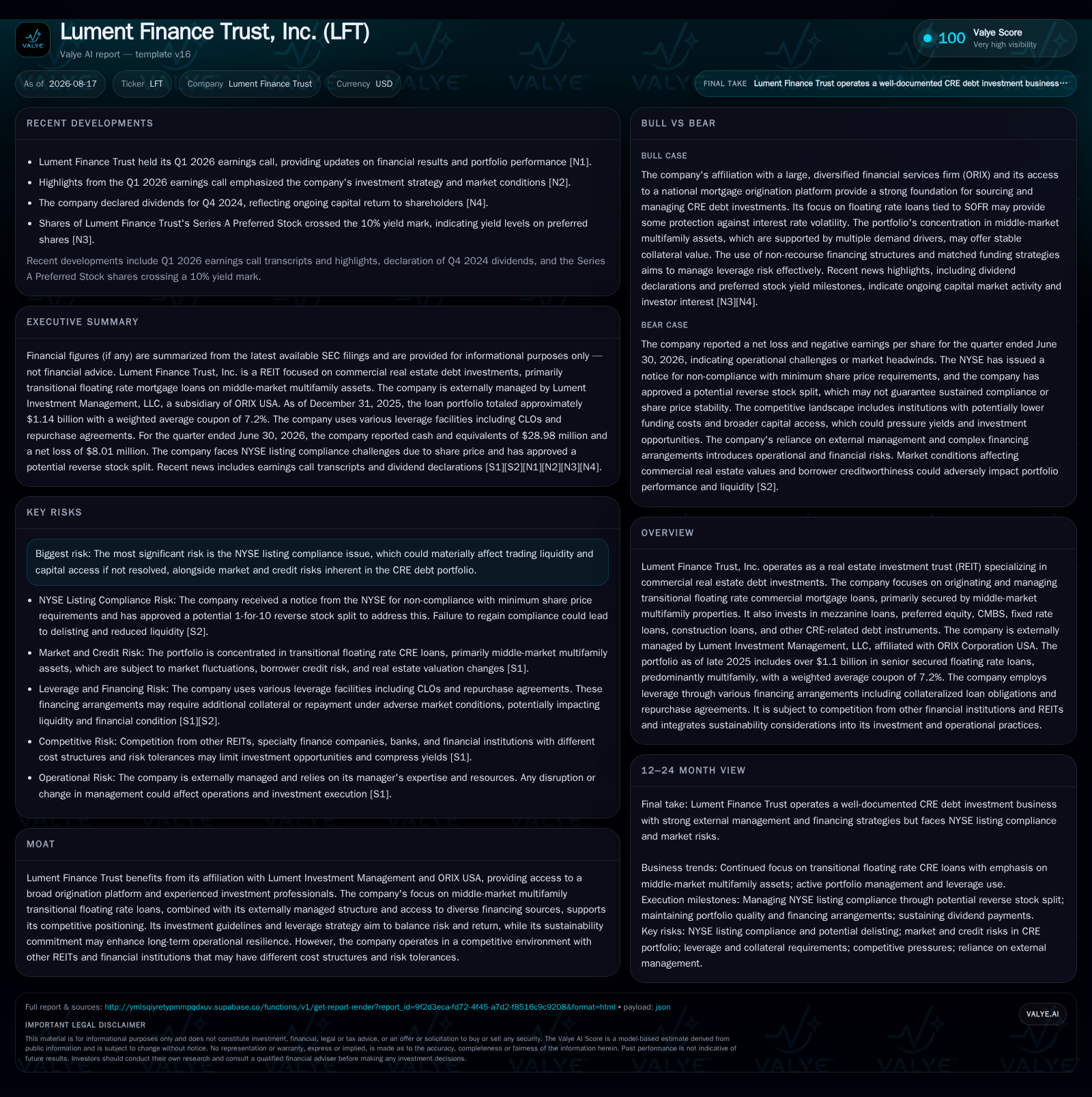
Lument Finance Trust, Inc. continues to focus on originating and managing floating rate commercial real estate loans secured by middle-market multifamily properties, supported by a robust origination platform through its external manager affiliated with ORIX USA. The latest quarterly filing shows no material changes in portfolio composition or credit quality. However, the company faces a critical risk of NYSE delisting after its common stock traded below $1.00 for an extended period. To address this, the Board has authorized consideration of a 1-for-10 reverse stock split, aimed at restoring compliance but carrying execution uncertainty. Lument's business model leverages structured finance vehicles such as collateralized loan obligations and repurchase agreements to optimize leverage and net interest margin within a competitive CRE debt REIT environment.
Recent Operating Update and NYSE Compliance Challenge
Lument Finance Trust’s Q2 2026 filing confirms continued stability in its commercial real estate debt portfolio without notable changes in credit metrics or asset allocation [S2]. The company maintains its core emphasis on transitional floating rate commercial mortgage loans secured by middle-market multifamily properties — a segment balancing yield enhancement with controlled credit risk during rising interest rates [S1]. This consistency underscores effective deployment of capital through Lument Investment Management’s extensive origination platform.
The most pressing development is the receipt of a deficiency notice from the New York Stock Exchange dated July 24, 2026. LFT’s common stock traded below the NYSE minimum price requirement of $1.00 over a consecutive 30-day period, initiating a six-month window to restore compliance or face potential delisting [S2]. Delisting would materially impair trading liquidity and restrict access to public capital markets.
To mitigate this risk, the Board authorized consideration of a reverse stock split at a ratio of one share for every ten currently outstanding shares [S2]. While such measures are customary among small-cap REITs confronting share price declines, their success depends on market reception and sustained investor confidence post-execution.
Business Model and Strategic Positioning
Lument Finance Trust operates as an externally managed REIT specializing in commercial real estate debt investments focused predominantly on floating rate transitional loans secured by middle-market multifamily assets [S1]. The company generates revenue primarily through interest income derived from originated or acquired mortgage loans alongside mezzanine debt, preferred equity interests, CMBS exposure, fixed rate loans, and construction financing.
Its external manager, Lument Investment Management — part of ORIX USA — provides strategic advantages including scale and geographic reach with over 550 employees across more than 30 U.S. offices. This infrastructure supports rapid capital deployment and fosters strong borrower relationships necessary for sourcing attractive lending opportunities [S1].
Leverage is central to enhancing returns; LFT employs collateralized loan obligations (CLOs) and repurchase agreements to borrow efficiently against its loan portfolio while managing funding costs relative to weighted average coupon rates near 7.2% [S1]. This structure enables effective net interest margin management amid fluctuating benchmark rates.
Industry Context and Competitive Landscape
Within the commercial real estate debt REIT sector, Lument targets transitional middle-market multifamily loans which typically offer higher yields than stabilized assets but carry moderate credit risk due to property status. Peers such as Starwood Property Trust and Blackstone Mortgage Trust operate at larger scales with broader asset diversification but face similar dynamics concerning interest rate sensitivity and credit quality.
Lument’s competitive advantage derives from its affiliation with ORIX USA’s established origination platform—facilitating deal flow velocity and rigorous underwriting processes—alongside external management expertise. Floating rate exposures benefit from rising benchmark rates that increase interest income yields faster than associated borrowing costs can adjust.
Growth may also stem from portfolio diversification into mezzanine debt, preferred equity positions, construction loans, and CMBS investments—each offering incremental yield opportunities while distributing idiosyncratic risk across different credit instruments [S1]. Strategic partnerships with ORIX USA enhance access to competitive financing sources crucial for sustaining growth.
Risks and Watchpoints
The paramount near-term risk is regulatory: failure to comply with NYSE minimum share price requirements could result in delisting with attendant impacts including reduced liquidity and penny stock classification challenges that restrict broker activity [S2]
Credit risk inherent in transitional CRE loans remains pertinent especially if economic headwinds cause borrower distress or property valuations decline sufficiently to elevate loan-to-value ratios beyond thresholds protecting principal.
Interest rate volatility presents dual challenges: rising benchmarks increase floating rate loan yields but simultaneously elevate funding costs on CLOs or repo agreements potentially compressing net interest margins if not carefully managed.
Operational risks include reliance on third-party asset management performance as well as cybersecurity threats highlighted in annual disclosures given dependence on ORIX USA’s centralized IT infrastructure [S1].
Outlook: Monitoring Key Developments
Investor focus should track whether the Board elects to implement the reverse stock split within the cure period ending January 2027 and whether this action achieves sustainable share price recovery.
Subsequent quarterly disclosures will provide insight into portfolio credit trends including any deterioration reflected in non-performing loan ratios or default incidence as well as originations reflecting market demand.
Additionally, attention should be paid to updates regarding external manager fees or changes in financing arrangements that impact leverage levels or liquidity cushions.
Financial Profile Discussion
As of June 30, 2026, Lument Finance Trust held approximately $29 million in cash and equivalents supporting near-term operational liquidity needs absent extraordinary events [F1]. The company’s externally managed structure combined with significant leverage via CLOs and repurchase agreements underpins its capital structure strategy focused on balancing yield enhancement against financial flexibility [S1].
Net income was negative $2.7 million for the full year ending December 31, 2025—a reflection consistent with typical mark-to-market adjustments or provisioning within transitional loan portfolios rather than operational underperformance alone [F1]
While Funds from Operations (FFO), adjusted FFO (AFFO), dividend payout ratios, and book value per share are standard metrics among CRE debt REIT investors, these were not detailed in the available filings for this quarter.
Overall, LFT’s financial profile embodies the sector’s trade-offs between leveraging floating rate assets for income generation while navigating credit risks and market-driven regulatory compliance challenges.
Disclaimer: This is research-only, informational analysis and not investment advice. It may include AI-generated interpretation and general industry context. Always verify important details using primary sources.

Comments