
Chicago Atlantic BDC: Floating-Rate Portfolio Dynamics, Merger Uncertainties, and the Road Ahead
Chicago Atlantic BDC, Inc. faces a pivotal period as it navigates interest rate sensitivity, valuation ambiguity in illiquid debt portfolios, and the execution risks of a pending merger with REFI. While quarterly earnings have fluctuated, the company's floating-rate loan focus could provide resilience—if credit quality and integration challenges are managed effectively.
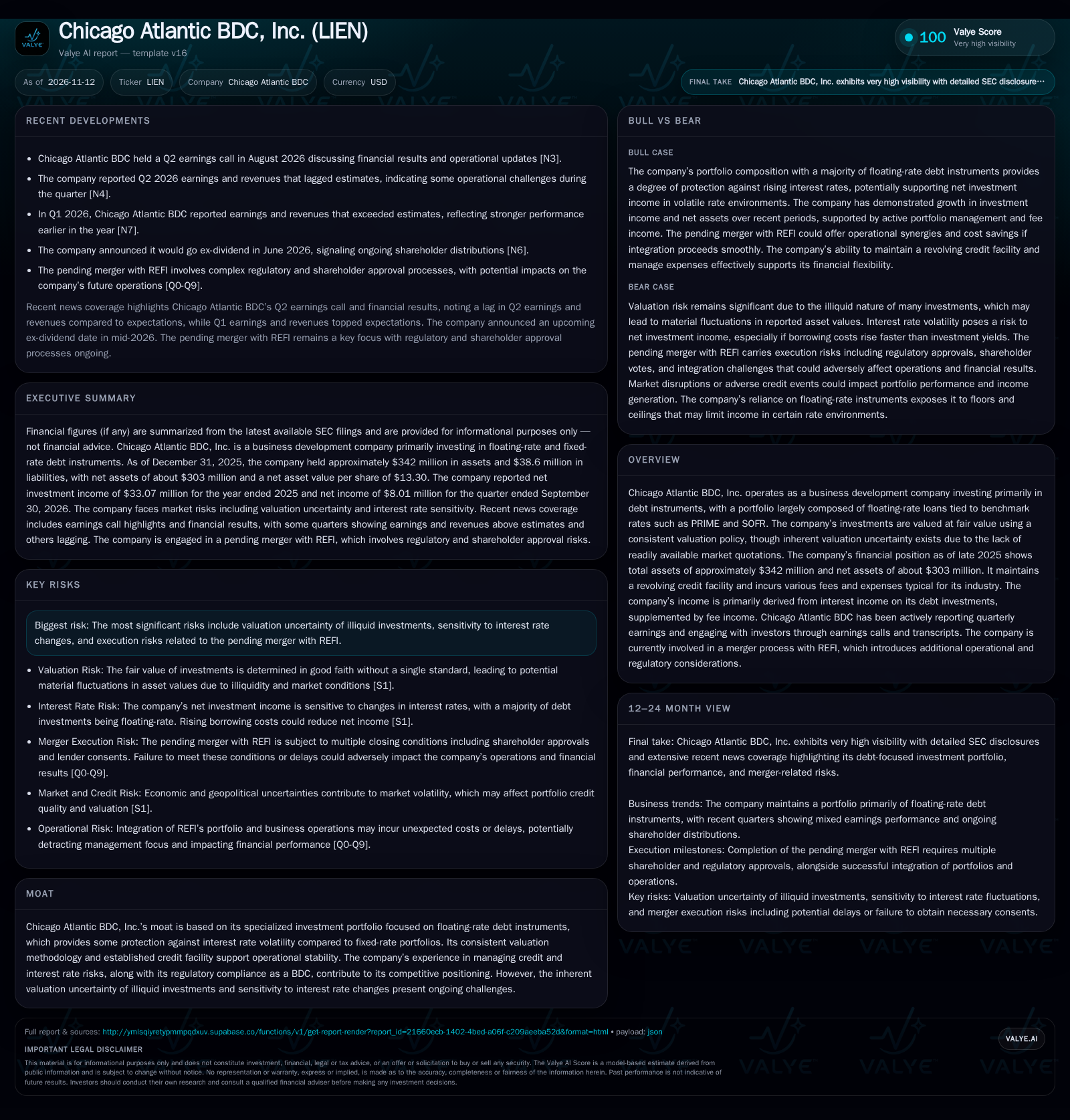
Chicago Atlantic BDC, Inc. holds a $333M debt-focused portfolio, with 71.8% in floating-rate instruments, leaving it highly sensitive to rate swings and portfolio revaluations. The company’s pending merger with REFI introduces both integration opportunity and substantial execution risk. Recent earnings volatility signals operational challenges but also upside potential if synergies and credit performance hold [S1] [S2] [N4] [N7].
Chicago Atlantic BDC, Inc. operates in a space where the interplay of interest rates, credit risk, and illiquid asset valuation defines the investment outcome. With most of its $333 million portfolio in floating-rate debt, the company is positioned to benefit—or suffer—from rate movements, while also grappling with the persistent challenge of valuing hard-to-trade instruments. Recent earnings volatility and a pending merger with REFI add layers of complexity, offering both upside in operational scale and the risk of integration missteps. How Chicago Atlantic BDC manages these intertwined factors will set its course over the next several quarters.
Recent Performance and Strategic Developments Shape Outlook
As of December 31, 2025, Chicago Atlantic BDC managed a portfolio valued at approximately $333 million, with 71.8% of investments in floating-rate debt tied to PRIME or SOFR and the remainder in fixed-rate instruments [S1]. This composition makes the company’s income highly sensitive to changes in benchmark rates. For the year ended 2025, net investment income reached $33.07 million, while net income for the quarter ended September 30, 2026, was $8.01 million with EPS of $0.35 [S1] [S2]. However, quarterly results have been mixed: Q1 2026 exceeded earnings estimates, but Q2 lagged, highlighting operational volatility [N4] [N7].
The company reported cash and liquidity metrics for the period; these figures do not by themselves establish operating runway, investment capacity, financial flexibility, or financing capacity. [S2] [S1] The pending merger with REFI introduces both opportunity and risk, as approval and integration hurdles remain unresolved and could materially affect future operations.
Beyond the headline portfolio composition and earnings figures, a deeper understanding of liquidity dynamics and capital deployment strategies would further clarify Chicago Atlantic BDC’s operational flexibility. For instance, the timing and cadence of loan originations relative to loan repayments or prepayments could materially influence interest income stability. Additionally, the company’s ability to access capital markets or credit facilities on favorable terms would condition its capacity to capitalize on rising rates or distressed opportunities. A nuanced view of these factors, especially in the context of merger-related capital demands, would help assess whether the company can sustain investment momentum without undue leverage or dilution risks.
How Floating-Rate Debt Drives Earnings—And Risk
Chicago Atlantic BDC’s core business is generating interest income from a portfolio dominated by floating-rate loans. This model can benefit from rising benchmark rates, as loan yields typically reset higher, potentially boosting net investment income if credit performance and spreads hold steady. However, this structure also exposes the company to interest rate risk: should borrowing costs on its own floating-rate liabilities rise faster than asset yields, net interest margins could compress.
The company’s revenue mix likely includes arrangement fees, prepayment penalties, and possibly equity kickers, but the report does not detail these mechanics. Fixed expenses—such as management and incentive fees—introduce operating leverage, meaning swings in portfolio performance or asset values can have outsized effects on earnings. The fair-value accounting of illiquid debt introduces further volatility, as asset revaluations can impact both reported income and net asset value, especially during periods of market stress [S1].
The floating-rate debt model’s sensitivity to benchmark rate shifts also interacts with credit spread dynamics in complex ways. If credit spreads widen due to deteriorating borrower fundamentals or macroeconomic stress, the effective yield on floating-rate loans may not keep pace with rising reference rates, compressing net interest margins despite nominal rate increases. Conversely, in stable or improving credit environments, floating-rate exposure can amplify income growth. Moreover, the company's liability structure—whether it predominantly finances assets with fixed- or floating-rate debt—will influence net interest margin volatility. Understanding this asset-liability mismatch risk and its hedging or mitigation strategies is critical to evaluating earnings durability.
Specialization, Regulatory Structure, and the Challenge from Peers
Chicago Atlantic BDC’s specialization in floating-rate debt is a potential differentiator, especially if rates remain elevated or rise further. In theory, this should insulate the company from some fixed-rate BDC peer risks, such as income stagnation during inflationary periods. However, the market for private debt is competitive, with numerous BDCs, private credit funds, and alternative lenders vying for similar yields.
The company’s regulatory status as a BDC imposes distribution requirements but also provides tax advantages, attracting yield-focused investors. The lack of liquid secondary markets for many private debt investments can be a double-edged sword—offering higher yields but making exits and valuations more challenging. Without explicit evidence of superior underwriting, proprietary deal flow, or lower cost of capital, Chicago Atlantic BDC’s competitive edge may rest primarily on its portfolio mix and risk management discipline.
The pending REFI merger, if completed and well-integrated, could enhance scale and operating efficiency, but also raises the risk of cultural and asset-quality mismatches.
The competitive landscape for private debt investing is also shaped by evolving regulatory and market conditions that could affect deal flow and pricing power. For example, changes in banking regulations or capital requirements might shift lending volumes between traditional banks and non-bank lenders like BDCs, potentially altering competitive dynamics. Additionally, investor appetite for private credit products is sensitive to broader economic cycles and risk sentiment, which can impact fundraising and portfolio deployment. Chicago Atlantic BDC’s ability to maintain or grow its market share may hinge on its underwriting discipline, operational efficiency, and adaptability to these shifting external factors, especially as it integrates REFI’s platform and culture.
Merger Integration and Rate Tailwinds Unlock Value
In a favorable scenario, the merger with REFI closes smoothly, expanding Chicago Atlantic BDC’s asset base and allowing cost synergies and greater portfolio diversification. If benchmark rates remain stable or rise modestly, the high floating-rate loan exposure could further boost net investment income. Successful integration could also provide cross-selling opportunities and broaden the investment universe, potentially supporting a higher net asset value per share.
Confirmation would come from post-merger financials showing increased net investment income, stable or rising NAV, and improved operating margins. Watch for management commentary on realized synergies and early signs of portfolio performance improvement.
Earnings Volatility Persists Amid Merger and Market Uncertainties
The most plausible near-term trajectory sees Chicago Atlantic BDC continuing to generate solid, but volatile, net investment income, reflecting its floating-rate exposure and the inherent uncertainty in illiquid asset valuations. The merger with REFI may close, but integration is likely to be gradual, with some cost drag and operational friction. Portfolio growth may be constrained by liquidity, and periodic credit events or asset revaluations could cause quarterly earnings swings.
Evidence for this scenario would be continued mixed earnings reports, with quarters oscillating between topping and lagging estimates, and management updates indicating steady, if unspectacular, progress on merger integration and portfolio quality.
Valuation Shocks and Integration Missteps Derail Momentum
A negative outcome could unfold if the merger with REFI stalls or is abandoned, leading to sunk transaction costs and strategic uncertainty. Alternatively, if the merger closes but asset quality issues or operational misalignments emerge, the company could face unexpected write-downs or credit losses. A rapid drop in benchmark rates would also hurt net investment income, as floating-rate yields reset lower while fixed expenses persist.
This scenario would be confirmed by a sharp drop in reported net asset value, negative earnings surprises, missed or reduced dividend distributions, and management disclosures of non-performing assets or integration setbacks.
Milestones That Will Clarify Chicago Atlantic BDC’s Post-Merger Trajectory
Reported net asset value (NAV) per share in post-merger quarters will indicate whether asset revaluations or integration costs are eroding shareholder value.
Net investment income and net interest margin trends, especially relative to benchmark rate movements, will reveal whether the floating-rate strategy is delivering as intended.
Credit quality metrics—such as non-accrual rates, realized losses, or internal credit ratings, if disclosed—will help assess underlying portfolio risk.
Quarterly dividend announcements and payout ratios will show whether the company is maintaining its required BDC distributions and financial health.
Progress updates on the REFI merger, including regulatory approvals, shareholder votes, and integration timelines, will be critical for scenario validation.
Utilization of the $25 million revolving credit facility and changes in cash balances will signal liquidity management and potential funding stress.
Management commentary on portfolio growth, deal pipeline, and expense discipline, especially in the context of the larger post-merger organization, would help test operational execution.
Disclaimer: This is research-only, informational analysis and not investment advice. It may include AI-generated interpretation and general industry context. Always verify important details using primary sources.

Comments