
Larimar Therapeutics Advances Rare Disease Therapy Amid Intensifying Losses and Regulatory Milestones
Clinical-stage biopharma Larimar Therapeutics pushes nomlabofusp towards pivotal regulatory filings, while managing escalating operating losses and operational risks in a competitive rare disease landscape.
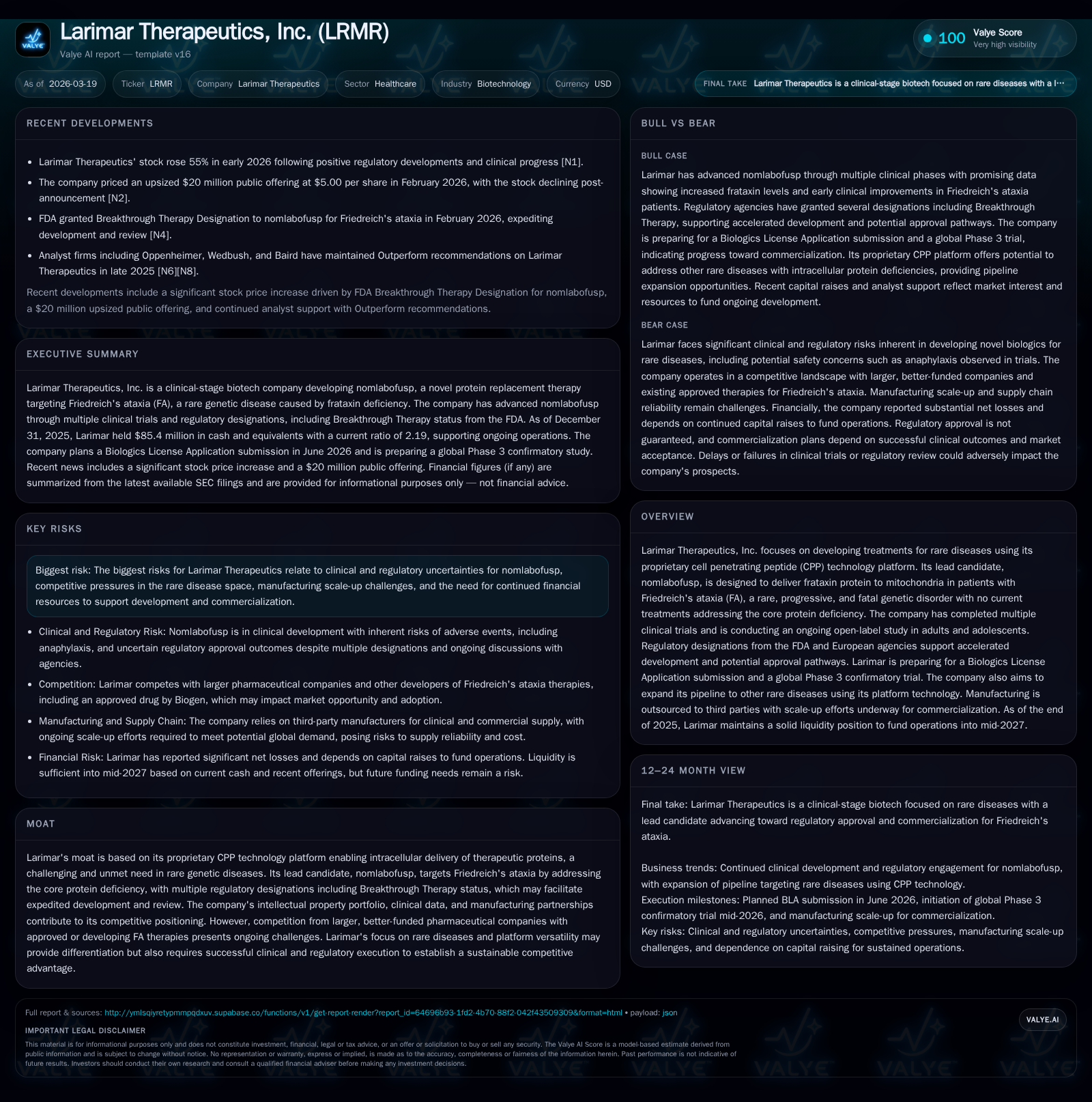
Larimar Therapeutics, Inc. is a clinical-stage biotechnology company focused on developing treatments for rare diseases using its proprietary cell penetrating peptide (CPP) platform. Its lead candidate, nomlabofusp, targets Friedreich's ataxia (FA) by delivering frataxin protein intracellularly and has received multiple expedited regulatory designations including FDA Breakthrough Therapy status. The company plans a Biologics License Application (BLA) submission targeted for mid-2026 alongside a global Phase 3 confirmatory trial. Larimar reported operating losses of $172.5 million in 2025 with no revenues to date [F1], driven by intensifying R&D and clinical development costs. At year-end 2025, Larimar held $85.4 million in cash plus proceeds from a February 2026 public offering expected to fund operations into Q2 2027 [F1][N2]. Manufacturing is outsourced under cGMP standards, presenting scale-up risks, while competition includes established and emerging players addressing FA and related indications [S24].
Company Overview
Larimar Therapeutics is a clinical-stage biotechnology firm developing treatments for rare genetic diseases marked by intracellular protein deficiencies. Their proprietary cell penetrating peptide (CPP) technology enables delivery of therapeutic proteins directly into cells, aiming to overcome challenges where large molecules typically cannot cross cellular membranes efficiently [S1].
The lead candidate, nomlabofusp, is a recombinant fusion protein designed to deliver frataxin (FXN) into mitochondria of patients with Friedreich's ataxia (FA), a progressive neurodegenerative disorder caused by insufficient FXN production due to genetic mutations.
Historical Financial Performance
Larimar has reported no revenues since inception through at least FY2019, consistent with its pre-commercial stage [F1]. Operating losses have markedly increased as clinical development has advanced:
Historical performance (annual)
| FY | Net ($mm) | CFO ($mm) | OpInc ($mm) | Capex ($) | Net YoY |
|---|---|---|---|---|---|
| 2025 | -166 | -113 | -172 | 91000 | -105.5% |
| 2024 | -81 | -71 | -91 | 515000 | -118.1% |
| 2023 | -37 | -33 | -42 | 164000 | -4.5% |
| 2022 | -35 | -28 | -37 | 100000 |
Source: SEC companyfacts cache [F1].
Capital returns and efficiency (annual)
| FY | FCF ($mm) | ROE% |
|---|---|---|
| 2025 | -113 | -212.2 |
| 2024 | -71 | -46.9 |
| 2023 | -34 | -45.2 |
| 2022 | -28 | -31.9 |
Source: SEC companyfacts cache [F1].
Operating losses nearly quadrupled from approximately $36.5 million in FY2022 to over $172 million in FY2025 as clinical activities intensified [F1]. Negative operating cash flow exceeded $113 million in FY2025 while capital expenditures remained minimal—reflecting reliance on outsourcing for manufacturing and infrastructure [F1][S24]. Equity fluctuated with financing rounds but decreased notably in FY2025 driven by cumulative net losses.
Pipeline and Regulatory Status
Nomlabofusp continues progressing through clinical development:
It has secured multiple expedited designations including Orphan Drug Designation (FDA & EMA), Fast Track Designation (FDA), Pediatric Rare Disease Designation (FDA), Breakthrough Therapy Designation (FDA), PRIME status (EMA), and access to MHRA’s Innovative Licensing and Access Pathway (ILAP) in the UK [S1][N4][S13].
The FDA selected the program for the START pilot program aimed at accelerating rare disease drug development.
Regulatory discussions have considered skin frataxin concentration as a surrogate endpoint reasonably likely to predict clinical benefit under accelerated approval provisions—potentially shortening time-to-market compared to traditional functional endpoints requiring longer follow-up [S23].
Enrollment continues in ongoing open-label studies including pediatric patients aged 2–11 years.
Larimar targets filing a Biologics License Application (BLA) by June 2026 alongside plans for a global Phase 3 confirmatory trial supporting eventual commercialization [N4][S23].
Manufacturing Strategy
Nomlabofusp manufacturing is outsourced to third-party contract manufacturing organizations compliant with current Good Manufacturing Practices (cGMP). This conserves capital but introduces operational risks related to capacity scale-up and regulatory compliance audits. Potential supply interruptions or non-compliance could adversely affect clinical trial timelines or commercial launch readiness [S14][S24]. The FDA’s lot release testing requirements and periodic inspections underscore the complexity of maintaining manufacturing quality standards.
Competitive Landscape
Larimar operates amid active competition in the rare genetic disease space:
Biogen markets SKYCLARYS™ (omaveloxolone), approved for FA treatment in adults and adolescents aged 16+ since early 2023/2024.
Other competitors include Design Therapeutics, Lexeo Therapeutics, Neurocrine Biosciences/Voyager Therapeutics, Solid Biosciences, and PTC Therapeutics—the latter recently receiving an FDA complete response letter delaying approval pending further data [S24].
Larimar’s CPP platform seeks differentiation by addressing the core mitochondrial protein deficiency rather than downstream symptom management—a challenging but potentially high-impact approach.
Risks and Regulatory Considerations
Key risks include:
Clinical risk associated with demonstrating safety and efficacy sufficient for accelerated approval given small patient populations.
Uncertainties regarding surrogate endpoint acceptance despite encouraging regulatory dialogue.
Continued financing requirements amid steep cash burn; recent equity raises provide runway only through mid-2027 absent additional funding [F1][N2].
Manufacturing scale-up challenges that could delay supply critical for late-stage trials and commercialization.
Pricing pressures from evolving U.S. and international healthcare policies including Inflation Reduction Act provisions affecting biologic drugs reimbursement [S9][S15][S19].
Competition from larger biopharma companies with established market presence may impact commercial uptake even if approval is obtained.
Capital Allocation and Financial Returns
Larimar’s financial resources are predominantly allocated toward research & development with minimal capital expenditures due to outsourcing strategies. No dividends or share repurchases have been reported; equity declined significantly due to accumulated net losses.
Approximate return on equity based on FY2025 figures is negative at about -212%, reflecting sustained net losses relative to shareholder equity [F1]. Liquidity comprised $85.4 million cash at year-end plus approximately $107.6 million gross proceeds from February 2026 public offering provide operational funding into mid-2027 without immediate refinancing needs indicated [F1][N2].
Outlook and Market Dynamics
While orphan drug designations confer regulatory incentives including market exclusivity post-approval, limited patient populations inherently constrain peak sales potential absent label expansions or additional pipeline successes.
Emerging reimbursement frameworks internationally may introduce pricing pressure despite premium pricing often afforded orphan drugs owing to unmet medical need severity. Demonstrating meaningful functional benefit beyond surrogate markers will be critical for payer acceptance.
Operational execution remains paramount given recent adjustments such as modified dosing regimens implemented following early trial adverse events including anaphylaxis risk mitigation efforts [S23].
Key Upcoming Catalysts
- Targeted BLA submission by June 2026 incorporating accelerated approval considerations.
- Initiation and progression data from planned global Phase 3 confirmatory studies evaluating key efficacy endpoints.
- Regulatory feedback including potential Advisory Committee outcomes influencing approval timelines.
- Validation of manufacturing processes ensuring cGMP compliance ahead of commercial readiness.
- Monitoring financial performance against milestones influencing capital raise timing.
- Competitor developments that may shift market positioning or competitive dynamics.
Conclusion
Larimar Therapeutics exemplifies a high-risk/high-reward biotech endeavor targeting life-threatening rare diseases via innovative intracellular delivery technology. Despite substantial operating losses typical of deep-stage R&D without revenue generation yet realized, significant regulatory recognitions such as FDA Breakthrough Therapy designation validate the scientific premise and may expedite access to first-in-class treatments for Friedreich's ataxia patients worldwide.
Execution risks remain considerable: successful translation of biological rationale into clinical benefit must be demonstrated; manufacturing complexities must be managed efficiently; capital markets must sustain funding until product commercialization delivers returns; and competitive pressures require strategic navigation. Larimar’s future hinges on advancing imminent regulatory milestones scheduled over the coming year.
Disclaimer: This is research-only, informational analysis and not investment advice. It may include AI-generated interpretation and general industry context. Always verify important details using primary sources.

Comments