
Intuitive Machines Advances Lunar Infrastructure with Build-Connect-Operate Model
Intuitive Machines' integrated business model catalyzes space infrastructure evolution from discrete missions to enduring lunar and cislunar operations amidst operational headwinds.
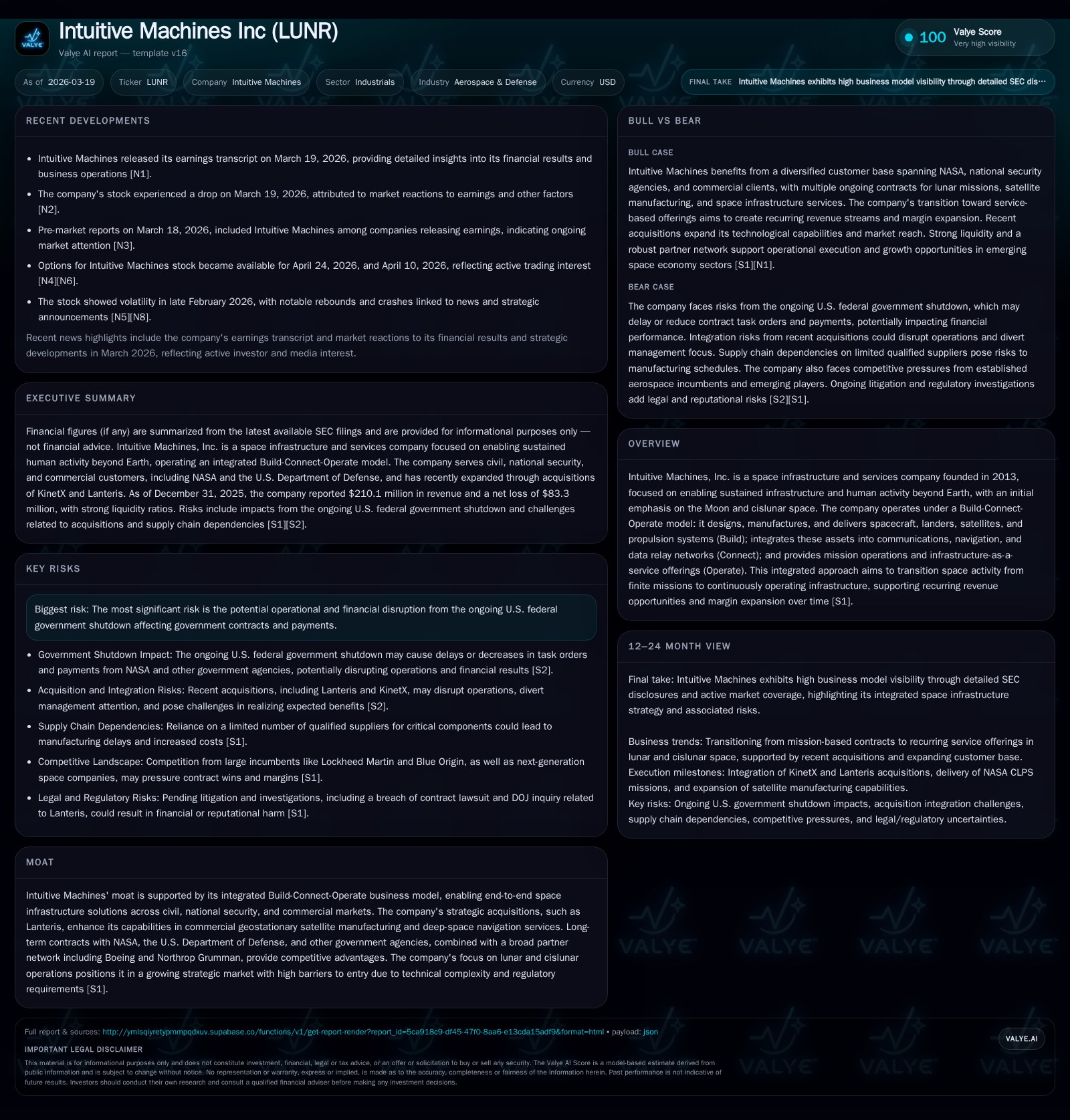
Founded in 2013, Intuitive Machines is charting a path to sustained human activity beyond Earth by building spacecraft, integrating communications and navigation networks, and operating long-duration space infrastructure. The company’s unique Build-Connect-Operate model differentiates it within aerospace defense markets and fosters recurring revenue potential. Recent acquisitions such as Lanteris have expanded its geostationary satellite manufacturing capabilities. Financially, Intuitive Machines continues to invest heavily in capital expenditures to build foundational infrastructure, resulting in operating losses but improving net income and operational cash flows. Monitoring the integration of new assets and contract execution will be key to assessing future growth trajectories.
Historical Financial Performance Reflecting Growth Dynamics and Challenges
Intuitive Machines' recent financial profile captures the realities of a company in aggressive expansion mode. For fiscal year (FY) 2025, the company reported revenues of $210.1 million, reflecting top-line growth as it solidifies its presence in the burgeoning lunar and cislunar commercial space industry [F1]. However, this revenue expansion came with steep operating expenses, pushing the operating loss to $87.2 million—a deterioration of roughly 52% compared to FY2024's $57.4 million loss [F1]. This trend underscores rising costs linked to scaling operations and infrastructure development.
Despite worsening operating losses, net income showed relative improvement: the loss narrowed by approximately 70.6% year-over-year to $83.3 million down from $283.4 million in FY2024 [F1]. This improvement likely reflects cost control measures alongside increased revenue contributions.
Cash flows further highlight the investment-heavy phase; operating cash flow (CFO) losses decreased by about 75% to $14.3 million negative in FY2025, signaling some operational cash generation progress [F1]. Meanwhile, capital expenditure (capex) surged over threefold to $41.6 million (a 311.8% increase), emblematic of heavy spending supporting spacecraft production lines and technology platforms integral to the company's Build phase [F1]. Combining CFO with capex yields a significant negative free cash flow exceeding $55 million, reflecting substantial upfront capital deployment necessitated by complex aerospace manufacturing cycles.
Historical performance (annual)
| FY | Net ($mm) | CFO ($mm) | OpInc ($mm) | Capex ($mm) | Net YoY |
|---|---|---|---|---|---|
| 2025 | -83 | -14 | -87 | 42 | +70.6% |
| 2024 | -283 | -58 | -57 | 10 | -551.3% |
| 2023 | 63 | -45 | -56 | 30 | +33083.9% |
| 2022 | 0 | -1 | -5 |
Source: SEC companyfacts cache [F1].
Capital returns and efficiency (annual)
| FY | Div ($mm) | FCF ($mm) | ROE% |
|---|---|---|---|
| 2025 | -56 | 11.0 | |
| 2024 | 0 | -68 | 28.1 |
| 2023 | 8 | -75 | -23.9 |
| 2022 | -1.9 |
Source: SEC companyfacts cache [F1].
Table: Intuitive Machines - Select Annual Financial Metrics (FY2024-FY2025) extracted from [F1]
Integrated Build-Connect-Operate Model Underpinning Competitive Moat
Intuitive Machines' differentiation stems from an integrated Build-Connect-Operate model engineered for space infrastructure that transcends conventional project-based milestones [S1][S19]. The 'Build' component covers design and manufacture of spacecraft—landers, satellites, propulsion units—that serve government and commercial clients across low Earth orbit (LEO), geostationary orbit (GEO), cislunar corridors, and deep space.
The 'Connect' capability integrates these assets into persistent communication, navigation, command-and-control networks including data relay systems crucial for sustained lunar surface operations and Gateway elements [S13][S19]. Finally, 'Operate' provides long-term mission operation services such as hosted payload management, autonomous system control, navigation/timing solutions—transitioning single-mission deliverables into continuously running infrastructure embracing an "infrastructure-as-a-service" paradigm [S6][S14].
This end-to-end control offers trust advantages versus incumbents like Lockheed Martin who often operate siloed offerings tailored for crewed missions or fragmented contracts. It enables Intuitive Machines to capitalize on multi-orbit service demand streams across civil space initiatives—including NASA Artemis payloads—national security projects via DoD missile defense tracking layers—and commercial satellite operators seeking hosted payload data support [S5][S9].
Recent Acquisition Impact: Lanteris and Expansion into Geostationary Capabilities
The January 2026 acquisition of Lanteris Space Holdings LLC marks a pivotal expansion into commercial GEO satellite manufacturing and advanced navigation services [S1][S2]. The deal consideration approximated $800 million combining cash ($450M) and stock ($350M) components [S2], bringing established satellite bus platforms noted for scalable structures optimized for fuel-efficient station keeping.
Lanteris has produced GEO satellites powering high-capacity spot-beam broadband applications including Hughes Network Systems’ JUPITER 3 ultra-high density platform [S10]. This acquisition bolsters Intuitive Machines’ ability to serve commercial telecom customers while layering in advanced navigation capabilities critical for deep-space missions.
Operationally, integrating Lanteris presents typical aerospace consolidation risks—cultural alignment challenges, systems harmonization needs—and sits amid competition from Airbus, Boeing, Northrop Grumman for civil contracts as well as national security geostationary projects [S5][S8]. The DOJ investigation concerning alleged cybersecurity compliance issues tied to Lanteris adds complexity though indemnification provisions partly mitigate direct financial exposure [S4][S8].
Revenue Drivers and Market Position Across Civil, Defense, and Commercial Contracts
Revenue mainly derives from fixed-price government contracts under NASA’s CLPS lunar cargo delivery program—with several successful surface payload missions—and development of Lunar Terrain Vehicles for heavy cargo transport [S5][S18]. Concurrently, the company supports national security via Space Development Agency contracts employing infrared sensor-equipped buses developed through subsidiaries like Lanteris [S9].
Commercially, hosted payload data services and constellation management sustain partnerships supporting GEO satellite operators utilizing Lanteris platforms [S6][S9][N5]. Customers span U.S federal agencies including NASA/DoD consortia plus international clients leveraging geostationary communication satellites.
Regulatory barriers—especially stringent cybersecurity protocols enforced contractually—alongside technical complexity uphold high entry hurdles defending Intuitive Machines’ niche against incumbents such as Blue Origin and Lockheed Martin pursuing crewed lunar or large-scale mission systems [S6][S11].
Operational Risks from Government Shutdown and Litigation Landscape
The ongoing U.S federal government shutdown since October 2025 injects uncertainty into contract fulfillment timelines affecting NASA task orders that drive significant revenue portions [S2]. Payment delays or suspensions threaten short-term liquidity as funding impasses persist.
Additional risks include pending litigation such as a breach-of-contract case filed by Starlight Strategies IV LLC concerning preferred stock conversion rights—a dispute unresolved with motions pending summary judgment—posing reputational risk though no loss accrual is recorded due to uncertain timing or magnitude [S4]. The DOJ’s Civil Investigative Demand regarding alleged False Claims Act violations linked to Lanteris’ cybersecurity compliance underscores regulatory exposure despite management cooperation commitments [S8][S15].
Cybersecurity remains a governance priority with senior leadership oversight ensuring frameworks aligned with ISO/IEC standards and advancing Cybersecurity Maturity Model Certification (CMMC) 2.0 compliance required by federal contracts starting in 2026 [S11][S15].
Capital Allocation: Investment Focused Amid Negative Equity Position
Capital deployment emphasizes growth acceleration over returns. Capex ballooned over threefold to $41.6 million in FY2025 reflecting investments aimed at scaling production capabilities supporting Build activities alongside R&D targeting lunar lander technologies [F1][S17]. Operating cash flows remain negative at $14.3 million but show improvement indicating operational progress.
Equity stands deeply negative at approximately $755 million primarily due to cumulative losses plus acquisition accounting impacts post-Lanteris purchase—the deficit notwithstanding an implied positive return metric if using net income relative to equity balance suggests transitional dynamics typical of capital-intensive aerospace startups maturing toward profitability over time [F1].
No dividends or share buybacks are planned or paid reflecting prudent cash conservation aligned with reinvestment needs during this aggressive infrastructure buildup stage [F1][S23], consistent with sector patterns where early internal funding precedes external growth capital raises.
Strategic Outlook: Transition Toward Recurring Revenue Models
Filings highlight a pivot away from bespoke mission milestones toward service-based offerings embedding recurring revenue streams via longer-duration infrastructure-as-a-service models covering communications relay networks and positioning-navigation-timing services aimed at civil exploration programs and defense customers alike [S1][S6].
Operating assets beyond initial deployment enables margin accretion through continuous utilization rather than finite projects—addressing historical volatility endemic in aerospace contracting by smoothing revenue recognition profiles.
Investments today in network integration within Connect plus autonomous mission management under Operate underpin this shift driving a differentiated market stance poised for scale as demand grows for sustained lunar presence supporting scientific inquiry plus homeland security surveillance around cislunar regimes.
Monitoring Milestones Ahead
Key metrics include integration progress on Lanteris platforms; delivery schedules for upcoming CLPS lunar landers including heavy cargo vehicles under NASA Artemis; scaling Near Space Network data relay constellations enabling continuous cislunar connectivity; plus contract wins or extensions amid evolving geopolitical factors impacting federal budgets post-government shutdown resolution timing [N1][N3][N11].
Recent equity raises totaling $175 million aim at mitigating leverage concerns while politically sensitive contract environments pose downside risk if delays materially impact cash flows requiring close monitoring of working capital cycles post-acquisition absorptions [N3].
With technical complexity limiting competition within GEO/deep-space domains coupled with regulatory thresholds deterring new entrants overlapping national security interests further solidify Intuitive Machines’ moaty positioning—they must execute flawlessly on integrating Build-Connect-Operate workflows transforming episodic missions into seamless aerospace infrastructure services.
This analysis is based solely on publicly disclosed information without offering investment advice.
Disclaimer: This is research-only, informational analysis and not investment advice. It may include AI-generated interpretation and general industry context. Always verify important details using primary sources.

Comments