
Mustang Bio Battles Clinical-Stage Challenges While Building Immunotherapy Pipeline
Mustang Bio pursues innovative CAR T-cell and oncolytic virus therapies for solid tumors amid tightening cash flow and regulatory hurdles.
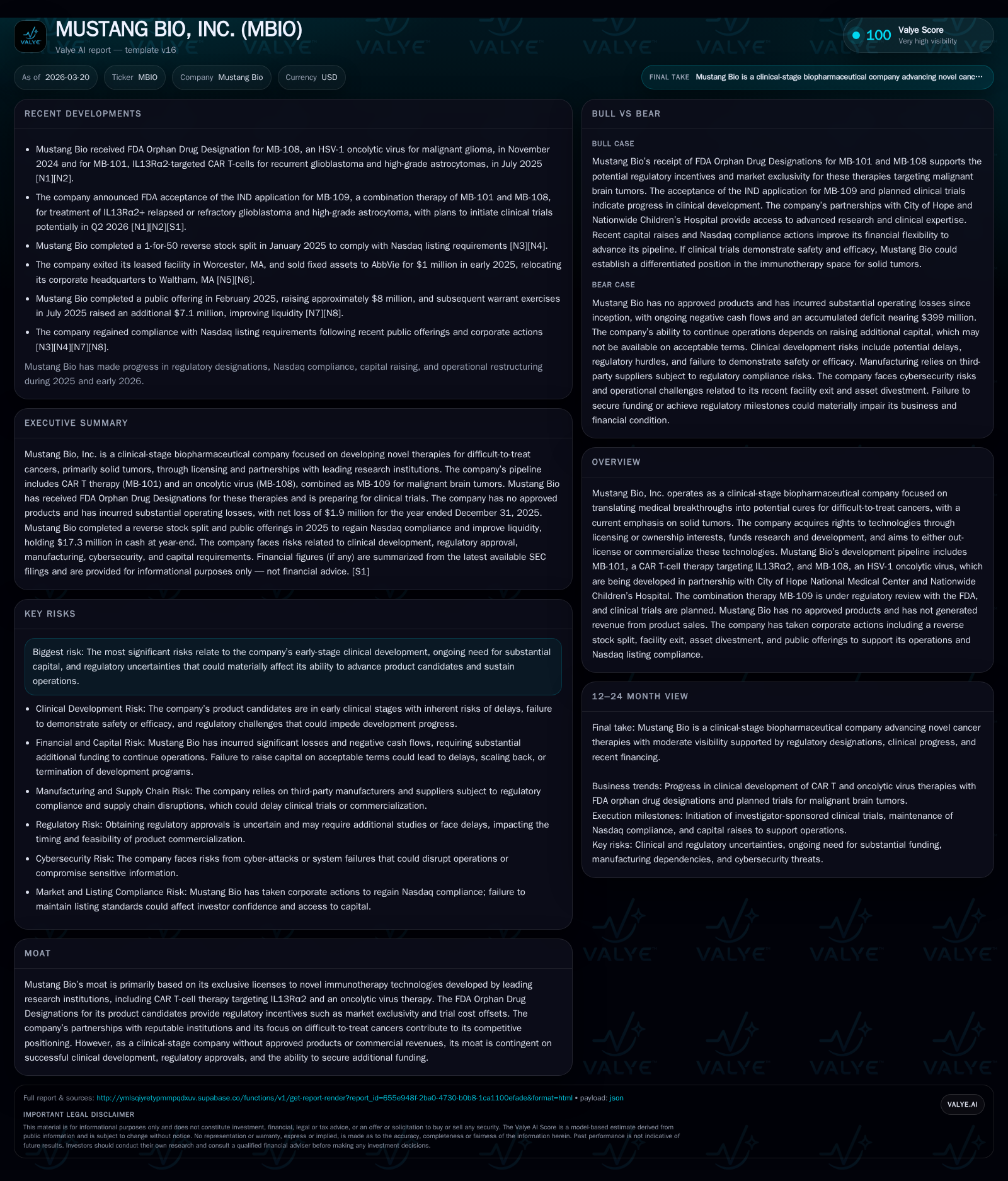
Mustang Bio, a clinical-stage biopharmaceutical firm, focuses on licensed immunotherapies targeting difficult solid tumors with CAR T-cell (MB-101) and oncolytic virus (MB-108) programs. Despite accumulated losses nearing $398.6 million and ongoing negative cash flow of $5.26 million in 2025, the company has bolstered liquidity through equity offerings and warrant exercises to extend its runway. Regulatory dynamics, including FDA orphan drug designations and review of MB-109 combination therapy, present critical inflection points. Mustang faces capital constraints, regulatory complexities, and reliance on exclusive licensing partnerships, shaping a high-risk developmental trajectory.
Historical Operating Trends Reflect Financial Strain With Improving Losses
Mustang Bio’s financial history reveals a typical clinical-stage biopharmaceutical profile characterized by persistent operating losses and negative operating cash flow as it invests heavily in R&D prior to commercialization. The firm recorded an operating loss of $2.43 million in 2025, a significant reduction from $16.25 million in 2024 and well below the peak loss of $76.16 million in 2022 [F1]. Net income similarly improved from -$77.53 million in 2022 to a loss of approximately $1.92 million in 2025.
Despite these improvements, Mustang Bio continues to generate negative cash flow from operations—$5.26 million outflow for 2025—which is nearly a 54% improvement compared with the $11.41 million negative CFO reported for 2024 [F1]. Capital expenditures were negligible recently, with zero recorded for both 2024 and 2025 after modest prior-year outlays.
The accumulated deficit stood at approximately $398.6 million by December 31, 2025 [S6][S13]. These figures underscore extensive capital consumption typical of early-stage biotech focused on immunotherapies without commercial products or revenues.
Historical performance (annual)
| FY | Net ($mm) | CFO ($mm) | OpInc ($mm) | Capex ($mm) | Net YoY |
|---|---|---|---|---|---|
| 2025 | -2 | -5 | -2 | +87.8% | |
| 2024 | -16 | -11 | -16 | 0 | +69.5% |
| 2023 | -52 | -49 | -49 | 0 | +33.4% |
| 2022 | -78 | -65 | -76 | 3 |
Source: SEC companyfacts cache [F1].
Capital returns and efficiency (annual)
| FY | FCF ($mm) | ROE% |
|---|---|---|
| 2025 | -20.2 | |
| 2024 | -11 | 406.7 |
| 2023 | -50 | -41952.8 |
| 2022 | -68 | -167.5 |
Source: SEC companyfacts cache [F1].
All figures rounded; no revenue growth due to lack of commercial activity [F1].
Improving loss metrics reflect meaningful cost control efforts and capital raises executed through early-to-mid-2025 that reduced operating expenses and extended financial runway [S6][S13]. Nonetheless, Mustang Bio remains dependent on external financing to sustain operations.
Pipeline Focus: Licensed Therapies Addressing Challenging Oncology Targets
Mustang Bio’s intellectual property centers around two principal therapies: MB-101 and MB-108—both immunotherapy approaches licensed exclusively from prominent research institutions.
MB-101 is a chimeric antigen receptor T-cell (CAR T-cell) therapy engineered to target IL13Rα2 receptors predominantly expressed in aggressive solid tumors such as glioblastoma multiforme . This receptor-specific targeting aims to enhance tumor selectivity while mitigating off-tumor toxicity—a key challenge limiting solid tumor CAR T-cell efficacy.
MB-108 is an HSV-1 based oncolytic virus designed to selectively replicate within tumor cells causing direct cytolysis while stimulating systemic anticancer immunity . Both therapies have received FDA Orphan Drug Designation status conferring market exclusivity incentives.
These programs are developed via partnerships with City of Hope National Medical Center and Nationwide Children’s Hospital—collaborators providing institutional research capabilities underpinning Mustang’s exclusive licenses . The combination therapy MB-109 integrates these modalities; it is currently under FDA review with clinical trial initiation plans pending approval [S3][S5].
These advanced modalities represent Mustang’s focus on difficult-to-treat cancers where unmet medical needs remain substantial despite technical challenges related to delivery methods and manufacturing logistics typical for cell therapies and viral agents.
Navigating Regulatory Landscape and Upcoming Clinical Initiatives
Mustang Bio’s advancement depends on navigating intricate regulatory protocols governing novel biologics. Key developments include FDA review of MB-109 combination therapy proposed for clinical trial initiation pending approval [S3][S5].
FDA oversight addresses safety profiles specific to genetically modified cellular products and live viral vectors plus adherence to Good Manufacturing Practice (cGMP) standards necessary for potential commercialization.
Additionally, Mustang must comply with federal Anti-Kickback Statute provisions restricting certain financial interactions post-approval alongside data privacy laws like HIPAA/HITECH governing patient information during trials [S3][S4][S8][S12][S18]. These operational challenges require governance overseen by audit committees ensuring risk mitigation against penalties that could disrupt timelines or impose fines.
Uncertainty also arises from potential agency staffing disruptions exemplified by U.S. government shutdowns that may delay submission reviews with cascading impacts on milestone-based funding critical before revenue generation [S3][S5][S12].
Capital Structure, Cash Position and Financing Actions
Financially dependent entirely on equity financings given zero product revenue base:
As of December 31, 2025 Mustang reported $17.3 million in cash and equivalents—augmented by approximately $14.5 million raised via a February equity offering complemented by ATM sales and warrant exercises during mid-year transactions [F1][S6][S13][S24].
• Going concern doubts previously disclosed have been resolved based on current liquidity sufficiency projected through at least twelve months post-report [S6][S13]. • Equity totaled roughly $9.53 million at year-end recovering from a negative position recorded at prior fiscal year close—a testament to capital restructuring efficacy [F1]. • No dividends or share repurchases authorized or executed reflecting standard biotech practice prioritizing reinvestment toward pipeline advancement [S1]. • Operational burn rate remains significant necessitating continued access to public markets constrained by sub-$75 million public float limitation restricting Form S-3 shelf registration capacity—a bottleneck impacting financing cadence [S6][S13]. • Contractual obligations primarily involve service providers such as CROs and CMOs often featuring one-sided indemnity clauses increasing operational risk exposure if adverse events arise [S7].
Thus the company faces typical biotech financing cycles involving recurrent dilutive raises amid high fixed costs until validating clinical readouts enable value unlock or partnership monetization.
Risk Profiles: Developmental Stage Challenges,
Regulatory Complexities & Partner Dependencies
Mustang’s risk profile includes:
• Clinical Risk: All candidates remain investigational without approved indications; oncology trials carry high attrition especially for solid tumor CAR T therapies due to tumor immune evasion tactics [S2]. • Regulatory Risks: Prolonged agency reviews combined with evolving healthcare policies increase uncertainties including government shutdown delays impacting milestone payments or commercialization timelines [S3][S5]. • Contractual Risks: Licensing arrangements dependent on third parties expose Mustang to termination risks triggered by non-compliance alongside possible onerous indemnification liabilities featured prominently in service agreements where counterparties’ liability caps may not protect Mustang sufficiently [S7]. • Healthcare Compliance Risk: Federal Anti-Kickback Statute prohibitions may constrain permissible commercial activities post-launch while transparency mandates require detailed disclosures potentially raising administrative costs or legal exposures [S3][S4][S8][S12][S18]. • Operational Risks: Cybersecurity vulnerabilities constitute acknowledged corporate risks requiring proactive management underscored by Audit Committee oversight reflecting governance best practices [S1]. • Litigation Exposure: Patent disputes or liability claims related to product defects pose latent threats capable of diverting management focus and increasing expenses reducing R&D capital availability [S9][S25][S26]. • Market Risks: Geopolitical tensions affecting supply chains plus macroeconomic volatility compound uncertainty through fluctuating capital availability critical for life sciences investment cycles [S15].
These entrenched risks typify biopharma innovation ventures demanding resilient financial strategies coupled with nimble operational controls.
Investor Considerations: Catalysts & Capital Adequacy Focus
Investors should monitor:
- Clinical Milestones: Initiation of MB-109 clinical trials following FDA clearance remains the foremost near-term catalyst signaling pipeline validation progress.
- Regulatory Updates: Progression towards further orphan designation expansions or fast-track approvals would de-risk pathway assumptions enhancing valuation prospects.
- Liquidity Status: Monitoring quarterly cash burn relative to liquidity improvement actions will inform sustainability until partnering or revenue offsets materialize.
- Partnership Dynamics: Stability and expansion of institutional alliances provide essential infrastructure for late-stage development transitions.
- Compliance Posture: Evidence of robust governance addressing healthcare fraud/abuse laws alongside cybersecurity resilience will mitigate disruption risks.
- Market Listing Status: Maintaining Nasdaq listing criteria avoids disruptive delisting outcomes negatively impacting investor access.
- Legal Developments: Absence or emergence of material litigation affecting intellectual property rights or product liability is consequential.
- Broader Industry Trends: Observing competitive CAR T-cell or oncolytic virus developments informs relative positioning but imposes no direct predictive assertions here.
Mustang Bio embodies an archetype clinical-stage immuno-oncology platform balancing scientific innovation at nascent approval stages against acute capital dependence embedded within complex health policy frameworks.
Disclaimer: This analysis relies exclusively upon cited SEC filings ([F1], [S#]) without speculative projections or non-public data; it contains no investment advice nor recommendations regarding Mustang Bio securities.
Disclaimer: This is research-only, informational analysis and not investment advice. It may include AI-generated interpretation and general industry context. Always verify important details using primary sources.

Comments