
Magnum Ice Cream Co. N.V. Capitalizes on Brand Scale While Managing Post-Demerger Risks and Margin Pressures
Following its 2025 demerger from Unilever, Magnum Ice Cream Company leverages global reach and brand heritage amidst transitional operational challenges and commodity cost inflation.
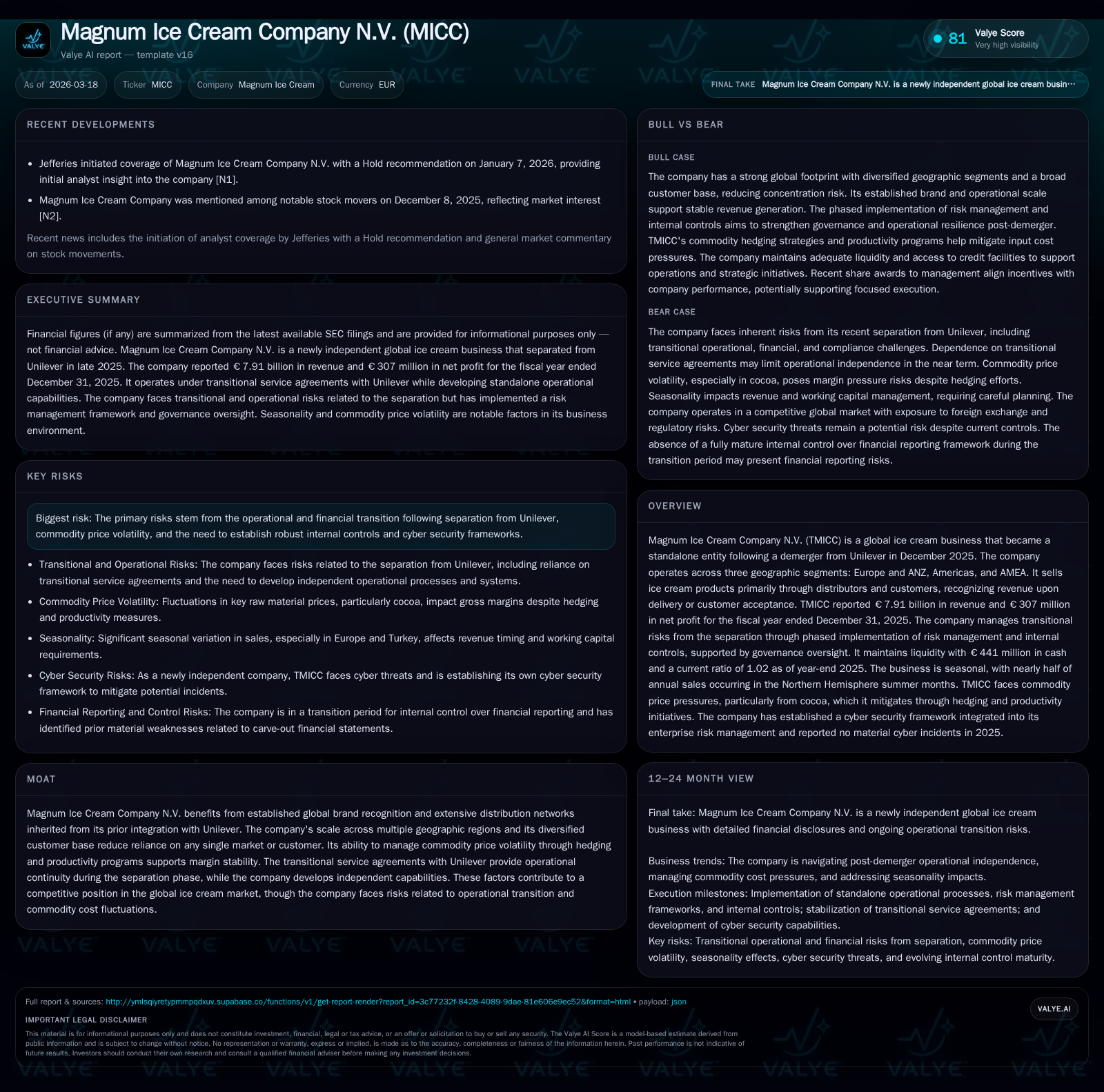
Magnum Ice Cream Company N.V. (MICC) emerged as an independent entity at the end of 2025, reporting €7.91 billion in revenue and €307 million in net profit for that fiscal year. Its operations span Europe and ANZ, the Americas, and AMEA regions, with nearly half of sales concentrated in Northern Hemisphere summers due to seasonality. The company is navigating risks related to operational separation and internal control establishment, while maintaining a solid liquidity position with €441 million cash on hand and a current ratio of 1.02. Future growth depends on managing commodity volatility, successful transition to standalone systems, and market expansion across its diversified geographic footprint.
Background and Historical Performance
Magnum Ice Cream Company N.V. (TMICC) became a standalone global ice cream operator following its spin-off from Unilever in December 2025 [S1]. The company inherited a vast international footprint with operations structured around three main geographic segments: Europe & ANZ (covering Europe, Australia, New Zealand), Americas (North and South America), and AMEA (Africa, Asia & Middle East including Türkiye) [S14][S27].
Fiscal 2025 marked TMICC's inaugural full-year as an independent entity despite only having four weeks under standalone status—revenue for the year was €7.91 billion with net income of €307 million [F1]. This performance reflects the continuing strength of long-established brands alongside resilient consumer demand.
The business is notably seasonal, with approximately half of annual sales realized during Northern Hemisphere summer months due to increased consumption patterns [S14]. Revenue recognition aligns largely with product delivery or customer acceptance — mostly distributors — which suits their channel model [S17].
Operational costs emphasize raw materials such as cocoa which significantly influenced margin pressure during 2025 alongside other commodity inflations. The company executed selective pricing actions combined with productivity initiatives which somewhat offset these cost headwinds [S15].
The below table summarizes key financial metrics for fiscal years leading to standalone reporting:
Historical performance (annual)
| FY |
|---|
| 2025 |
Source: SEC companyfacts cache [F1].
Post-Demerger Operational Transition
TMICC's transition to independence involved operating under extensive Transitional Service Agreements (TSAs) with Unilever to manage legacy shared financial and operational processes during initial separation phases [S1]. These TSAs provide stability but also introduce inherent operational risks including compliance challenges.
The company is actively implementing a phased risk management framework designed to address gaps in internal controls aligned with COSO principles and SOX expectations given its multi-listed status [S1][S16]. Management acknowledges limitations remain in absolute risk assurance as control systems mature during the stabilization phase.
Heightened cyber security risk accompanies new standalone status; TMICC evolved its own cyber framework integrating industry best practices while initially coordinating defense efforts jointly with Unilever [S15]. Formal governance policies embed cyber risk within enterprise-wide oversight.
Market Positioning and Competitive Advantages
The company's moat largely derives from well-known global ice cream brands built under Unilever stewardship plus expansive distribution capabilities spanning several continents [S14]. This wide presence dilutes reliance upon any particular geography or customer group — no individual client accounts for more than 10% of total revenue according to segment disclosures [S27].
Commodity price fluctuations constitute a persistent vulnerability given dependence on ingredients such as cocoa. TMICC employs dedicated commodity risk management teams applying hedging strategies aimed at smoothing margin impact while adjusting pricing where feasible to preserve volume trajectories [S4][S15].
Financial Health: Liquidity and Capital Structure
Liquidity metrics underline a sound short-term financial position: cash and equivalents stood at €441 million at December 31, 2025 supporting a current ratio of approximately 1.02 [F1], indicating close balance between liquid assets and near-term liabilities.
Capital expenditure levels were not explicitly disclosed but R&D outlays were moderate around the low double-digit millions range supporting innovation initiatives typical in consumer staples companies [S20].
TMICC arranged significant financing tools pre-demerger including an €8 billion Euro Medium Term Note programme alongside a €1 billion syndicated revolving credit facility—all without financial covenants but including customary administrative restrictions [S4][S6][S9]. Part of this portfolio consisted of term loan facilities for working capital purposes.
No drawings against revolving facilities were recorded at year-end reflecting prudent cash stewardship facilitated by positive operating cash flow conversion (~€483 million CFO in fiscal year) [F1][S23]. The company’s bond issuance totaled about €3 billion providing fixed-cost funding sources underpinning capital structure stability.
Shareholder equity was bolstered by share issuance concurrent with listing valued over €7.9 billion capturing premium over nominal share value indicative of market confidence at listing time [S28]. Also notable is implementation of long-term incentive plans replacing Unilever awards ensuring executive alignment with independent company performance targets [S2].
Future Growth Prospects and Key Considerations
Growth drivers for MICC hinge on leveraging global brand recognition into expanding existing markets especially via emerging AMEA operations where middle-class growth potential persists. Selective pricing strategies paired with productivity enhancements aim to counteract persistent commodity inflation pressures expected to continue influencing gross margins in near term. Successful transition away from Unilever’s operational infrastructure towards fully autonomous systems will be critical in maintaining efficient supply chains, risk mitigation efficacy, and regulatory compliance. Consumer trends towards premium indulgence products may offer incremental upside if effectively capitalized through innovation pipelines embedded within R&D spend. Environmental sustainability commitments could shape product development cycles given growing regulatory scrutiny across markets where packaging waste norms increasingly tighten. Monitoring evolving geopolitical dynamics impacting trade flows will be important considering exposure across diverse international jurisdictions.
Returns & Capital Allocation
Return on equity can be approximated using reported net income (€307 million) against shareholders’ equity derived from reported figures suggesting an ROE near ~48.5%, reflecting efficient capital utilization early post-listing although influenced by accounting impacts from separation transactions [F1]. Operating cash flow generation remains positive though below net income pointing to working capital fluctuations partly tied to timing around the demerger process itself [F1][S23]. No dividend declarations or share repurchase programs have been disclosed yet as TMICC prioritizes reinvestment into operational stabilization typical for newly listed consumer staples firms [S21][N/A].
Risks Summary
Primary uncertainties include transitional operational risks inherent in complex corporate separations such as developing full independent IT systems, stringent internal audit effectiveness maturation, escalating cybersecurity threats inherent for new standalone entities, along with ongoing commodity price volatility impacting input costs notably cocoa prices essential for ice cream production globally [S15]. Failure to timely mitigate these risks could impair financial metrics or erode customer confidence especially if supply chain disruption occurs or costs are inadequately passed through pricing structures. Additionally, regulatory challenges around marketing practices or product formulations subject regional food safety constraints may emerge requiring adaptive capability. Currency fluctuations add an overlay layer of market risk throughout international sales collection cycles although management uses market instruments per treasury policy mitigating downside exposure substantially [S4][S12].
This analysis presents a fact-based overview grounded entirely in disclosed company information without investment recommendations or speculative projections beyond cited evidence consequences.
Disclaimer: This is research-only, informational analysis and not investment advice. It may include AI-generated interpretation and general industry context. Always verify important details using primary sources.

Comments