
MultiSensor AI Advances Integrated Monitoring to Capture Recurring Revenue Growth
The company’s pivot from hardware sales to a SaaS platform underpins its strategy to scale multi-sensor predictive maintenance solutions.
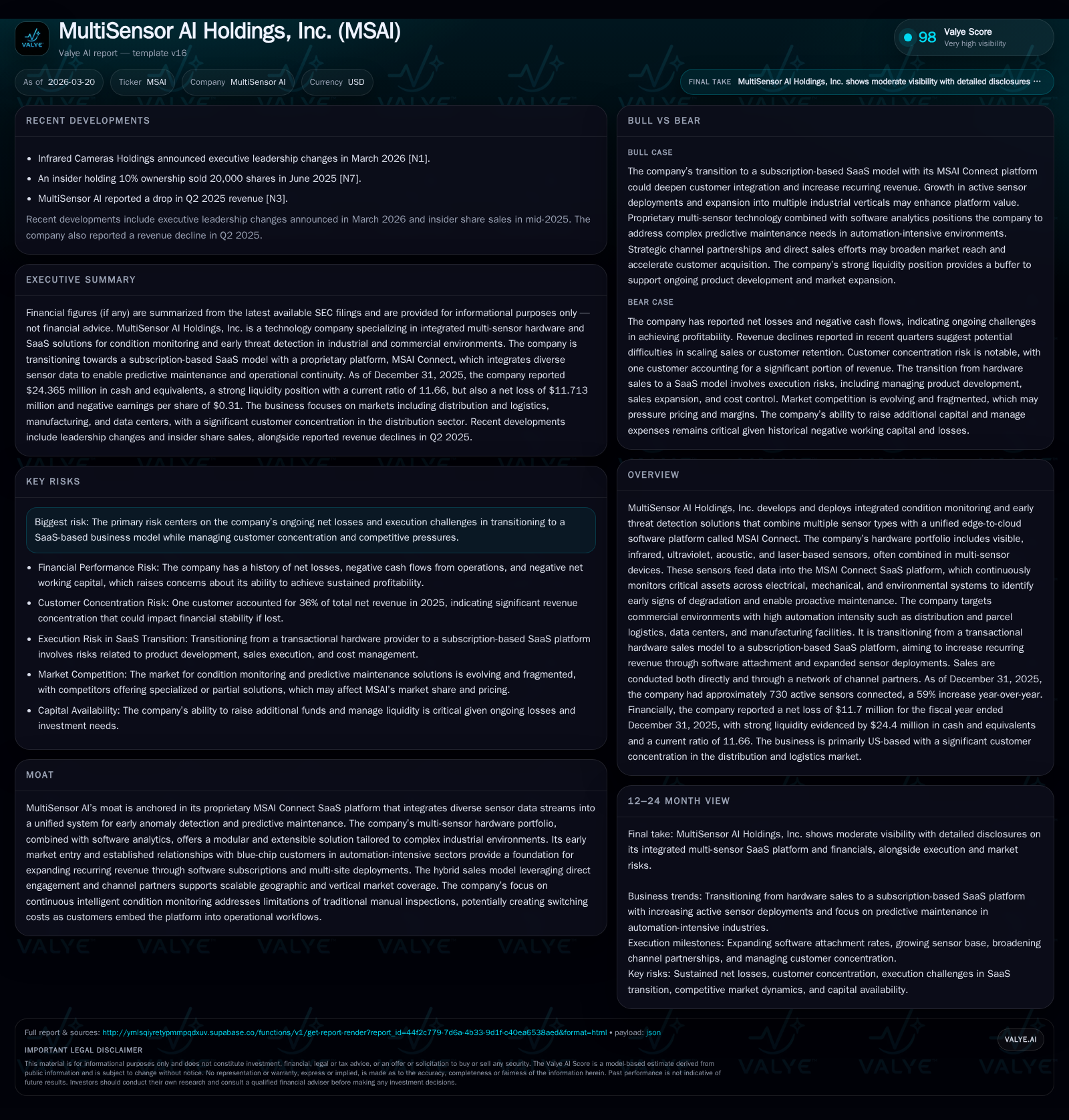
MultiSensor AI Holdings, Inc. has demonstrated steady progress in refining its financial profile despite ongoing losses as it transitions from a transactional hardware vendor to a software-centric predictive maintenance provider. The firm leverages its proprietary MSAI Connect platform to unify diverse sensor data streams, targeting automation-intensive markets such as distribution, manufacturing, and data centers. With expansion focused on increasing software attachment rates and recurring revenue, the company faces execution risks but is supported by a robust technology moat and a significant total addressable market estimated at $9 billion in 2025.
Historical Financial Performance and Key Growth Drivers
MultiSensor AI Holdings has steadily improved its operating income trajectory over recent years though it remains in the red as it undergoes an operational pivot. The company reported operating losses declining from approximately -$21.5 million in FY2023 to -$12.0 million in FY2025, an improvement of roughly 36% year-over-year between FY2024 and FY2025 [F1]. Net losses narrowed similarly from -$22.3 million in FY2023 to -$11.7 million in FY2025, equating to a roughly 45% reduction year-over-year over the same period.
Operating cash flows reflect continued negative outflows, though improving by nearly half from -$15.6 million in FY2024 to -$8.0 million in FY2025. Capital expenditures (capex) declined from $2.7 million in FY2024 to $1.6 million in FY2025, reflecting scaled-back hardware investment aligned with the strategic shift toward SaaS offerings [F1].
Historical performance (annual)
| FY | Net ($mm) | CFO ($mm) | OpInc ($mm) | Capex ($mm) | Net YoY |
|---|---|---|---|---|---|
| 2025 | -12 | -8 | -12 | 2 | +45.5% |
| 2024 | -21 | -16 | -19 | 3 | +3.5% |
| 2023 | -22 | -5 | -22 | 2 | -60510.7% |
| 2022 | 0 | -1 | -1 |
Source: SEC companyfacts cache [F1].
Capital returns and efficiency (annual)
| FY | FCF ($mm) | ROE% |
|---|---|---|
| 2025 | -10 | -36.6 |
| 2024 | -18 | -174.9 |
| 2023 | -6 | 8309.0 |
| 2022 | 30.6 |
Source: SEC companyfacts cache [F1].
The data show improving trends but sustained losses indicative of the company’s transformation phase from predominantly hardware sales toward subscription-based services anchored by continuous condition monitoring.
Strategic Business Model Transition to SaaS-Based Solutions
Central to MultiSensor AI’s strategic evolution is transitioning away from discrete hardware transactions toward recurring revenue driven by its proprietary MSAI Connect platform [S5][S10][S11]. This platform integrates multiple sensor types—including visible light cameras; infrared imagers spanning shortwave to longwave bands; ultraviolet sensors; acoustic imagers; and laser-based spectrometers—into a unified edge-to-cloud software architecture enabling continuous asset condition monitoring.
In practice, the shift involves increasing “software attachment rates” across installed hardware bases; expanding multi-site deployments; and layering advanced AI-powered analytics over time for early anomaly detection and predictive maintenance [S10][S22]. Platform features include streaming raw radiometric thermal imaging data—not just metadata—enabling scalable machine learning models trained on diverse sensor inputs deployed globally [S19].
This integration supports more prescriptive maintenance workflows replacing traditional manual inspection regimes through real-time alerts and operational intelligence embedded into enterprise systems. The company’s roadmap emphasizes modular system architecture designed for extensibility including third-party sensing modalities [S7][S12].
However, the transition bears execution risk around sales cycle modifications and customer adoption pace typical for converting legacy enterprise clients historically accustomed to capital expenditures on hardware procurement into subscription SaaS buyers [S18]. MultiSensor AI is investing heavily in product enablement teams that coordinate cross-functional efforts ensuring development aligns tightly with validated customer use cases and scalable economics [S12][S22].
Market Opportunities Across Distribution, Manufacturing, and Data Centers
MultiSensor AI targets three primary market verticals: distribution & logistics; manufacturing; and data centers—markets characterized by high automation intensity and critical uptime reliability needs [S4][S6][S20]. The company estimated the total addressable market (TAM) across these sectors at approximately $9 billion in 2025 split into $3.9 billion for distribution & logistics; $2.7 billion for manufacturing; and $2.4 billion for data centers [S4].
Distribution & Logistics: ~$3.9 billion TAM focused on conveyor anomaly detection; operational safety hotspot identification; predictive maintenance for material handling equipment within warehouses and parcel hubs [S4]. End-users traditionally span mechanical engineers to expanding operational leaders as solutions evolve.
Manufacturing: ~$2.7 billion TAM covering process control monitoring for automotive assembly lines; electrical panel health; early fire detection; battery system management especially electrified transport infrastructure [S4]. Customers increasingly prioritize quality assurance alongside safety.
Data Centers: ~$2.4 billion TAM addressing monitoring of backup generators UPS systems; liquid cooling pumps; power distribution panels critical for high-density server farms driven by AI workloads requiring uninterrupted uptime [S4][S6].
Geographically focus centers on United States plus allied regions including Canada and European Union member states along with the United Kingdom following recent strategic reprioritization that excludes more specialized heavy industries like oil & gas or metals mining due to elevated sensor customization requirements [S6][S27].
Capital Deployment and Returns Amid Profitability Challenges
Capital allocation reflects dual priorities of sustaining sensor hardware innovation while significantly investing in software platform development centered on AI/ML capabilities for predictive analytics [F1][S7][S12][S17][S18]. Total capex has shown volatility descending sharply by nearly 39% year-over-year into FY2025 at about $1.6 million coincident with broadening R&D emphasis over physical device production.
Operating cash flows remain negative at approximately -$8 million for fiscal year ending December 31st 2025 leading to a free cash flow deficit near $9.65 million after subtracting capex spending—a notable improvement but underscoring ongoing investment needs without near-term profitability prospects [F1].
At year-end FY2025 MultiSensor AI maintained a robust balance sheet evidenced by cash & equivalents totaling roughly $24 million alongside current assets of approximately $30.8 million against current liabilities near $2.6 million yielding an exceptionally strong current ratio exceeding 11—a key liquidity measure granting runway for continued expansion efforts despite sustained net losses [F1].
Return on equity remains negative (-36.6%) reflecting historical accumulated losses but improved capital structure marked by significant positive equity reading over $32 million at December year-end 2025 compared with minimal equity levels several years prior signaling enhanced shareholder capitalization [F1]. This equity rebuilding presumably from financing rounds underpins future scaling plans.
Customer Base Concentration Risks and Channel Strategy
A substantial concentration exists within MultiSensor AI’s revenue mix whereby one customer within distribution & logistics accounted for approximately 36% of total net revenue during fiscal year ended December 31st 2025—with no other customer exceeding a single-digit share indicating top-heavy exposure [S4]. While concentration brings risk related to dependency fluctuations or contract renewals it also reflects success penetrating blue-chip accounts necessary for credible platform validation.
To offset concentration risk and enhance geographic plus vertical penetration the company pursues a hybrid sales approach balancing direct account engagement—especially with strategic enterprise customers—and an expanding network of channel partners providing localized technical support and regional marketing reach [S5][S9][S11]. These channels facilitate broader deployment scale capital-efficiently without diluting core commercial focus.
Multi-site deployments remain fundamental growth vectors aiming not only at new client acquisition but also deepening existing relationships through increased software attachment rates creating higher recurring revenue per account via platform entrenchment across operational footprints [S10][S22].
Technology Differentiation and Competitive Positioning
MultiSensor AI’s moat rests on its MSAI Connect SaaS platform uniquely capable of ingesting heterogeneous sensor feeds at scale—including thermal radiometric imaging delivering quantitative temperature mapping—enabling advanced AI-driven prognostic algorithms that transcend traditional manual or handheld inspection inefficiencies prevalent within targeted industries [S15].
The multilayered solution incorporates edge computing nodes collecting real-time sensor data federated into cloud repositories facilitating centralized monitoring dashboards offering live anomaly detection alerts across geographically dispersed facilities—a functionality rarely replicated at comparable granularity or integration depth by competitors who often rely on either standalone devices or fragmented integrator ecosystems lacking expansive SaaS capabilities [S15].
The company continues evolving its sensor portfolio prioritizing sensitivity enhancements coupled with cost-efficient modularity designed for scalable roll-outs supporting diverse use cases—from conveyor systems thermal hotspots to UPS battery state diagnostics—anchored by proprietary software enabling unified condition intelligence driving customer operational resilience improvements [S7][S12].
Key Execution Risks and Future Growth Indicators
While MultiSensor AI shows promising technological differentiation aided by early market penetration among automation-intensive enterprises the path forward involves pronounced execution risk primarily emanating from sustained negative earnings driven by the complex transition towards integrated SaaS business operations requiring comprehensive commercial model recalibration alongside expanded product roadmap investments [N1][F1].[N1]
Customer concentration poses potential revenue vulnerability should key accounts curtail deployment scaling or seek alternative platforms amid intensifying competition including established large-scale infrared device manufacturers or nascent cloud-enabled entrants targeting niche reliability applications particularly within fast-evolving data center segments [N1][F1].[N1]
Growth indicators warranting attention include acceleration of subscription revenue contribution percentages relative to legacy hardware sales; expansion velocity of multi-site installations confirming platform stickiness; continual gross margin improvement evidencing operating leverage realization; plus successful channel partner network enlargements targeting prioritized geographies featuring United States plus major European markets following recent strategic focus pivots [F1][N1].[N1]
Disclaimer: This is research-only, informational analysis and not investment advice. It may include AI-generated interpretation and general industry context. Always verify important details using primary sources.

Comments