
Neonode Inc.'s Shift to Licensing: Financial Recovery and Market Focus for 2025
Neonode's strategic transition from product sales to pure technology licensing catalyzed a significant rebound in financial performance while highlighting customer and market concentration risks.
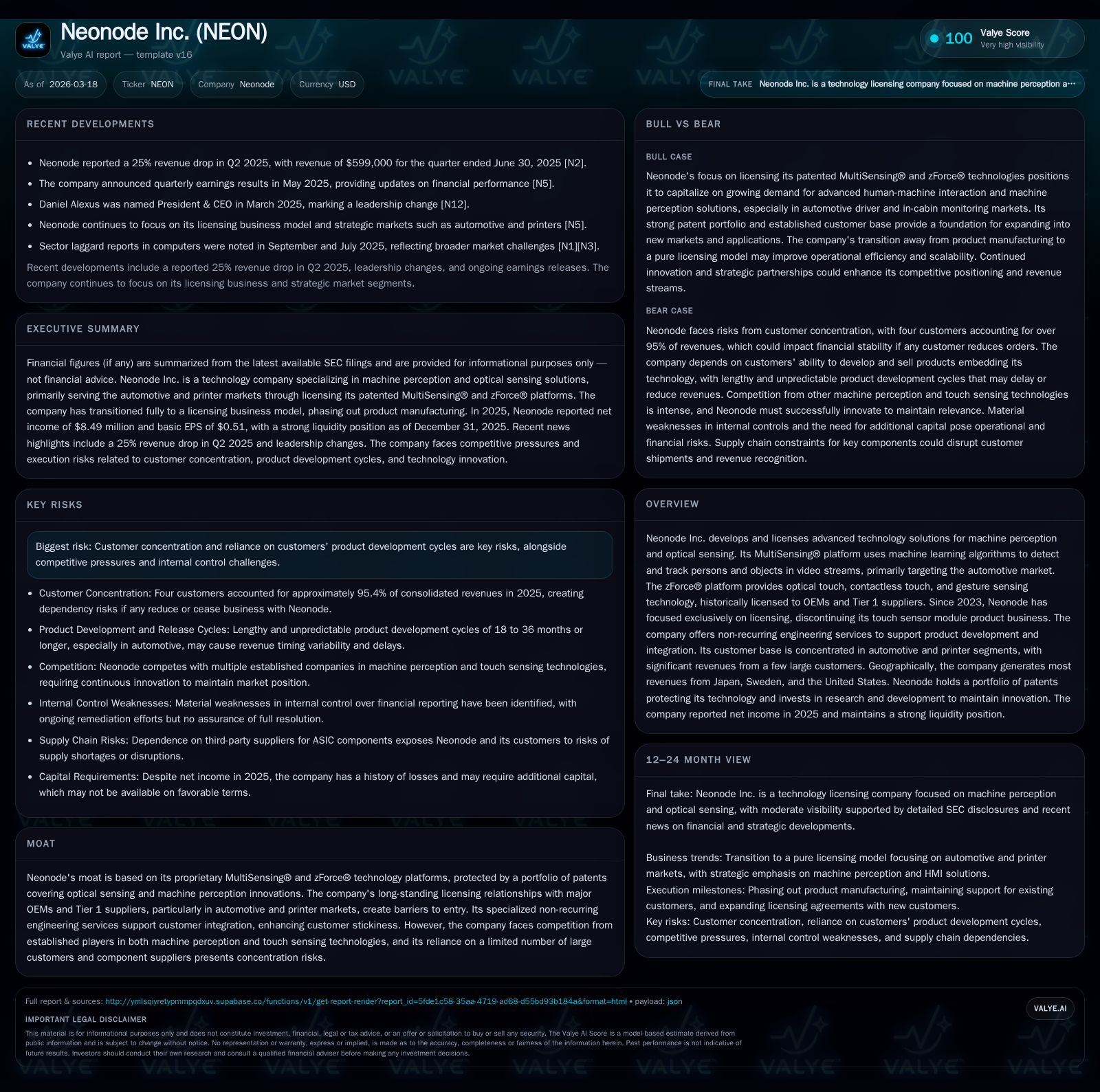
After years of losses, Neonode Inc. recorded a substantial net income turnaround in 2025 driven by a strategic pivot to licensing its optical sensing and machine perception technologies. The company phased out its touch sensor module product business by the end of 2024, aligning its portfolio around patent-protected MultiSensing® solutions primarily targeting automotive OEMs and Tier 1 suppliers. Despite impressive profitability gains, Neonode’s revenue base remains highly concentrated among a handful of customers predominantly from Japan, Sweden, and the U.S., underscoring ongoing execution risks tied to product cycles. Operating cash flow challenges persist amid low capital expenditures and minimal share repurchases, as the company invests in its platform transformation and non-recurring engineering services that support deep integration with select customers.
Historic Revenue Trends: The Decline of Product Sales and Transition Impact
Between fiscal years 2021 and 2024, Neonode's revenues declined from approximately $5.84 million to about $3.11 million [F1], reflecting the phase-out of its touch sensor module (TSM) product business announced in December 2023 and executed through 2024 via licensing the TSM technology to strategic partners alongside selling remaining inventory [S6]. This strategic shift refocused Neonode’s commercial model toward recurring licensing fees driven by customer shipments embedding patented technologies rather than hardware sales.
Unpacking the 2025 Financial Turnaround: Profitability Amid Licensing Focus
Fiscal year 2025 marked a financial inflection point with Neonode reporting net income of $8.49 million after losses exceeding $6 million in 2024 [F1]. This turnaround was supported by gains related to patent assignments alongside improved licensing revenue from MultiSensing® machine perception technologies and residual zForce® royalties [S1]. Operating income rose sharply to $7.37 million from a negative $6.55 million in the prior year—a more than 212% increase year-over-year [F1]. Despite these accrual-based profitability gains, operating cash flow remained negative at about -$10.25 million in 2025, pointing to timing differences in cash realization inherent in licensing models and ongoing investments in business transformation [F1].
Historical performance (annual)
| FY | Rev ($mm) | Net ($mm) | CFO ($mm) | OpInc ($mm) | Rev YoY | Net YoY |
|---|---|---|---|---|---|---|
| 2025 | 8 | -10 | 7 | +231.3% | ||
| 2024 | 3 | -6 | -6 | -7 | -30.1% | +36.1% |
| 2023 | 4 | -10 | -6 | -11 | -21.5% | -107.3% |
| 2022 | 6 | -5 | -7 | -5 | -2.8% |
Source: SEC companyfacts cache [F1].
Capital returns and efficiency (annual)
| FY | Buybacks ($) | FCF ($mm) | ROE% |
|---|---|---|---|
| 2025 | -10 | 34.4 | |
| 2024 | -6 | -39.3 | |
| 2023 | 12000 | -6 | -59.0 |
| 2022 | 12000 | -25.1 |
Source: SEC companyfacts cache [F1].
Customer Concentration Risks and Geographic Revenue Dynamics
Revenue concentration is pronounced with four customers accounting for approximately 95.4% of consolidated net revenues in calendar year 2025—up from about 80.9% in the prior year [S4][S5]. Key customers include Seiko Epson (34.3%), Alps Alpine (19.4%), Hewlett-Packard (19%), and a Commercial Vehicle OEM (14.6%) [S4]. This concentration exposes Neonode to risks associated with individual client purchasing patterns and long development cycles typically spanning between 18-36 months for automotive systems [S17].
Geographically, Japan contributed roughly 62% of total revenues followed by Sweden at 14.5% and the United States at approximately 20.6% [S5]. This regional distribution aligns with major OEMs' headquarters but also introduces currency exposure risks given expenses primarily denominated in Swedish Krona without active hedging strategies [S14].
Technological Foundations: MultiSensing® Growth Focus Versus zForce® Maintenance Mode
Neonode’s two core platforms include zForce®, an optical touch/contactless/gesture sensing solution licensed since at least 2010 primarily supporting legacy markets such as office equipment and industrial automation; and MultiSensing®, a newer machine perception platform employing advanced machine learning aimed mainly at automotive driver monitoring applications [S6][S7][S9].
Following a strategic review culminating in September 2025, Neonode transitioned zForce® into maintenance mode ceasing new sales but continuing support for existing customers [S6]. Meanwhile, MultiSensing® has become the principal growth driver targeting automotive domains like occupant monitoring for advanced driver-assistance systems (ADAS), where embedded AI solutions are gaining regulatory momentum [S9][S16].
Capital Allocation: Conservative Investments Amid Operating Cash Flow Deficits
Despite strong net income yielding an approximate return on equity near 34.4% based on reported equity of $24.69 million at end-2025 [F1], Neonode continues to face operating cash flow deficits around -$10.25 million due to timing differences between earnings recognition and cash collections alongside investment needs [F1]. Capital expenditures remain modest at roughly $91k consistent with a software-focused licensing model while share repurchases have been minimal historically ($12k last reported) with no dividends paid during recent years [F1][S22]. This cautious allocation underscores management's focus on preserving liquidity amid ongoing operational transformation.
Non-Recurring Engineering Services: Enhancing Customer Integration
To complement its licensing business model, Neonode offers non-recurring engineering (NRE) services that provide application development support during integration phases on flat or hourly fee bases [S7]. These services strengthen client relationships by ensuring optimal functionality of embedded components within customer products—a critical factor given complex system requirements especially in automotive infotainment sectors.
Outlook: Growth Opportunities Balanced Against Execution Risks
Neonode’s future growth depends on expanding penetration within automotive machine perception markets driven by regulatory safety mandates as well as exploring emerging verticals such as automated retail self-checkout systems exhibiting early market interest [S4][S9]. Nonetheless, long OEM design-to-production cycles coupled with high customer concentration present persistent risks impacting revenue visibility and timing.
The company also faces competitive pressures from established capacitive touch providers and alternative machine perception technologies including radar and ultrasonic sensors offered by peers like SmartEye or Seeing Machines [S16]. Intellectual property enforcement remains integral to safeguarding competitive advantage globally amidst varying jurisdictional protections [S12][S15][S18].
This analysis synthesizes publicly available SEC filings without offering investment advice but aims to illuminate Neonode’s operational pivot towards a leaner pure-licensing model underpinning its financial recovery alongside structural risks inherent in concentrated technology IP businesses serving automotive OEM supply chains.
Disclaimer: This is research-only, informational analysis and not investment advice. It may include AI-generated interpretation and general industry context. Always verify important details using primary sources.

Comments