
NPK International Q2 2026: Rental Fleet Growth and Stable Liquidity Amid Cyclical Demand
NPK International expanded its rental fleet and maintained a stable liquidity position in Q2 2026, supporting its core composite mat rental business amid ongoing cyclical risks.
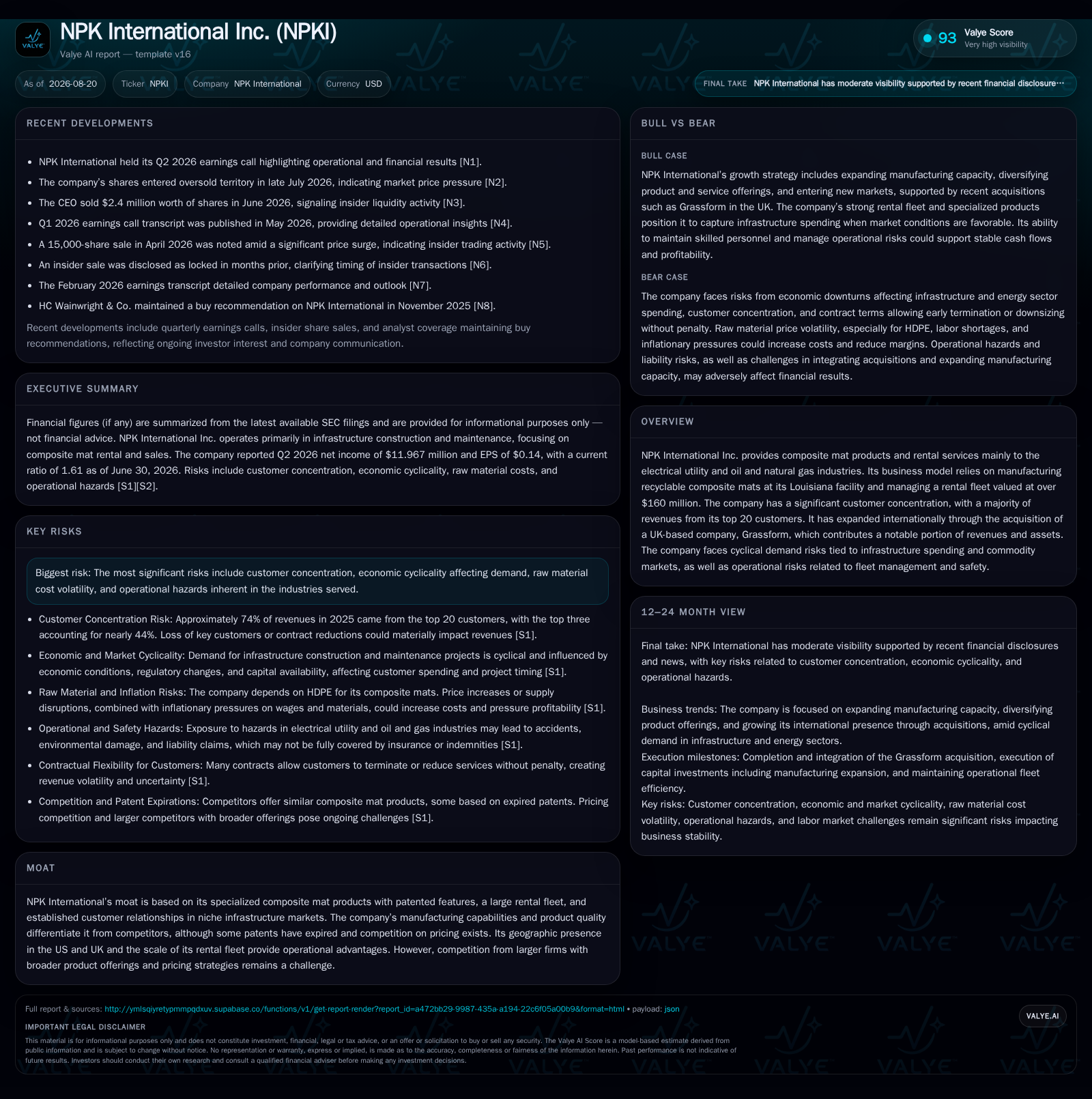
In Q2 2026, NPK International increased the size of its rental fleet, enhancing its capacity to generate revenue in infrastructure-related markets. The company reported a current ratio of 1.61 as of June 30, 2026, reflecting a stable liquidity position that supports operational continuity and fleet investment. Despite these positives, NPK faces significant risks from high customer concentration and cyclical demand tied to infrastructure spending and commodity markets. Its recent international expansion through the UK-based Grassform acquisition adds geographic diversification to its revenue and asset base.
Q2 2026 Operating Update and Rental Fleet Expansion
NPK International reported an expansion of its rental fleet during the second quarter of 2026, increasing its operational asset base [S2]. In the industrial products manufacturing and rental sector, rental fleet size is generally considered an important factor for potential revenue generation capacity, as it reflects the volume of assets available for customer projects in infrastructure construction and maintenance. If the expanded rental fleet is effectively utilized, it could enable NPK International to serve a larger number of projects or higher-volume contracts, which may support top-line growth potential. This expansion could also influence the company's competitive positioning in its niche markets, where fleet availability and utilization rates are relevant performance indicators.
Liquidity and Balance Sheet Position
As of June 30, 2026, NPK International maintained a current ratio of 1.61, reflecting a stable liquidity position with current assets of approximately $85.0 million against current liabilities of about $52.7 million [F1]. The company held $8.35 million in cash and equivalents, alongside total debt of $10.57 million, resulting in a net debt position near $2.2 million [F1]. This moderate leverage and sufficient working capital support operational resilience during the cyclical risks inherent to NPK's end markets. Adequate liquidity enables the company to fund ongoing fleet investments and absorb potential fluctuations in cash flow caused by demand variability. In this capital-intensive industry, maintaining a balance between fleet expansion and financial flexibility is essential to sustain growth and navigate downturns.
Customer Concentration and Cyclical Demand Risks
NPK International's revenue base is significantly concentrated, with the majority of its revenues generated from its top 20 customers, primarily operating in the electrical utility, oil and natural gas, and infrastructure construction industries [S1]. High customer concentration increases the risk of revenue volatility if key customers reduce their spending or delay projects. This risk is compounded by the cyclical nature of demand tied to infrastructure spending and commodity market conditions. Infrastructure construction and maintenance projects historically experience fluctuations due to economic recessions, regulatory challenges, material and labor shortages, and commodity price volatility, all of which can affect customer capital expenditures and project timing [S1]. Similarly, spending by oil and natural gas customers depends on factors such as hydrocarbon demand expectations and energy price volatility. These cyclical dynamics can materially impact NPK's revenue and profitability, making it crucial for the company to manage customer relationships and diversify its revenue sources where possible.
International Expansion and Competitive Positioning
In addition to domestic operations, NPK International expanded internationally through its acquisition of UK-based Grassform, which contributes to its revenue and asset base [S1]. Geographic diversification through such acquisitions can help mitigate some of the cyclicality associated with domestic infrastructure markets by providing exposure to different regional economic conditions and project pipelines. NPK's business model combines manufacturing of patented recyclable composite mats with rental services, leveraging its manufacturing facility in Carencro, Louisiana, and its rental fleet to serve infrastructure and energy sector customers [S1]. While the company benefits from patented products and a growing fleet, it faces competitive constraints from patent expirations and pricing pressures, underscoring the importance of operational efficiency and fleet management.
Business Economics and Implications
The rental fleet expansion enhances NPK International's revenue-generating capacity by increasing the volume of assets available for rental contracts, a primary revenue driver in this sector. Fleet size and utilization rates directly influence operating leverage, as fixed costs associated with fleet maintenance and safety compliance are spread over a larger revenue base when utilization is high. Stable liquidity, demonstrated by a current ratio of 1.61 and net debt of approximately $2.215 million as of June 30, 2026 [F1], supports the company's ability to invest in fleet growth and absorb cyclical demand fluctuations without immediate financial strain. However, the high customer concentration and exposure to cyclical infrastructure and commodity markets remain significant risk factors. A downturn in these sectors could lead to underutilization of the expanded fleet, margin pressure, and liquidity stress.
Watchpoints for Investors
Key indicators to monitor in upcoming quarters include rental fleet utilization rates and announcements of further fleet expansions, which will signal demand trends and operational efficiency. Liquidity and leverage metrics in subsequent filings will reveal the company's financial flexibility to sustain growth or weather downturns. While the fleet growth enhances competitive positioning, the company's significant customer concentration and exposure to economic cyclicality remain key risks. The international expansion through the Grassform acquisition adds geographic diversification, potentially mitigating some domestic cyclicality. Continued monitoring of fleet utilization, customer contracts, liquidity, and sector demand will be essential to evaluate NPK's near-term performance and growth prospects.
Disclaimer: This is research-only, informational analysis and not investment advice. It may include AI-generated interpretation and general industry context. Always verify important details using primary sources.

Comments