
Newbury Street II Advances Toward Business Combination with Fort Robotics PIPE Financing
Newbury Street II Acquisition Corp executed a Merger Agreement with Fort Robotics and secured a $31.25 million PIPE investment, marking significant progress toward its Business Combination.
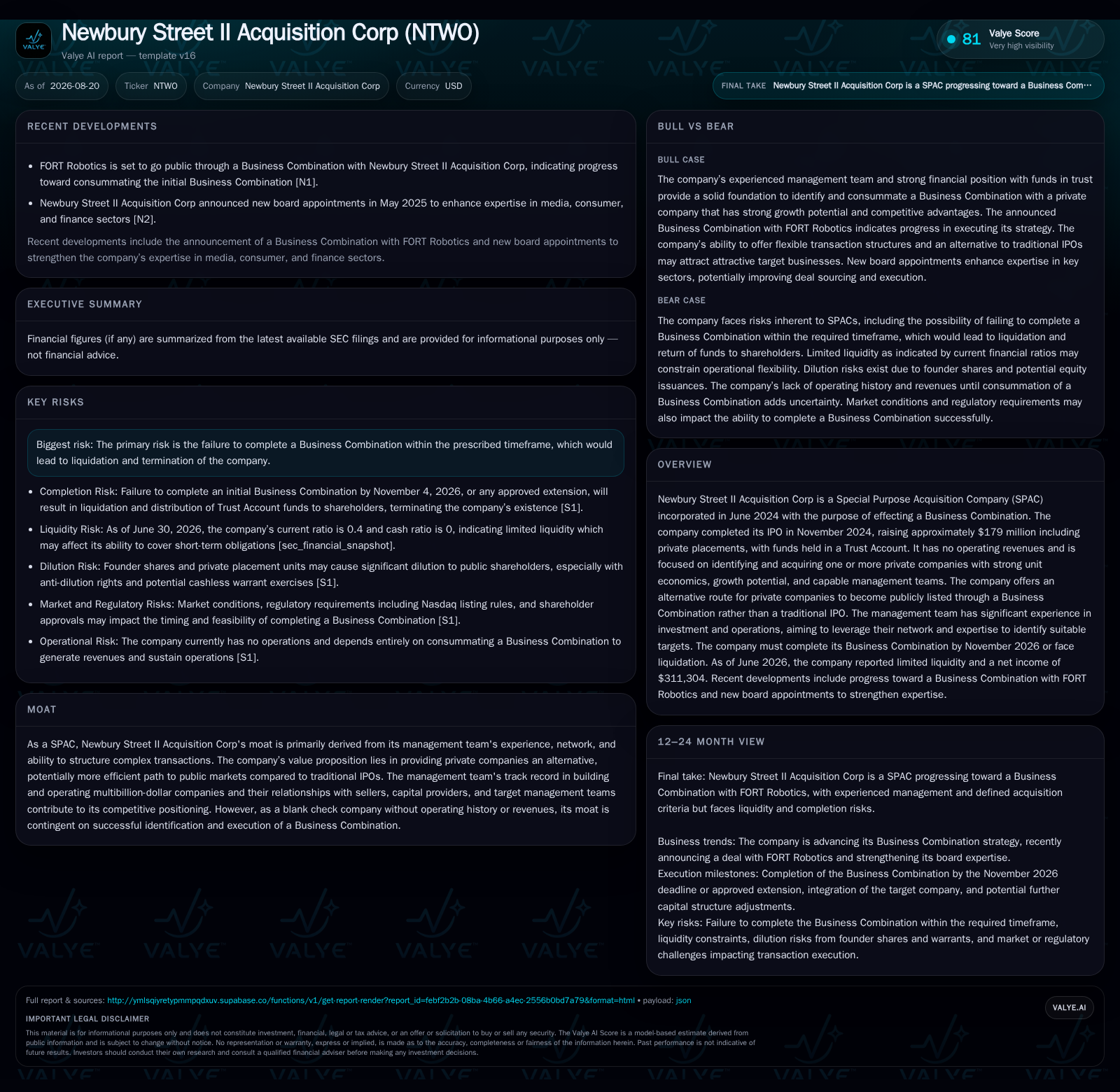
Newbury Street II Acquisition Corp, a SPAC with no operating revenues, has taken a critical step toward completing its initial Business Combination by executing a Merger Agreement with Fort Robotics in August 2026. Concurrently, the company secured a $31.25 million PIPE investment from initial investors to finance the transaction. Despite constrained liquidity reflected by a current ratio of 0.4 as of June 30, 2026, these developments materially advance Newbury Street II’s transition from a blank check company to an operating public entity ahead of its November 2026 deadline. Additional financing arrangements during the interim period remain possible, subject to mutual consent with Fort Robotics.
Recent Business Combination Progress
In August 2026, Newbury Street II Acquisition Corp took a significant step toward completing its initial Business Combination by executing a Merger Agreement with Fort Robotics [S3]. Simultaneously, the company entered into PIPE Subscription Agreements with initial PIPE investors to issue 3,125,000 shares at $10.00 per share, raising $31.25 million in private placement proceeds. This PIPE financing is a critical component of the transaction financing package that supports the Business Combination, providing necessary capital to consummate the deal and fund post-merger operations.
Alongside these agreements, Newbury Street II amended its Insider Letter Agreement with its Sponsor, Fort Robotics, and directors/officers, reflecting alignment among key stakeholders as the transaction advances. The company also retains the option to secure additional transaction financing during the interim period before closing. Such additional financing could take various forms, including private placements of equity or convertible securities, but would require Fort Robotics’ prior consent and mutually agreeable terms [S3].
Liquidity and Financial Position
Newbury Street II has no operating revenues and remains a blank check company pending the completion of its Business Combination with Fort Robotics. Revenue generation and operating results will depend entirely on the acquired company post-merger [S2][S1]
SPAC Business Model and Risks
As a Special Purpose Acquisition Company (SPAC), Newbury Street II raised capital through an initial public offering by selling units consisting of shares and warrants. These proceeds are held in a Trust Account until the company completes a Business Combination, which is the process of merging with a private operating company to become a publicly traded operating entity. Until such a combination is consummated, the SPAC has no operating revenues or business activities [S1].
The company must complete its Business Combination by November 4, 2026, or it will be required to liquidate and return funds to shareholders [S1]. This deadline creates a structural time constraint common to SPACs, making the execution of the Merger Agreement and securing PIPE financing essential milestones to avoid liquidation.
Risks to completing the Business Combination include potential delays in regulatory or shareholder approvals, inability to secure sufficient financing, or adverse developments in Fort Robotics’ business or valuation. Failure to complete the transaction on time would lead to liquidation, returning capital to investors but ending the SPAC’s growth opportunity [S1][S3][F1].
Scenario Analysis and Investor Implications
One plausible scenario is that Newbury Street II successfully completes the Business Combination with Fort Robotics by the November 2026 deadline, supported by the $31.25 million PIPE investment and any additional transaction financing secured during the interim period. This outcome would transition Newbury Street II from a blank check company to an operating public entity, unlocking value for investors who participated in the IPO and PIPE [S3][S1]. Confirmation of this scenario would include the filing of definitive proxy or tender offer materials, receipt of necessary regulatory and shareholder approvals, and the closing of the Business Combination.
Conversely, the bear case involves failure to complete the Business Combination by the deadline due to liquidity constraints, inability to secure additional financing, or regulatory and shareholder obstacles [F1][S3]. This would result in liquidation and return of funds to shareholders, ending the company’s public market prospects. Evidence supporting this scenario would include announcements of deal termination, failure to file or complete proxy materials, or disclosures of a liquidation plan.
Conclusion
The execution of the Merger Agreement with Fort Robotics and the concurrent $31.25 million PIPE investment materially de-risk Newbury Street II’s path to completing its Business Combination [S3]. These contractual and financing commitments provide both the legal framework and capital necessary to consummate the transaction, which is the primary value driver for the SPAC’s investors.
However, the company’s constrained liquidity position as of June 30, 2026, with a current ratio of 0.4, highlights the critical importance of the PIPE and potential additional financing to fund transaction-related expenses and post-merger operations [F1][S3]. Without these financing sources, Newbury Street II lacks sufficient resources to cover near-term obligations.
Investors should monitor upcoming filings for proxy or tender offer materials, announcements of closing or additional financing, and regulatory or shareholder developments that could affect the transaction timeline. These indicators will provide clarity on whether Newbury Street II will successfully complete its Business Combination and transition into an operating public company before the November 2026 deadline.
Disclaimer: This is research-only, informational analysis and not investment advice. It may include AI-generated interpretation and general industry context. Always verify important details using primary sources.

Comments