
Once Upon a Farm: Tracking Early Public Offering Momentum and Growth Expectations
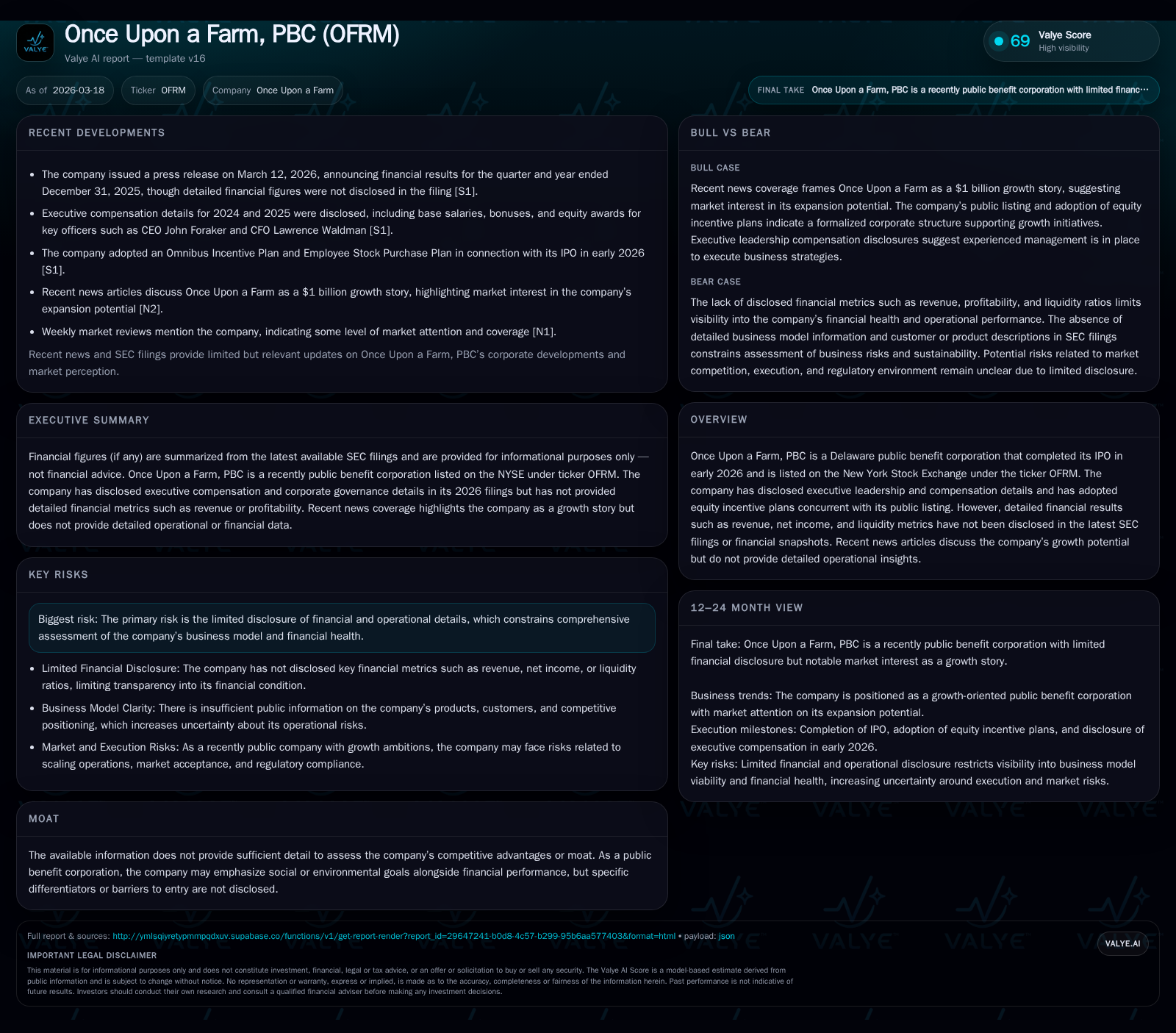
The report evaluates Once Upon a Farm, PBC's transition to public status in early 2026, emphasizing limited financial disclosures against optimistic market narratives and evolving capital strategies.
Once Upon a Farm, PBC entered the public markets via its IPO in February 2026, marking a significant milestone as a Delaware public benefit corporation. Despite this transition, detailed financial data including revenue and profitability remain undisclosed, complicating conventional assessments. Market commentary suggests optimism around the company’s growth potential, framed as a compelling 'billion-dollar growth story,' but transparent guidance and milestones are yet to be communicated. Capital allocation decisions so far include equity incentive plans and indemnification agreements congruent with its emerging growth status, while shareholder return policies like dividends or buybacks have not been announced.
Early Growth Trajectory and IPO Timing
Once Upon a Farm, PBC marked its entry into the public capital markets by completing an initial public offering (IPO) in early February 2026. The transaction involved the sale of approximately 7.63 million shares from the company and 3.37 million shares from selling stockholders at an offering price of $18 per share, with an additional underwriter option allowing for nearly 1.65 million shares exercisable within a month after closing. The underwriters Goldman Sachs & Co. LLC and J.P Morgan Securities LLC led the offering, which was registered under SEC File No. 333-290577 [S14].
Despite achieving this liquidity event—a pivotal step for scaling operations—the company has thus far refrained from disclosing detailed historical periods of revenues or profitability in its required SEC filings and XBRL data sets [F1], [S1]. This opacity constrains traditional ways to chronicle its pre-IPO growth trajectory explicitly.
Current Financial Visibility: What We Know and What Remains Hidden
The current state of financial disclosure offers only broad strokes. A press release accompanying March 12, 2026's Form 8-K filing reported year-end 2025 results but withheld granular numeric details such as total revenue figures, net income, operating cash flow levels, or liquidity ratios that are customary for investor scrutiny [S3].
Further adding to opacity are missing primary metric breakdowns regarding segment contributions or geographic revenue mix typically found in annual reports [S5]. Consequently, the absence of comparable historic fiscal data precludes traditional financial ratio analyses or trend assessments.
Market commentators acknowledge this scarcity of quantitative visibility while highlighting optimistic narratives about the company's prospects in niche consumer health-conscious food products, particularly within organic and fresh offerings that intersect evolving consumer packaged goods dynamics [N2]. However, such perspectives remain unsubstantiated by independently verifiable operational performance data.
Growth Catalysts and Market Potential According to Recent Analyst Views
A February 10 Nasdaq article characterizes Once Upon a Farm as part of an emergent 'billion-dollar growth story,' underscoring expanding demand in health-focused fresh foods leveraging sustainable production methods—attributes resonant with the company's public benefit corporate identity [N2]. This designation positions OFRM at an intersection where growth arises from increasing consumer prioritization of nutrition quality alongside environmental stewardship.
This thematic framing implies future expansion vectors may hinge on scaling retail distribution channels in key regions alongside enhancing product innovation pipelines consistent with consumer packaged goods lifecycle phases. Nonetheless, specific market penetration rates or competitive positioning vis-à-vis established players are yet unrevealed.
Assessing Strategic Risks from Risk Factors and Regulatory Disclosures
The company’s formal risk disclosures contained in its March 2026 Form 10-K enumerate expected vulnerabilities relevant to emerging public companies including regulatory compliance burdens pertinent to food safety standards, intellectual property challenges, competitive intensity, and potential litigation exposure that might emerge as brand awareness grows [S4], [S6].
Also noted are risks associated with governance as a public benefit corporation that may impose constraints on corporate decision-making prioritizing stakeholder interests beyond shareholder returns. The absence of detailed financial information further accentuates the challenge in fully evaluating these risks’ magnitude.
Capital Allocation Policies: IPO Proceeds, Shareholder Returns, and Incentive Plans
Following its IPO completion on February 9, 2026, OFRM implemented comprehensive equity-based incentive frameworks underpinning executive and employee alignment with long-term corporate goals. These include the Once Upon a Farm, PBC 2026 Omnibus Incentive Plan effective February 5th and an Employee Stock Purchase Plan commencing deliveries on February 9th—measures standard among emerging growth companies to attract retention through equity participation [S10], [S13].
No publicly announced policies for dividends or share repurchase initiatives exist at this stage; reported filings confirm no cash returns to shareholders via these routes have occurred post-IPO nor are planned imminently given likely reinvestment priorities amid uncertain free cash flow generation capacity [S7], [S8], [S9].
Executive compensation disclosed reveals base salaries supplemented by performance-based bonuses (calculated early 2026 for fiscal year 2025) plus substantial stock option awards accorded during the IPO period—a structure aligning management incentives closely with anticipated value creation from growth execution phases [S15], [S16].
Critical Operational Milestones to Monitor Moving Forward
Absent explicit forward guidance from management, attention converges on routine quarterly reporting cycles as touchstones for financial transparency advancement—particularly the first quarter report due after March 31, 2026—as well as operational updates signifying retail footprint expansion plans or production capacity undertakings noted in preliminary market discussions yet lacking firm announcement timelines [N2], [S3].
Regulatory developments influencing certification statuses or compliance bodies governing organic food production also warrant monitoring given their potential material effect on product availability and reputational capital.
Valuation Insights Amid an Emerging Growth Company Framework
From a valuation standpoint, OFRM fits squarely into emerging growth company paradigms underscored by nascent financial transparency balanced against investor appetite for socially responsible investment opportunities blending growth aspirations with public benefit mandates. This duality typically commands risk premiums reflecting both uncertainty around scale economics realization alongside premium pricing driven by ESG-aligned brand narratives.
Without disclosed EBITDA margins or free cash flow trajectories available at present, valuation models rely heavily on qualitative factors including management credibility—augmented by recently adopted governance mechanisms such as indemnification agreements protecting directors/executives—and market sentiment driven by analyst coverage touting long-term potential despite current informational gaps [S10], [S14].
| Fiscal Year | Revenue | Net Income | Operating Cash Flow | Capital Expenditures |
|---|---|---|---|---|
| 2025 | - | - | - | - |
Note: Revenue, net income, operating cash flow (CFO), and capital expenditures (Capex) for FY2025 were not disclosed as of latest filings thereby omitted from table; consistent with limited disclosure limitations documented above.
In summary, Once Upon a Farm’s successful IPO marks a foundational step towards scaling within health-conscious consumer niches underpinned by social impact considerations inherent to its Public Benefit Corporation status. However, restricted disclosure complicates traditional fundamental analyses making forthcoming operational updates crucial for deeper insight into growth execution efficacy. Investors should track evolving disclosure practices alongside milestone achievements throughout fiscal year 2026 to better ascertain trajectory sustainability within competitive retail landscapes.
Disclaimer: This analysis is based solely on information publicly available as of March 18, 2026. It avoids speculative extrapolations beyond documented facts to maintain objective assessment integrity consistent with buy-side research standards.
Disclaimer: This is research-only, informational analysis and not investment advice. It may include AI-generated interpretation and general industry context. Always verify important details using primary sources.

Comments