
Onfolio Holdings Q2 2026: Continued Operating Losses and Severe Liquidity Constraints Amid Nasdaq Compliance Risks
Onfolio Holdings reported $1.5 million in Q2 2026 revenues alongside a $4.5 million net loss, facing critical liquidity shortages and Nasdaq listing compliance challenges.
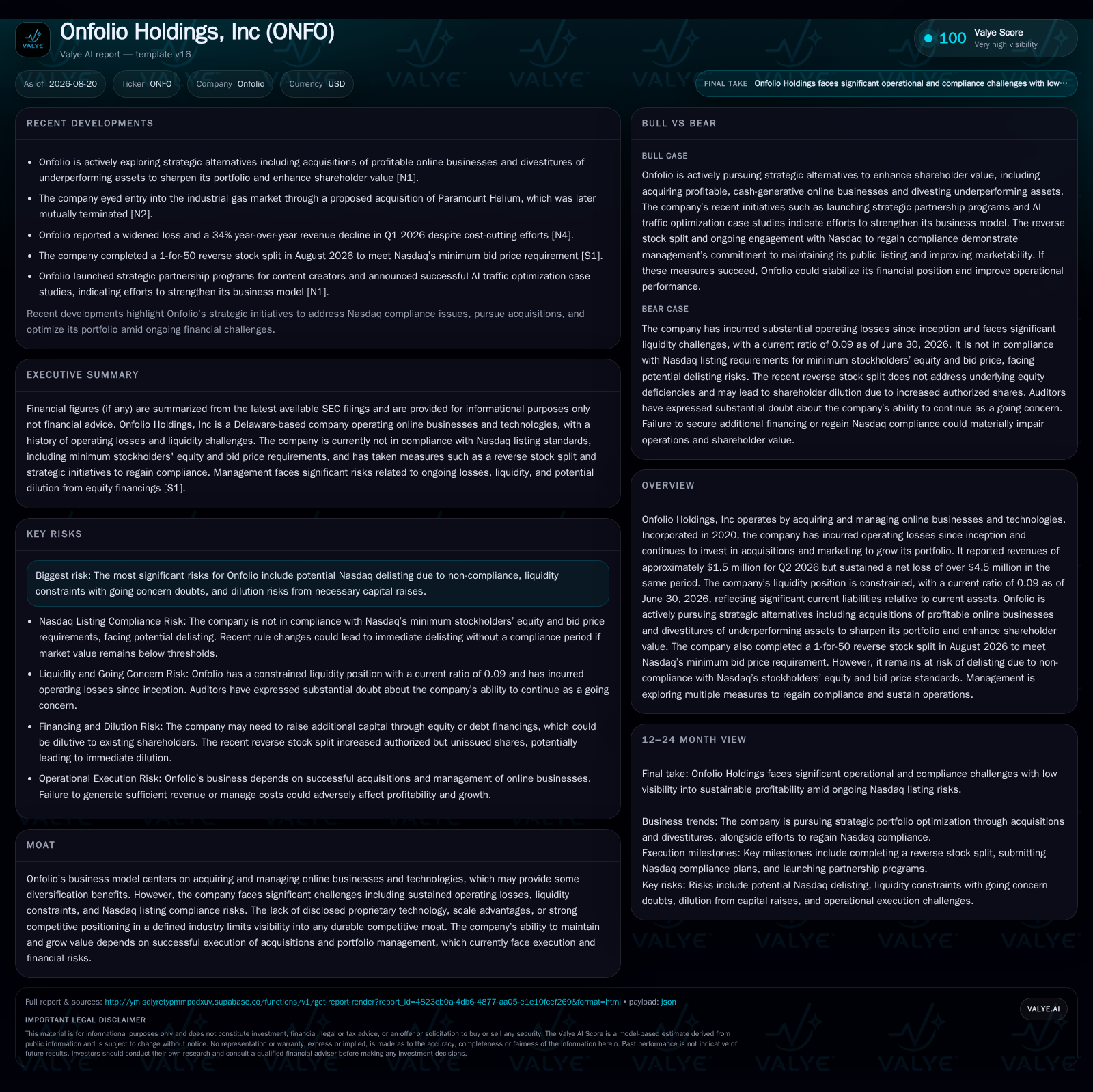
In Q2 2026, Onfolio Holdings generated approximately $1.5 million in revenue but sustained a net loss exceeding $4.5 million, underscoring ongoing operational difficulties. The company’s liquidity position remains severely constrained, with a current ratio of 0.09 as of June 30, 2026, indicating a substantial working capital deficit that raises significant risks to its Nasdaq listing status. To address these challenges, Onfolio is pursuing strategic alternatives including acquisitions of profitable online businesses and divestitures of underperforming assets, although execution and financing risks persist.
Q2 2026 Operating and Financial Results
Onfolio Holdings reported approximately $1.5 million in revenue for the quarter ended June 30, 2026, generated from its portfolio of acquired online businesses [S2]. Despite this revenue, the company incurred a net loss exceeding $4.5 million during the same period, reflecting ongoing operating challenges and negative margins [S2]. The financial snapshot as of June 30, 2026, reveals a severe liquidity constraint, with current assets totaling $866,012 against current liabilities of $9,602,792, resulting in a critically low current ratio of 0.09 [F1]. This working capital deficit signals substantial short-term financial stress, undermining operational sustainability and raising concerns about the company’s ability to meet near-term obligations.
The negative operating cash flow implied by sustained losses and the working capital gap suggests that Onfolio is currently unable to self-fund its operations or acquisitions without external financing [S2]. In the online business acquisition sector, maintaining sufficient liquidity is essential to support ongoing portfolio management, integration activities, and growth through acquisitions. Onfolio’s current financial profile indicates structural challenges in achieving profitability and cash flow breakeven.
This imbalance restricts Onfolio’s operational flexibility and increases its dependence on external capital sources to fund ongoing operations and strategic initiatives.
Nasdaq Listing Compliance and Regulatory Risks
Onfolio is currently not in compliance with Nasdaq’s minimum stockholders’ equity and minimum bid price requirements. In May 2026, the company received a notice from Nasdaq citing non-compliance with the minimum stockholders’ equity rule, which mandates at least $2.5 million in equity [S2]. Subsequently, in July 2026, Nasdaq notified the company of failure to meet the minimum bid price requirement, as its common stock traded below $1.00 per share for 30 consecutive business days [S2].
To address the bid price deficiency, Onfolio completed a 1-for-50 reverse stock split in August 2026, aiming to elevate its share price above Nasdaq’s threshold [S2]. While this action is a standard remedial step, the company must sustain compliance by maintaining the adjusted share price for at least ten consecutive business days by the December 29, 2026 deadline [S2]. Nasdaq’s recent rule changes, including provisions for immediate delisting without a compliance period if market value remains below $5 million for 30 consecutive days, add urgency to Onfolio’s situation, although a temporary SEC stay has delayed enforcement [S2].
Failure to regain and maintain Nasdaq compliance could result in delisting, severely restricting Onfolio’s access to capital markets and liquidity options [F1][S2]. This regulatory risk compounds the company’s existing financial vulnerabilities and poses immediate existential risks to its public listing and operational continuity
Strategic Alternatives and Capital Structure Initiatives
In response to its financial and regulatory pressures, Onfolio is actively pursuing a range of strategic alternatives to stabilize and grow the business [S4][S5].
Targeted reductions in operating expenses are being implemented to improve cash flow profiles and move toward profitability [S4]. The company’s strategic plan also involves continued capital raises, though no assurances exist regarding the availability or terms of such financing [S6][S7].
The success of these strategic alternatives depends heavily on timely execution, favorable capital market conditions, and effective integration of acquired assets [S6][S7]. Execution risks and financing uncertainties remain significant hurdles. Failure to secure additional funding on acceptable terms could force Onfolio to delay or curtail acquisitions, reduce sales and marketing efforts, and forgo potential business opportunities, further exacerbating liquidity and operational challenges
Business Model and Industry Context
Onfolio Holdings operates as an online business acquisition holding company, generating revenue by consolidating the revenues of its portfolio of acquired digital businesses and technologies [S2]. Customers pay for products or services offered by these acquired entities, and Onfolio’s growth hinges on expanding its acquisition pipeline and improving operational efficiencies across its portfolio [S2].
Margins and cash flow depend on successful integration, cost management, and scaling of acquired businesses. Currently, Onfolio reports operating losses and relies on external capital to fund acquisitions and sustain operations [S2][S4]. Unlike some peers with proprietary technology or scale advantages, Onfolio’s competitive position is tied to its ability to execute acquisitions effectively and optimize portfolio performance.
Key performance indicators in this sector include revenue growth from acquisitions, operating margins, liquidity ratios, and compliance with listing requirements [S2]. Peer companies typically demonstrate stronger liquidity and profitability profiles, underscoring the structural challenges Onfolio faces in achieving sustainable financial health
Analytical Conclusions and Scenario Analysis
Onfolio’s severe liquidity constraints and Nasdaq non-compliance pose immediate existential risks to its public listing and operational continuity. Without successful execution of strategic alternatives and capital raises, the company risks delisting and potential insolvency.
The company’s strategy to pursue acquisitions of profitable online businesses and divest underperforming assets is a necessary but execution-risky approach to restore financial health and shareholder value.
Two plausible scenarios emerge:
- Base Scenario: Onfolio successfully completes targeted acquisitions and divestitures, improves operating margins, and raises capital to regain Nasdaq compliance and stabilize liquidity. This scenario depends on effective execution, capital market support, and operational improvements. This scenario is plausible given the severe working capital deficit and ongoing losses. These indicators will provide critical insight into Onfolio’s ability to navigate its financial and regulatory challenges and sustain its business model.
The company’s pursuit of strategic alternatives offers potential pathways to recovery but entails substantial execution and financing uncertainties that will determine its near-term viability.
Disclaimer: This is research-only, informational analysis and not investment advice. It may include AI-generated interpretation and general industry context. Always verify important details using primary sources.

Comments