
Belpointe PREP, LLC: Growth Trajectory and Financial Dynamics Within Opportunity Zones
Belpointe PREP leverages its qualified opportunity fund status to build a diversified real estate portfolio while navigating significant operating losses and leverage challenges.
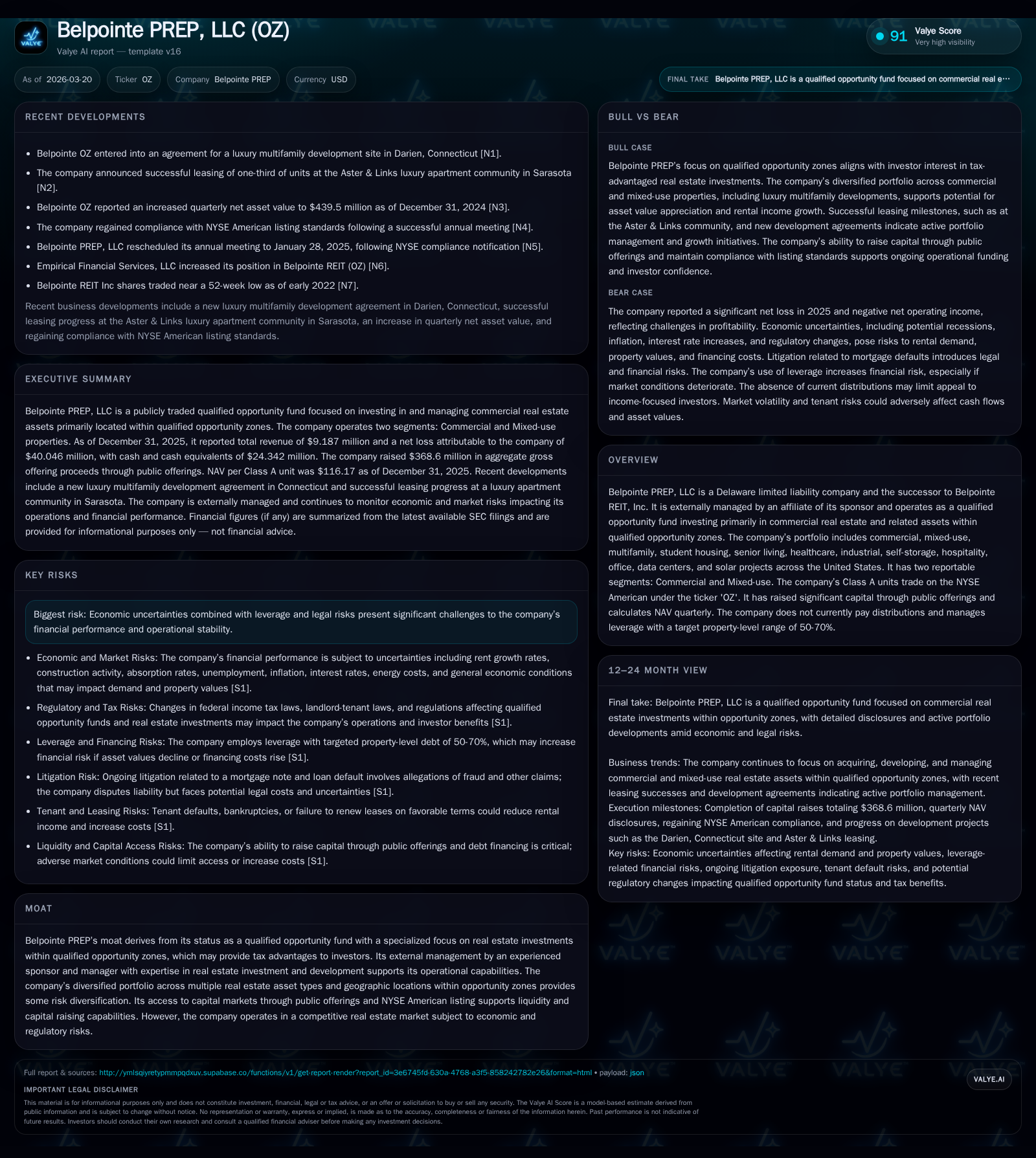
Belpointe PREP, LLC, trading under the ticker OZ, focuses on commercial and mixed-use real estate investments within qualified opportunity zones (QOZs) across the U.S. The company has demonstrated rapid revenue growth from $1.39 million in 2022 to $9.19 million in 2025 but sustained steeply increasing net losses and negative operating cash flows during this period. Its strategy employs significant property-level leverage targeted between 50-70%, with flexibility for higher leverage during development phases. Liquidity primarily derives from public equity offerings and debt financing, underpinning ongoing expansion and capital expenditures despite operating deficits. The firm does not currently pay distributions, citing a lack of positive operating cash flow, but management anticipates eventual distributions targeting 6-8% yields. Legal uncertainties related to specific mortgage litigation persist but are considered immaterial at present. Going forward, Belpointe’s growth hinges on successful capital raises, careful risk management amid economic volatility, and realization of operating efficiencies.
From Niche Emergence to Rapid Revenue Growth: Historical Performance Overview
Belpointe PREP has exhibited a rapid ramp-up of its revenue base since inception as a qualified opportunity fund focused on commercial real estate in designated zones. Total revenues climbed from approximately $1.39 million in fiscal year (FY) 2022 to $9.19 million by the end of FY2025 — representing a compound effect of portfolio growth and asset stabilization within a four-year span [F1]. This corresponds to an extraordinary year-over-year increase of approximately 243.4% from FY2024 to FY2025.
Despite top-line advances, the company’s net income trend reflects significant operating losses which expanded sharply from $(7.68) million in FY2022 to $(40.05) million in FY2025 [F1]. This steepening loss trajectory (a decline of roughly 67.9% YoY in net income year-over-year for FY25) signals investment-heavy phases—with costs tied to acquisition, development, and financing outpacing initial income generation.
Operating cash flows have mirrored this pattern: negative cash flow from operations nearly doubled from $(13.69) million in FY2024 to $(25.21) million in FY2025 [F1] indicating heightened cash burn related largely to interest payments and pre-rental cost absorption during development cycles.
The approximate return on equity was a negative -54.3% in FY2025 calculated as net loss divided by equity as reported [F1]. Such strain highlights the financial efficiency challenges intrinsic to early-stage externally managed funds that carry substantial development risk exposed through leverage.
Historical performance (annual)
| FY | Rev ($mm) | Net ($mm) | CFO ($mm) | Rev YoY | Net YoY |
|---|---|---|---|---|---|
| 2025 | 9 | -40 | -25 | +243.4% | -67.9% |
| 2024 | 3 | -24 | -14 | +18.7% | -66.2% |
| 2023 | 2 | -14 | -7 | +62.0% | -86.8% |
| 2022 | 1 | -8 | -7 |
Source: SEC companyfacts cache [F1].
Revenue acceleration is accompanied by escalating losses and deteriorating cash flow reflecting an investment phase.
Diverse Asset Base in Opportunity Zones: Portfolio Composition and Strategic Implications
Belpointe’s portfolio strategy leverages its unique position as a qualified opportunity fund (QOF), investing exclusively within designated qualified opportunity zones (QOZs). This framework provides potential tax incentives that attract capital but also imposes geographical investment restrictions.
Their asset base stretches across commercial properties and mixed-use developments with extensions into multifamily residential complexes including student housing and senior living facilities. Healthcare-centric assets such as medical office buildings coexist alongside industrial warehouses and self-storage units. Additionally noteworthy is exposure to emerging sectors like data centers supporting digital infrastructure needs and solar energy projects aligned with ESG trends [S1]; this diversification aids mitigation against sector-specific downturns.
External management by affiliated sponsors experienced in real estate leverages transactional expertise for acquisition underwriting and property-level operations [S1]. Given the competitive landscape within QOZ-targeted investments—where demand for quality assets often outstrips supply—the manager’s sourcing capability acts as a competitive advantage albeit subject to market volatility.
Within this complex mosaic of asset types lies inherent execution risk born from disparate leasing dynamics (e.g., short-term hospitality versus long-term industrial leases), regulatory variations across states where properties reside, and operational complexity of multi-tenant versus single-use assets.
Leverage Strategy and Capital Structure: Managing Risk and Financing Expansion
Leverage lies at the core of Belpointe PREP’s capital deployment model designed to amplify returns but inherently heightens financial risk exposure if asset performance falters or market liquidity tightens.
The company targets property-level leverage between 50-70%, excluding company-level debt or indebtedness secured by assets under active development [S4]. During acquisition or redevelopment stages however, it openly employs higher leverage on individual properties reflective of construction financing norms within real estate development cycles.
Key components of company debt include substantial non-recourse mortgages specifically tied to underlying properties which aid risk compartmentalization whereas company-level lines offer strategic liquidity buffers [S4]. Notable refinancing activity culminated in September 2025 with the Aster & Links Loans aggregating approximately $204 million backed by fixed-rate mezzanine components at blended interest rates linked variably to SOFR with floors [S10][S15]. Interest expense jumped further by over double compared with prior years ($17.1M annually vs $7.5M prior year), underscoring rising debt servicing costs paralleling portfolio scale-up [F1][S10].
The firm also employs derivative instruments like interest rate caps to economically hedge exposure from floating rate liabilities although these derivatives are not designated for hedge accounting impacting volatility recognition on earnings [S6].
Moreover, debt arrangements incorporate customary covenants including minimum liquidity thresholds ($10M liquid assets) and net worth floors ($110M minimum net worth), all complied with as of latest reporting [S17]. However absence of explicit borrowing limits per asset allows managerial discretion which may affect future risk-return profiles depending on market conditions.
Liquidity Profile and Cash Flow Trends: Assessing Financial Sustainability
Liquidity remains tightly linked to a combination of proceeds raised through public unit offerings alongside incremental draws on construction facility loans rather than positive internal cash generation given persistent negative operating cash flows [F1][S21].
Operating cash flow was deeply negative at just over $(25) million for FY2025 primarily attributed to financing costs such as interest payments combined with ongoing general administrative expenses incurred despite gradual rental revenues from stabilized assets [F1][S22]. Investing activities consumed roughly $62 million spent mostly funding ongoing construction developments typical in early-stage REITs focusing on growth-oriented portfolios [F1][S21].
Financing inflows around $87 million stemmed largely from new term loans — including incremental advances on the construction facility at VIV project — plus unit issuances raising approximately $11 million during the year [S21][S22][S24]. This capital recycling underscores reliance on external funding amid negative free cash flows.
The company ended FY2025 with roughly $24 million in unrestricted cash plus another $4.3 million held as restricted due mainly under lender-mandated reserves for debt servicing obligations [S18]. This represents relatively stable liquidity levels compared with prior year but closely balances current liabilities necessitating vigilant working capital management amidst uncertain macroeconomic backdrops impacting lending markets.
Distribution Policy and Investor Returns: Current Stance and Future Expectations
Reflective of its developmental stage characterized by negative operating cash flows and ongoing capitalization needs Belpointe PREP maintains a no-distribution policy explicitly conditioned upon generating sustainable positive operating cash flow before dividends commence [S1][S4]. Management currently targets prospective annual distribution yields within a range of approximately 6-8%, albeit timing remains discretionary under Board oversight.
Unit holders receive votes corresponding one-to-one per Class A unit though no preemptive rights or redemption options exist restricting secondary market flexibility slightly [S1]. The lack of distributions combined with elevated losses enforces a speculative investment profile driven largely by expected future appreciation through QOZ tax benefits rather than near-term income generation.
Capital discipline is reinforced via cautious incremental equity raises aligned carefully with reinvestment needs reducing dilution risks though still emphasizing retainment of resources for construction completion phases [S4][S25].
Legal Matters and Operational Risks: Impact on Stability and Valuation
The company disclosed ongoing litigation involving the Galinn Fund concerning foreclosure proceedings against CMC Storrs SPV LLC related to a mortgage note originated without proper authorization allegedly obtained through fraud [S1]. Despite vigorous defense assertions denying liability based on contractual deficiencies attributed partly to third-party negligence or fraud claims against intermediaries involved earlier in loan origination,[S1], this unresolved dispute introduces potential contingent liabilities albeit currently immaterial.
Such legal entanglements reflect typical complexities arising within partnered joint ventures where external affiliates act as primary developers/guarantors exposing Belpointe PREP as passive investor with limited control provisions requiring monitoring for investor risk assessment.
Additional operational risks include macroeconomic uncertainties like interest rate fluctuations affecting borrowing costs even after hedges; protracted lease-up timelines inherent in multifamily/student housing components; regulatory compliance risks surrounding QOZ certifications; concentrated geographic exposures despite segmented strategies; all warrant attention given amplified leverage levels [S1].
Outlook on Portfolio Growth and Market Conditions: Constraints and Catalysts
Looking forward Belpointe PREP’s growth will likely be dictated by several intertwined factors: its ability to continue raising equity capital efficiently via follow-on offerings; securing favorable debt financing terms especially amidst rising interest rate regimes; success in developing currently held construction projects into stabilized income-producing assets; normalization or improvement toward positive operating cash flow metrics enabling distributions; resolution or mitigation of legal uncertainties; and the broader macroeconomic environment influencing real estate demand fundamentals especially within Opportunity Zones which have both locational appeal yet regulatory oversight risks [S1].
The external manager retains broad discretion regarding investment pace reflecting both opportunistic acquisitions or opportunity fund compliance mandates limiting some strategic agility but allowing adaptiveness depending on market cycles.
Despite operational headwinds inherent given the scale-up phase highlighted by persistent losses investors should monitor progress toward key inflection points signaling maturity such as break-even CFO generation or sustained NOI improvements accretive enough to support coverage ratios above debt service requirements.
Key Milestones to Watch: Catalysts for Value Realization
Though there is no explicit forward guidance enumerated in filings beyond strategic commentary several critical milestones will shape near-to-medium term valuation assessments:
- The achievement of positive operating cash flow serving as prerequisite for initiating regular distributions consistent with stated target yields,
- Any resolution or material progress regarding pending litigation involving Galinn Fund claims reducing contingent liability uncertainty,
- Execution progress across major development projects notably VIV & Aster & Links pertaining adherence to budgeted timelines & delivery milestones,
- The ability to raise additional equity capital at or near current NAV levels necessary for funding ongoing pipeline commitments,
- Monitoring changes in credit markets influencing refinancing options potentially tightening or easing leverage capacity.
Given these factors prospective investors should maintain awareness that Belpointe PREP represents a growth-phase externally managed real estate enterprise harnessing tax-incentivized investing niches balanced against concentrated legal/regulatory/market risks typical within QOF structures.
This analysis is provided exclusively for informational purposes grounded strictly upon disclosed SEC filings up to March 20th, 2026 ([S1]-[S29]), recent numeric data snapshots ([F1]), alongside internal research notes without any investment recommendations.
Disclaimer: This is research-only, informational analysis and not investment advice. It may include AI-generated interpretation and general industry context. Always verify important details using primary sources.

Comments