
Paymentus Holdings’ Accelerated Growth and AI-Driven Platform Expansion
Paymentus Holdings leverages its cloud-native SaaS platform and proprietary Instant Payment Network to accelerate growth and innovation in electronic bill payment.
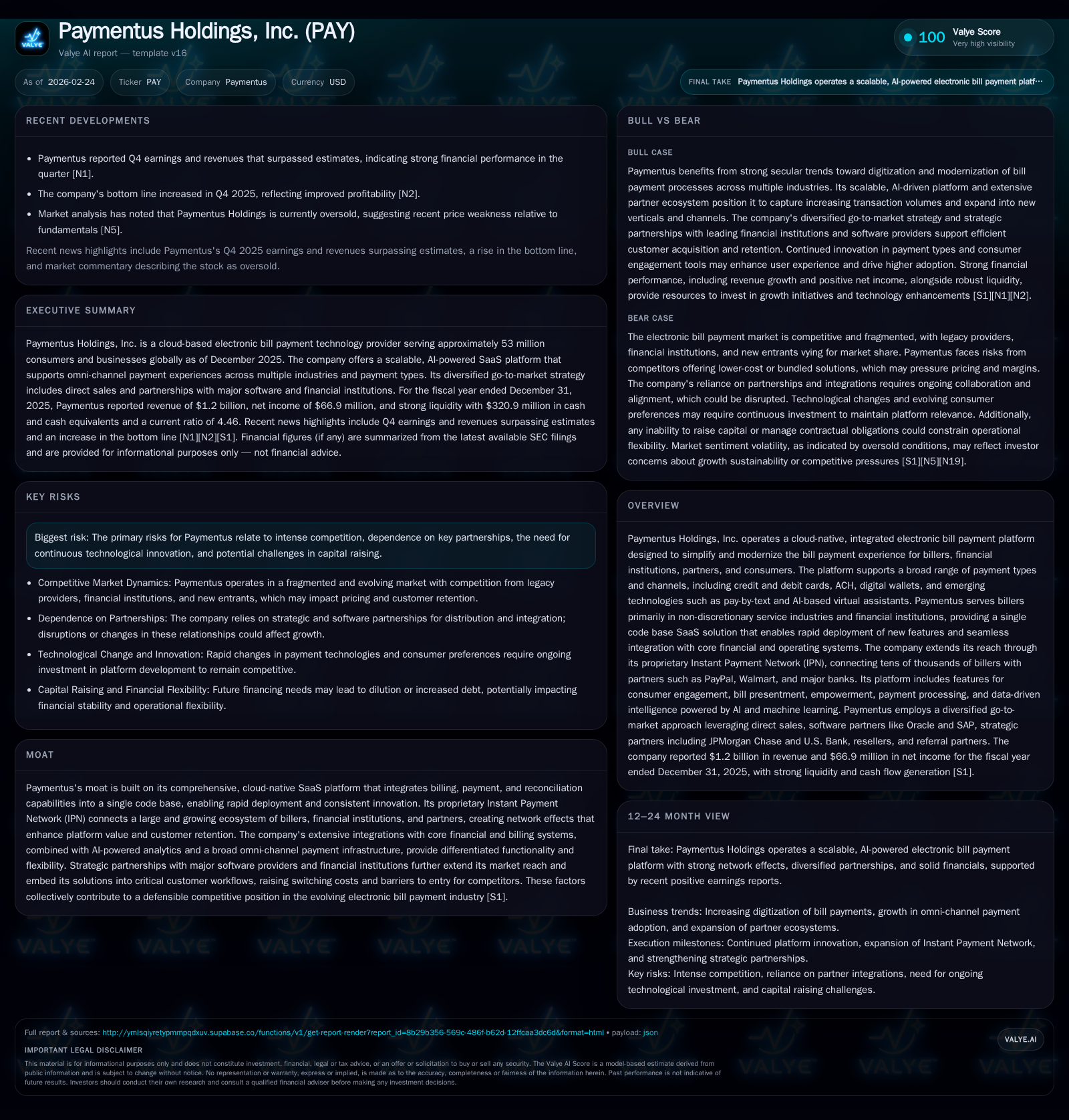
Paymentus Holdings has delivered a strong financial turnaround with rapid operating income growth from 2022 to 2025, driven by its scalable, single code base bill payment SaaS platform and extensive Instant Payment Network (IPN). The company’s competitive moat stems from its multi-channel omni-payment infrastructure integrated deeply with core billing systems and enhanced by AI analytics. Despite no declared dividends or buybacks, Paymentus generates robust free cash flow that is reinvested into product development, partner expansion, and selective acquisitions. Risks remain from legacy competitor pressures, regulatory scrutiny over transactional fees, and execution complexity in scaling AI features. Upcoming milestones to watch include IPN partnership expansions, new vertical entries, and further improvements in operating margins.
Revenue and Operating Income Growth: A Historical Surge
Over the four-year period spanning fiscal years 2022 to 2025, Paymentus Holdings transformed its profitability trajectory with substantial gains in operating income and net income. In FY2022, the company posted an operating loss of approximately -$3.0 million. This deficit was reversed by FY2023 when operating income turned positive at nearly $18.1 million. The acceleration continued sharply with operating income hitting about $44.9 million in FY2024 before soaring to $75.5 million in FY2025 — reflecting a remarkable year-over-year increase of 68.4% [F1].
Net income followed a similar progression: a slight loss (-$0.5 million) in FY2022 was overcome by steady gains to $22.3 million in FY2023, $44.2 million in FY2024, ultimately reaching $66.9 million in FY2025 (+51.5% YoY). Operating cash flow expanded even more dramatically — climbing from $19.9 million in FY2022 to over $162 million in FY2025 — underscoring improved cash conversion efficiency amid scaling operations [F1].
Minimal capital expenditures relative to operating cash flows (<$400k annual spend) allowed Paymentus to generate free cash flow north of $161 million in 2025 alone [F1], signaling disciplined capital management alongside aggressive revenue scaling.
Historical performance (annual)
| FY | Net ($mm) | CFO ($mm) | OpInc ($mm) | Capex ($) | Net YoY |
|---|---|---|---|---|---|
| 2025 | 67 | 162 | 76 | 361000 | +51.5% |
| 2024 | 44 | 64 | 45 | 457000 | +97.9% |
| 2023 | 22 | 69 | 18 | 600000 | +4451.3% |
| 2022 | -1 | 20 | -3 | 1257000 |
Note: Omitted columns lack sufficient annual XBRL coverage in the provided tags (need ≥2 annual points): Rev, Div, Buybacks. Source: SEC companyfacts cache [F1].
Capital returns and efficiency (annual)
| FY | FCF ($mm) | ROE% |
|---|---|---|
| 2025 | 162 | 11.9 |
| 2024 | 63 | 9.1 |
| 2023 | 68 | 5.2 |
| 2022 | 19 | -0.1 |
Source: SEC companyfacts cache [F1].
Note: Revenue is not available from provided tags; ROE estimated as Net Income / Equity at year-end.
These figures portray Paymentus's transition from a nascent stage characterized by losses into a mature SaaS payments provider harnessing scale economies, operational leverage and effective cost control.
The Instant Payment Network: Driving Ecosystem and Competitive Moat
Central to Paymentus's competitive differentiation is its proprietary Instant Payment Network (IPN), a cloud-native ecosystem that seamlessly integrates tens of thousands of billers with major consumer-facing platforms such as PayPal, Walmart, JPMorgan Chase, U.S Bank among others [S4][S22]. This multi-sided network effect generates significant value through widened reach while locking customers into the platform through high switching costs.
The IPN enables partners to embed Paymentus’s next-generation bill presentment and payment technologies directly within their environments without separate integrations for each biller—an architecture uncommon among legacy providers who rely on fragmented vendor solutions [S5]. This connectivity extends Paymentus's omni-channel payment infrastructure encompassing credit/debit cards, ACH transfers, digital wallets as well as emerging payment forms like pay-by-text and AI-driven virtual assistants [S4].
Network effects fuel organic growth as billers gain more consumers through partner channels while consumers benefit from centralized access across many service providers—creating a virtuous cycle that enhances retention for all parties involved.
Moreover, the single code base SaaS design allows Paymentus to deploy new features rapidly across the entire IPN ecosystem simultaneously—a distinct advantage over legacy multi-vendor stacks which suffer from slower update cycles and inconsistent user experiences [S4][S8]. This agility facilitates advanced functionalities such as real-time reconciliation capabilities that streamline revenue collection processes for billers.
In essence: the IPN acts as both a moat preventing competitor encroachment due to network lock-in effects and an accelerator amplifying transactional volume growth.
Strategic Positioning in an Evolving Digital Payments Landscape
Paymentus targets primarily non-discretionary industry verticals—utilities, financial services, insurance, government entities—and leverages direct sales teams alongside software partners like Oracle and strategic banking relationships including JPMorgan Chase for go-to-market execution [S4][S6].
This diversified acquisition approach exploits both outbound lead generation through targeted marketing efforts at industry events plus inbound referrals driven by embedded platform integrations seamlessly interfacing with billing systems such as SAP and Guidewire commonly used by enterprise clients [S4][S26].
Compared to traditional solutions typified by siloed legacy architectures offering limited payment methods often restricted to web portals or slow clearing check/in-person options, Paymentus provides highly configurable omni-channel access consolidated under one SaaS architecture—supporting web, mobile apps, IVR lines plus innovative channels such as chatbots or voice-enabled payments powered by AI agents [S5][S12]. The ability to integrate directly into financial institutions’ digital banking ecosystems further extends consumer reach while delivering faster same-day payments compared with bank-based three-day settlement delays prevalent among incumbents [S5].
Pricing differentiation remains relevant particularly within low-margin segments where cost sensitivity can outweigh product quality benefits but Paymentus strives for superior outcomes via automation of billing processes combined with analytics insights that optimize payment success rates reducing customer churn risks for clients [S6].
In sum: flexibility through a Software-as-a-Service single code base coupled with rapid deployment capabilities provide critical technological advantages positioning Paymentus favorably against internal bank solutions or slower legacy vendors.
Future Growth Vectors Anchored in SaaS Flexibility and AI Integration
Looking ahead into calendar years beyond 2026, Paymentus outlines multiple avenues fueling growth anchored firmly on its scalable SaaS platform:
Scaling IPN Partner Base: The company anticipates broadening its network via additional business networks and strategic alliances extending geographic reach beyond the U.S., leveraging existing domestic billers serving international consumers plus expanding footprints particularly in Canada and India without proportionate increases in local headcount — illustrating capital-efficient globalization plans [S8][S24].
New Industry Verticals: Selective entry into adjacent recurring essential service verticals where electronic bill payments are standard (mirroring prior successful expansion into healthcare/insurance sectors) is expected using configurable platform extensions minimizing incremental development costs [S8].
AI/ML Product Enhancements: Continued investment in artificial intelligence capabilities for smarter consumer engagement tools like predictive payment assistance via virtual agents combined with enhanced data analytics allowing billers better billing success insights constitute a key innovation vector underpinning retention/growth strategies [N1][S19]. These functionalities respond directly to evolving consumer expectations around personalization while delivering measurable returns for enterprise clients.
Technology Platform Investment: Capital allocation prioritizes R&D spending aimed at maintaining bleeding-edge security features compliance while increasing automation embedded within reconciliation workflows — effort critical given regulatory demands around data privacy/security alongside rising fraud sophistication across fintech universe [S19][S23].
While promising significant upside potential rooted in transformation towards embedded fintech models leveraging AI augmentation across traditional payment workflows, these growth initiatives carry execution risk typical of emerging technology integration including regulatory compliance challenges surrounding AI deployment frameworks now evolving under patchwork state/federal regimes [S23].
Capital Structure and Shareholder Returns: Strong Cash Flow Without Dividends
As of December 31, 2025 the company's liquidity position remained robust with cash & equivalents exceeding $320 million versus current liabilities below $99 million yielding a current ratio of roughly 4.46 times — signaling strong short-term solvency cushioning operational volatility risks [F1].[S10]
Long-term liabilities are moderate consistent with prudent financial stewardship capable of supporting organically funded growth initiatives alongside M&A opportunities should they arise.[S27]
Notably absent are dividends or share repurchases: Paymentus has never paid dividends nor conducted buybacks historically,[F1][S14] choosing instead to retain earnings fully to support ongoing platform investments including expanding IPN partnerships and product innovation necessary for sustaining competitive differentiation.[S14]
Profitability metrics reflect this investment focus: an estimated return on equity near 12% indicates efficient capital use balancing reinvestment needs while generating healthy net income margins.[F1]
Capital expenditures remain minimal relative to cash flows — hovering around low hundreds of thousands annually — underscoring the cloud-native model’s low fixed asset intensity compared with traditional software licensing or hardware-dependent businesses.[F1][S19]
In summary: investors should interpret the retained earnings policy not as lack of return but rather prioritizing durable long-term value creation through reinvestment enabling sustained accelerated volume growth mandated by evolving fintech dynamics.
Risks and Competitive Pressures: Innovation Imperative Amid Legacy Players
Despite strong fundamentals, inherent sector risks warrant careful monitoring:
- Competitive Intensity: Legacy billing solution incumbents possess entrenched customer bases often coupled with captive internal solutions developed by large financial institutions themselves threatening displacement via bundled offerings or aggressive pricing strategies.[S5][S6]
- Pricing Pressures: Given that much revenue derives from transaction fees passed partially onto consumers (common especially within utilities/local government), negative perceptions about fee structures may incite regulation limiting fee levels or surcharges resulting in downward margin pressure.[S16][S18]
- Regulatory Complexity: Compliance requirements span federal/state/local levels covering payments processing rules (PCI-DSS), anti-money laundering provisions plus emergent mandates specifically targeting AI use cases introduce legal uncertainty increasing compliance costs.[S11][S15][S23]
- Technology Evolvement: Failure to sustain continuous technological innovation—including secure adoption of AI-powered features—and maintain resilient infrastructure could impair client retention given competitive availability of alternative fintech solutions.[S20]
- Execution Risk: Sales cycles for large enterprise clients remain lengthy involving multi-tiered evaluation processes susceptible to external factors including personnel changes or economic tightening impacting decision timelines.[N4][S25]
- Valuation Volatility: Recent public market trading exhibited oversold conditions reflecting broader fintech sector valuation swings potentially disconnected from underlying business trajectory requiring cautious interpretation.[N5]
Overall these factors emphasize that Paymentus must continuously evolve technologically while managing partner relationships prudently amidst shifting regulatory landscapes critical for maintaining sustainable competitive advantage.
What to Watch: Milestones and Market Indicators for 2026
Going forward through calendar year 2026 stakeholders should track several key developments:
- Expansion metrics regarding number/scale of new IPN partner additions which drive incremental transaction volumes through multi-sided network effects underpinning top-line growth assumptions.[N1]
- Adoption rates within newly targeted non-discretionary verticals internationally leveraging platform configurability metrics signal successful cross-border scalability.[N4]
- Launch dates and usage statistics related to advanced AI-powered virtual assistant tools embedded within the payment flows indicate progress towards product differentiation objectives.[N1][S19]
- Operating margin trends reflecting ongoing improvements due largely to scaling efficiencies balanced against incremental R&D expense needed for product innovation.[N1][N4]
- Regulatory developments around interchange fee restrictions or AI compliance frameworks could materially influence strategic pricing models—heightened disclosure on such impacts enhance forward visibility.[N4]
- Any shifts toward dividend initiations or share repurchase programs would be materially noteworthy altering capital allocation signals though currently no indication exists.[F1][S14]
No explicit formal financial forecasts have been published beyond recent quarterly results; thus market participants rely on qualitative disclosures coupled with executing indicated strategic initiatives as primary performance guides.[N1][N4][S3]
Disclaimer: This analysis is based exclusively on publicly available information as disclosed up through February 24th, 2026 including SEC filings ([F1],[S#]) and recent news reports ([N#]). It does not constitute investment advice or recommendation but aims solely to provide an informed synthesis tailored for professional readers interested in Paymentus Holdings’ corporate strategy and financial profile.
Disclaimer: This is research-only, informational analysis and not investment advice. It may include AI-generated interpretation and general industry context. Always verify important details using primary sources.

Comments