
Pacific Health Care Organization's Strategic Growth in Workers’ Compensation Services
PFHO's specialized focus on workers' compensation cost containment underpins steady financial growth and strong liquidity through FY2025.
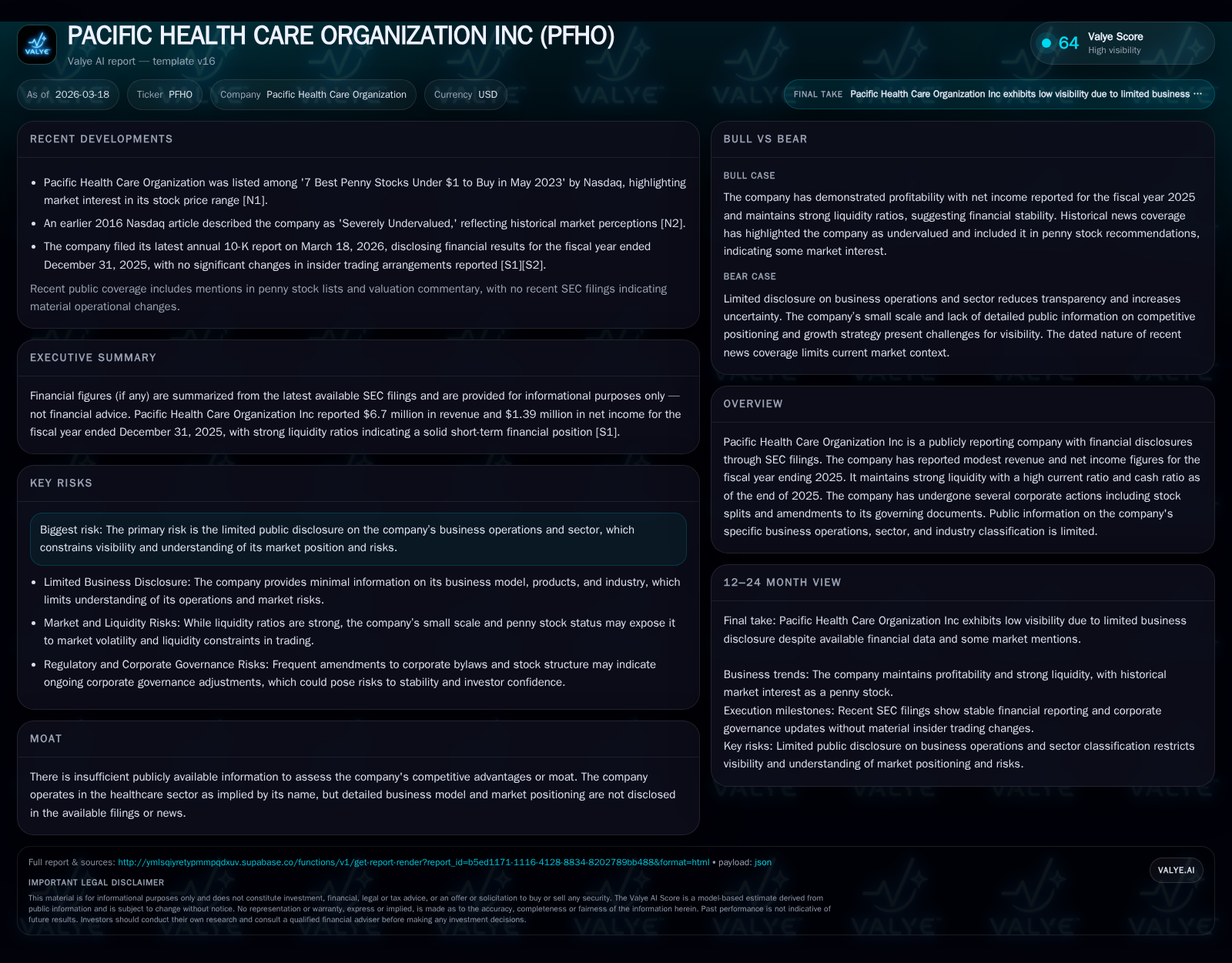
Pacific Health Care Organization Inc delivers integrated healthcare services focused on reducing workers’ compensation claim costs for California employers. The company has demonstrated consistent revenue growth with a 10.7% increase in FY2025, driven by expanding adoption of its managed care networks and utilization review services. Solid operating leverage and effective capital management have yielded a 57% jump in net income, while maintaining exceptionally strong liquidity with a current ratio above 34x. PFHO's future growth will hinge on regulatory developments and continued demand for carve-out and case management solutions within California's complex workers’ compensation landscape.
Company Background and Core Business Model
Pacific Health Care Organization Inc (PFHO) specializes in workers' compensation cost containment services tailored principally for California employers and claims administrators. Incorporated initially in Utah in 1970 as Clear Air, Inc., the company adopted its current name in 2001 following acquisitions that substantially expanded its California-based healthcare operations [S1].
At the heart of PFHO’s business model lies an integrated approach leveraging Health Care Organizations (HCOs) and Medical Provider Networks (MPNs) governed under California state licenses—of which PFHO holds two of three available. These network arrangements enable control over injured employees’ treatment pathways to reduce claims frequency and treatment duration, the primary cost drivers in workers’ compensation per audits conducted for the California Division of Workers’ Compensation [S1].
Beyond network management, PFHO offers ancillary yet complementary solutions such as utilization review to oversee treatment necessity, medical bill review for cost validation, Medicare set-aside administration targeting federal compliance, medical case management providing patient advocacy, and expert witness testimony supporting claim adjudications. The firm’s offerings are structured both as bundled managed care solutions or discrete standalone services allowing customer-tailored applications [S1].
PfHO’s subsidiaries—including Medex Healthcare managing HCOs/MPNs, MMC overseeing utilization and bill reviews, and MMM responsible for case management—reflect this layered model designed to deliver comprehensive workers' comp healthcare cost mitigation underpinned by regulatory compliance [S1]. The recent discontinuation of lien representation services due to reduced demand illustrates portfolio rationalization aligned with market needs [S1].
Historical Financial Performance and Growth Drivers
From FY2022 through FY2025, PFHO has achieved consistent top-line expansion with revenues climbing from $5.75 million in 2022 to $6.72 million in 2025 per SEC reported figures [F1]. The latest fiscal year marked a notable 10.7% year-over-year increase suggesting robust customer uptake of the company’s specialized cost containment services.
Operationally, PFHO converted revenue growth into enhanced profitability demonstrating margin expansion; operating income rose from approximately $666 thousand in FY2022 to nearly $1.0 million in FY2025 (+17.4% YoY latest), while net income surged substantially—reaching $1.39 million in FY2025—a significant 57% improvement over prior year levels [F1]. This profitability leap underscores effective operational leverage possibly driven by scaling managed care contracts, efficient medical bill oversight practices, and ongoing expense control initiatives.
Operating cash flow followed a positive trajectory with a pronounced jump of nearly 72% YoY to $1.16 million in FY2025 [F1]. Concurrently moderate capital expenditure outlays reflect measured reinvestment into network infrastructure or technology enhancements supporting service delivery.
Historical performance (annual)
| FY | Rev ($mm) | Net ($) | CFO ($) | OpInc ($) | Rev YoY | Net YoY |
|---|---|---|---|---|---|---|
| 2025 | 7 | 1387647 | 1160784 | 1001038 | +10.7% | +57.0% |
| 2024 | 6 | 883584 | 675084 | 852623 | +7.7% | +15.1% |
| 2023 | 6 | 767928 | 932359 | 678535 | -2.0% | +55.8% |
| 2022 | 6 | 492886 | 711237 | 666124 |
Source: SEC companyfacts cache [F1].
Capital returns and efficiency (annual)
| FY | Div ($) | FCF ($) | ROE% |
|---|---|---|---|
| 2025 | 37000 | 1137505 | 10.6 |
| 2024 | 0 | 665953 | 7.6 |
| 2023 | 1209587 | 914843 | 7.1 |
| 2022 | 672370 | 4.4 |
Source: SEC companyfacts cache [F1].
Table: PFHO Historical Financial Summary (FY2022–FY2025) showing steady revenue growth alongside substantial profitability gains.
Service Portfolio and Market Positioning within Workers' Compensation Healthcare
PFHO’s competitive positioning derives from its specialized focus on the California workers’ compensation system—a market characterized by stringent state regulations requiring licensed operation of Health Care Organizations (HCOs) or Medical Provider Networks (MPNs). Holding two of only three state licenses positions PFHO uniquely within this niche ecosystem [S1].
The company's core competencies center on managed care protocols that mitigate claim costs through oversight mechanisms: controlled provider network access limits unnecessary or prolonged treatments thereby addressing both frequency and duration dimensions essential for expense containment.
Complementing these are carve-out services which delegate certain claim cost components away from primary insurers; Medicare set-asides address complex federal compliance linked to injured worker benefits; utilization review ensures medical necessity aligning treatments with accepted guidelines; case management advocates for injured employees ensuring efficient recovery trajectories; employee advocate services facilitate claim navigation; lastly expert witness testimony supports litigation or dispute resolution processes [S1].
This multi-layered service architecture offers clients an integrated managed care solution with modularity enabling tailored configurations—an important factor given employer-specific risk appetites or claims profiles within diverse industrial sectors.
From an industry vernacular perspective: PFHO operates its licensed HCOs/MPNs effectively as gatekeepers within managed care networks; asserts control via utilization reviews acting as clinical filters; manages carved-out liabilities mitigating exposure; applies medical case management driving timely return-to-work outcomes—all hallmarks of sophisticated workers' comp service providers focusing on cost containment without compromising quality of care.
Regulatory and Operational Risks Affecting Business Dynamics
PFHO acknowledges key risks stemming from limited public disclosure about operational specifics constraining external visibility into business dynamics [S1]. Within its accounting practices critical judgments influence reported metrics—revenue recognition is complex due to multi-performance obligation contracts necessitating allocation based on unobservable standalone selling prices mostly derived via a cost-plus margin approach [S1]. The intricacy heightens exposure to shifts in contract terms or customer mix affecting recognized revenue streams.
Accounts receivable concentration poses credit risk—with four customers representing over ten percent of receivables at the end of FY2025 compared to three previously—highlighting dependency vulnerabilities impacting cash flow profiles should any large customer face payment difficulties [S1]. This dynamic requires vigilant monitoring against exposures amplified by the cyclical nature of healthcare claims payments.
California's regulatory environment adds complexity due to evolving Division of Workers’ Compensation mandates affecting licensing conditions or billing protocols which could constrain operations or necessitate costly compliance adaptations [S3][S9]. Further legal proceedings against former key personnel alleging breaches threaten intellectual property security within subsidiaries Medex and MMM potentially disrupting service continuity or requiring resource diversion towards litigation defenses [S11][S12].
Continual evaluation of loss allowances for credit risks remains critical given unpredictable economic conditions influencing claim reimbursement patterns; such evaluative estimates carry inherent uncertainty potentially causing material fluctuations in financial results [S1].
Capital Structure, Liquidity, and Corporate Actions
As of December 31, 2025 PFHO reported exceptionally robust liquidity: current assets totaled roughly $13.39 million against current liabilities near $389 thousand yielding a current ratio exceeding an extraordinary ~34x—indicative of a very conservative balance sheet posture with significant working capital cushions [F1]. Cash and equivalents alone comprised about $2.17 million sustaining operational agility.
The company exhibits nominal leverage or debt obligations reflective of conservative capital structure policies fostering financial flexibility amid market uncertainties [S4][S5][S6][F1]. Recent corporate actions include amendments to governing bylaws formalized during calendar year processes notably updating director minimums from two to three and reducing board meeting notice requirements along with eliminating role specific removal clauses—all signifying governance modernization efforts enhancing board effectiveness [S3][S6].
Multiple stock split activities have been executed historically including reverse splits at one-for-fifty alongside several forward splits reflecting attempts at optimizing share structure liquidity though details do not imply major recapitalization shifts [S3][S6][F1]. These moves likely aim at maintaining an appropriate trading range beneficial for shareholder markets even if relatively small-scale ownership breadth is implied.
Capital Allocation: Dividends, Buybacks, and Return on Equity Measures
PFHO resumed dividend distributions modestly in FY2025 paying approximately $37 thousand after years without payouts or minimal distributions noted earlier such as over $1.2 million dividend paid back in FY2023 followed by hiatuses; no share repurchase programs have been materially active since mid-2010s indicating cautious allocation focusing more on sustaining liquidity than returning capital via buybacks [F1][S16][S18][S19].
Estimated return on equity calculated as net income relative to average shareholders' equity reached roughly 10.6% for the most recent fiscal year—suggesting reasonable profitability generation relative to invested capital despite a low absolute magnitude consistent with mid-tier niche service provider scale metrics [F1].
Operating cash flow generation outstripping capital expenditures by nearly $1.14 million produced positive free cash flow supporting dividend capacity while underpinning operational reinvestment needs limited primarily to IT systems enhancing healthcare administration capabilities rather than asset-heavy infrastructure expansions [F1].
Future Outlook: Growth Opportunities and Potential Constraints
While explicit future guidance is unavailable due to limited public disclosures or news narratives currently absent from filings provided hereby Valye News standards ([N#]), PFHO signals strategic intent toward incremental expansion either through targeted acquisitions aligned with its healthcare cost containment suite or organic growth supported by expanding managed care contracts within California market jurisdictional bounds [S1][S2].
Opportunities reside predominantly in leveraging licensed network controls contained within HCOs/MPNs coupled with rising employer demand for compliant cost-effective claims management solutions responding to inflationary pressures on medical treatments.
Constraints include navigating an increasingly complex regulatory environment under California's Division of Workers Compensation where policy shifts could alter reimbursement models or network license conditions impacting achievable margins or scaling feasibility [S3][S9]. Additionally operational disruptions tied to ongoing litigation involving former executives could present reputational or financial headwinds if unresolved expeditiously [S11][S12].
Valye News analysis posits monitoring expansions in licensing spectrum or broadened client contract win rates along with quarterly updates illuminating claims duration reductions as meaningful indicators of sustainable growth trajectory.
Key Milestones and Metrics to Monitor Ahead
Stakeholders should track upcoming quarterly SEC filings especially those encompassing comprehensive risk disclosures around credit losses or contract renewals affecting revenue visibility [S2][S8]. Regulatory agencies may issue updates altering MPN/HCO operational frameworks warranting close observation given impact evident historically across the sector.
Increased granularity around accounts receivable concentration shifts post-FY2025 would signal evolving dependency risks necessitating credit risk recalibrations affecting working capital planning.
Furthermore growth signals might be inferred from announcements related to additional state licensure acquisitions outside California potentially diversifying geographic risk exposures.
Lastly progress resolving pending legal challenges against former key personnel would represent important milestones restoring full subsidiary integration confidence critical for long-term execution consistency.
This analysis reflects information sourced entirely from publicly filed SEC documents without forming investment advice or price expectations. It aims solely at providing comprehensive insight into Pacific Health Care Organization’s operational profile and financial standing contextualized within its specialized healthcare service domain.
Disclaimer: This is research-only, informational analysis and not investment advice. It may include AI-generated interpretation and general industry context. Always verify important details using primary sources.

Comments