
PHINIA Inc. Q2 2026: Leadership Changes and Segment Renaming Reflect Strategic Priorities
PHINIA announces new segment presidents and renames reportable segments, alongside a stable Q2 2026 operating update with solid liquidity.
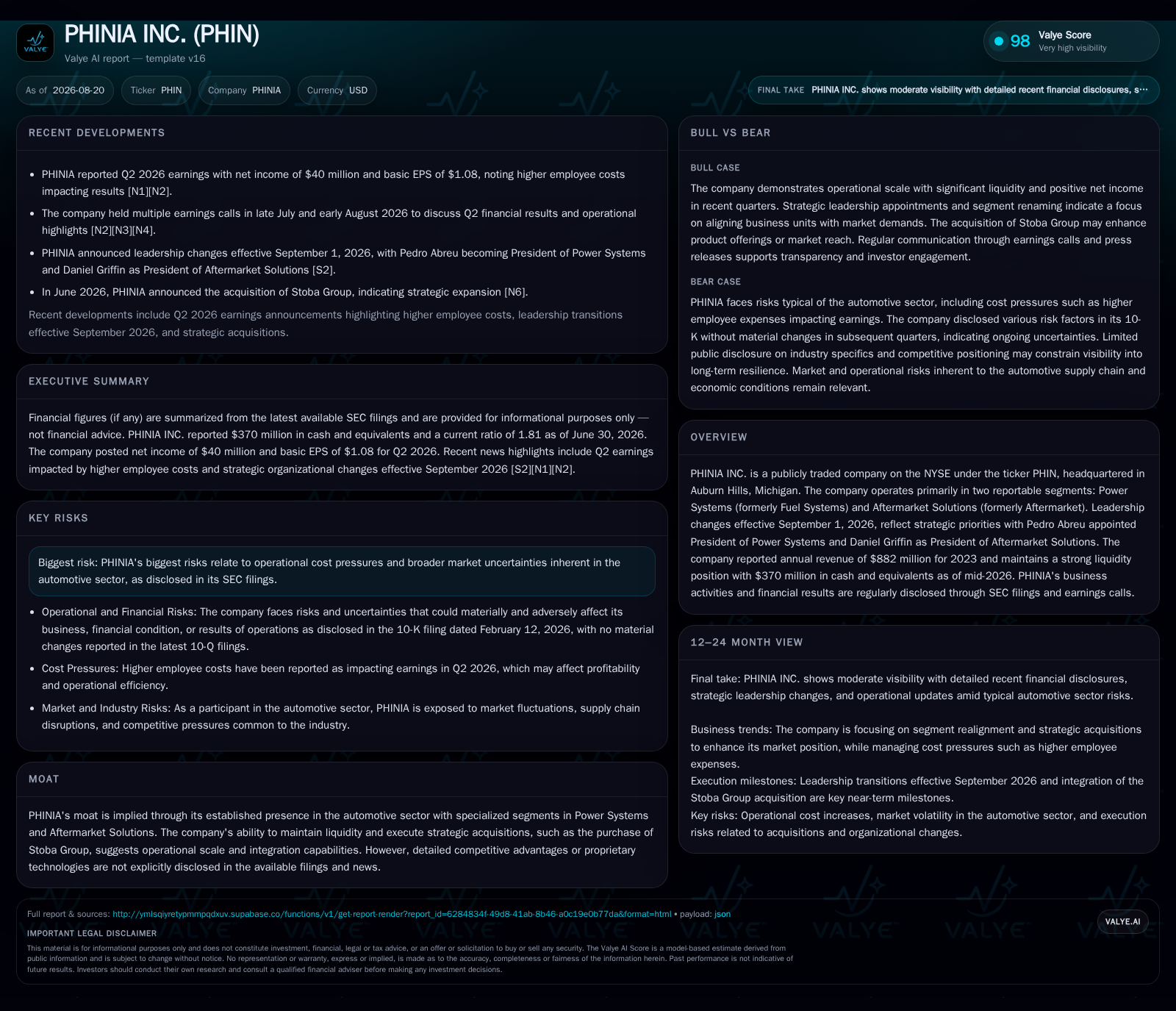
PHINIA Inc.'s Q2 2026 filings reveal no material changes in risk factors and a strong liquidity position with $370 million in cash as of June 30, 2026. Effective September 1, 2026, the company will rename its Fuel Systems and Aftermarket segments to Power Systems and Aftermarket Solutions, respectively, appointing Pedro Abreu and Daniel Griffin as presidents of these segments. These moves suggest a strategic focus on segment specialization and operational clarity, supported by a healthy balance sheet. Investors should monitor upcoming quarterly results for evidence of operational improvements or challenges under the new leadership structure.
Q2 2026 Operating and Financial Update
PHINIA Inc. reported no material changes to its previously disclosed risk factors during the second quarter of 2026, reflecting a stable risk profile amid ongoing sector uncertainties [S2]. The company maintained a strong liquidity position as of June 30, 2026, with cash and equivalents totaling $370 million and a current ratio of 1.81, supported by current assets of $1.838 billion against current liabilities of $1.018 billion [F1]. This liquidity provides PHINIA with sufficient short-term resources to meet obligations and invest in operational initiatives.
Leadership Changes and Segment Renaming
On August 6, 2026, PHINIA announced key leadership changes effective September 1, 2026, signaling a strategic realignment of its business segments [S3]. Pedro Abreu, previously Vice President and Chief Strategy Officer, will transition to President of the newly renamed Power Systems segment, formerly known as Fuel Systems. Concurrently, Daniel Griffin will assume the role of President of Aftermarket Solutions, the new name for the Aftermarket segment.
These changes reflect a deliberate shift to sharpen operational focus and clarify segment performance for investors. Assigning dedicated presidents to each renamed segment suggests an intent to enhance accountability and strategic execution within these distinct business areas. The renaming from Fuel Systems to Power Systems may better capture the segment's scope, while Aftermarket Solutions emphasizes the company's commitment to aftermarket parts and services.
Business Model and Industry Context
PHINIA operates primarily in the automotive components and aftermarket services industry, serving automotive and industrial customers who purchase power systems components and aftermarket automotive parts and services [S1]. Revenue is generated through two reportable segments: Power Systems and Aftermarket Solutions. The Power Systems segment focuses on manufacturing components integral to vehicle powertrains, while Aftermarket Solutions provides parts and services supporting vehicle maintenance and repair.
In this capital-intensive sector, operational efficiency and segment specialization may be important factors influencing margin and cash conversion. PHINIA's segment realignment is consistent with industry practices where companies organize operations by product lines and aftermarket services, which could help manage fixed costs and improve customer focus. The automotive sector's cyclical nature and structural pressures from cost volatility highlight the potential relevance of maintaining liquidity and defining leadership roles clearly.
Analytical Conclusions and Scenarios
The leadership appointments and segment renaming at PHINIA likely aim to enhance operational clarity and focus. By promoting internal executives to lead the renamed segments, the company may improve strategic execution and investor transparency regarding segment performance [S3]. This structural change could facilitate more disciplined management of manufacturing and aftermarket operations, potentially leading to improved operational efficiency.
With $370 million in cash and equivalents, current assets of $1.838 billion, current liabilities of $1.018 billion, and a current ratio of 1.81, the company has a financial buffer to absorb sector cyclicality and invest in segment initiatives without immediate financial strain [F1]. This liquidity reduces near-term financial uncertainty and underpins ongoing operations.
Looking ahead, one plausible scenario is that the new leadership structure will drive improved operational efficiency and clearer financial reporting without disruption, supported by stable market conditions and smooth leadership transitions [S3][S2]. This would be confirmed by subsequent quarterly filings showing stable or improved segment margins and revenue growth.
Conversely, the bear case would be that leadership changes and segment renaming fail to yield operational improvements, potentially leading to margin pressure amid automotive sector cost challenges [S2][S3][N1]. Management commentary on operational execution and any updates to risk factors or cost pressures will also be critical in assessing the effectiveness of these changes. Additionally, liquidity and working capital metrics should be observed to ensure ongoing financial stability amid sector cyclicality.
The leadership appointments and segment renaming may reflect an effort to enhance operational focus and transparency within the automotive components market, which is competitive.
Disclaimer: This is research-only, informational analysis and not investment advice. It may include AI-generated interpretation and general industry context. Always verify important details using primary sources.

Comments