
Patriot National Bancorp Reorients Lending Amid Regulatory Constraints
The company's latest quarterly report reveals continued regulatory remediation and a strategic shift focusing lending on commercial real estate and secured credit lines.
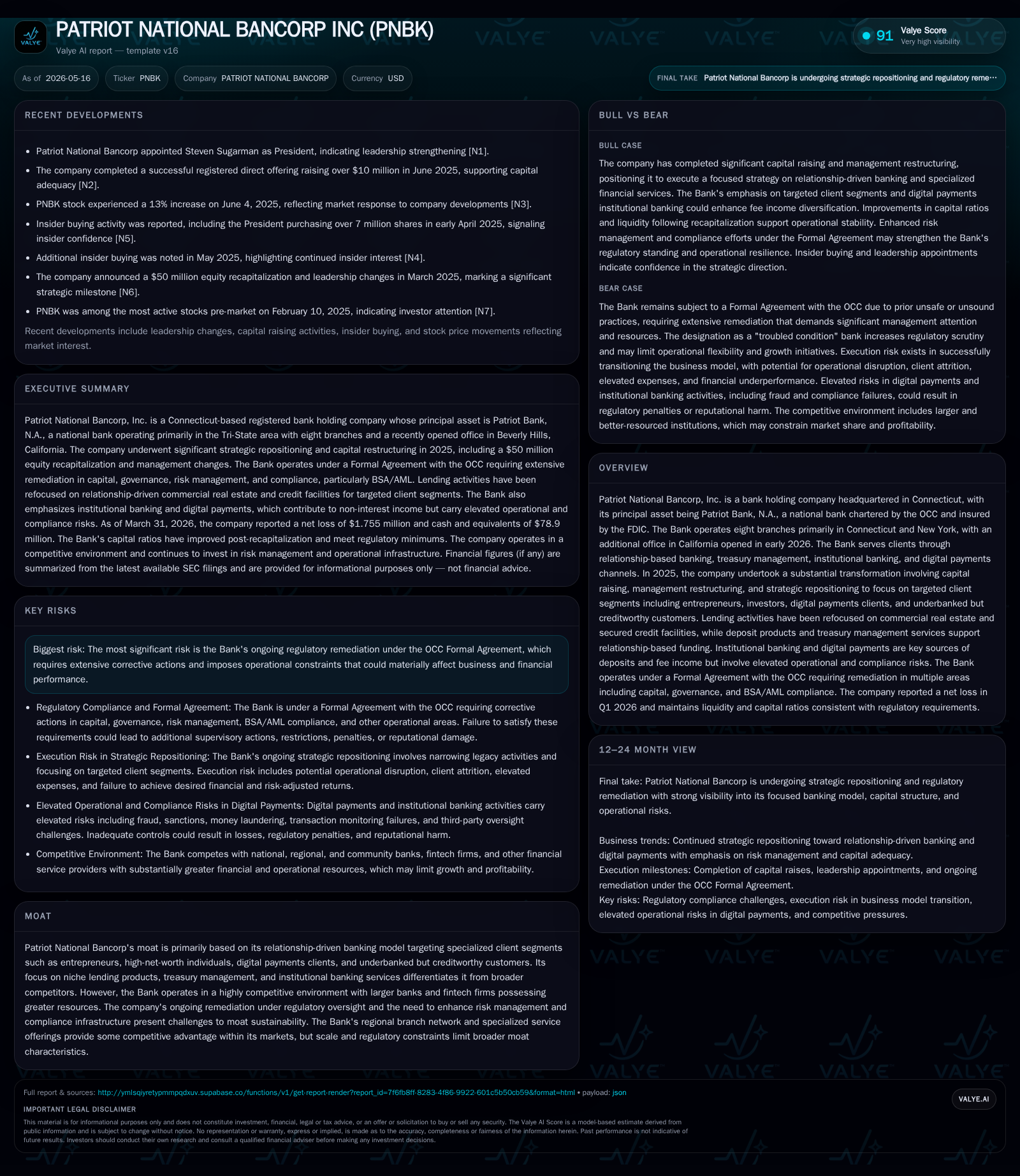
Patriot National Bancorp’s Q1 2026 update underscores sustained efforts to comply with the OCC Formal Agreement while advancing a strategic repositioning. The Bank has refocused its lending towards commercial real estate and secured credit facilities tailored to niche client segments, including entrepreneurs and digital payments clients. Despite regulatory hurdles and operational constraints from its 'troubled condition' status, these initiatives aim to stabilize and grow the franchise within its regional footprint. The company faces risks related to remediation progress, credit concentration, and operational dependencies but shows measured progress in governance and capital planning.
Latest Quarterly Operating Update: Remediation Meets Repositioning
Patriot National Bancorp’s May 2026 10-Q filing reconfirms the bank's continuing compliance efforts under an OCC Formal Agreement initiated in January 2025 due to identified unsafe or unsound banking practices. This regulatory framework demands substantial attention across governance, capital planning, BSA/AML compliance, credit risk controls, and reporting enhancements [S2, S3]. The Bank remains categorized as in “troubled condition,” which inherently restricts its operational flexibility including branching expansions, acquisitions, dividends, and personnel actions.
Despite these constraints, the recent quarter highlights ongoing remediation progress paired with deliberate strategic repositioning executed since 2025. Notably, Patriot has restructured management—evidenced by the appointment of Steven Sugarman as President earlier this year—providing fresh leadership for governance and strategy execution [N1]. Operational priorities remain aligned with satisfying OCC mandates while pacing product development consistent with enhanced risk controls.
Funding stability has improved aided by prior capital raises completed in 2025 that not only recapitalized the balance sheet but facilitated remediation investments. The filing explicitly discusses focused management of deposit retention during competitive pressures and careful liquidity oversight with an emphasis on managing short-term loan inventories arising mainly from digital payments activities [S2].
Core Business Model: Niche Relationship Banking and Specialized Lending
Patriot operates primarily through its wholly owned subsidiary Patriot Bank, N.A., a national bank chartered by the OCC with deposit insurance from the FDIC. The bank’s footprint includes eight branches mainly across Connecticut and New York plus a strategic office in California opened Q1 2026 to bolster presence in the Los Angeles market—a region important for institutional banking and digital payments clientele [S1, S13].
The core business model centers on relationship-driven banking targeting specialized client segments: entrepreneurs, investors, family offices, business leaders serving these groups, digital payment program managers, fintech companies, payment processors, as well as select underbanked yet creditworthy individuals or businesses. This segmentation reflects a more concentrated focus compared to prior legacy portfolios [S1].
Lending has been deliberately refocused away from legacy or non-core loan products towards:
- Commercial real estate lending grounded in borrower deposit relationships,
- Secured (and some unsecured) lines of credit for high-net-worth clients and entrepreneurs backed by collateral such as marketable securities or real estate,
- Rediscount or asset-backed loans primarily for institutional or wealth clientele.
Deposit products range from consumer demand deposits to treasury management services supporting business clients via ACH services, wire transfers, debit card processing, remote deposit capture among others—providing integrated cash management solutions suited to the target markets [S16].
This specialization attempts to balance revenue generation through interest income on loans alongside fee income streams tied to treasury management and payment processing services.
Competitive Environment and Regulatory Structure
Operating within highly competitive regional markets dominated by larger banks with deeper capital pools and evolving fintech counterparts presents both opportunity (for specialization) and challenge (scale/resource constraints). Patriot’s advantage lies in tailored service models focused on specific niches underserved by large universal banks or mass-market fintechs. Nonetheless, this narrower customer base concentrates portfolio risks.
Regulatory constraints remain a significant structural factor. The Formal Agreement imposed by the OCC places Patriot under rigorous supervision due to previously identified deficiencies in strategic planning, capital adequacy, compliance including BSA/AML oversight, credit administration, and concentration risk governance [S1]. The designation of “troubled condition” further restricts operational maneuverability—it increases examination frequency while limiting growth initiatives such as branch expansion or new product launches absent regulatory clearance.
Hence, while specialty positioning supports differentiation versus broader competitors, it comes with elevated regulatory costs and limits scale economies that could otherwise improve profitability.
Growth Catalysts: Client Segments, Product Focus, and Digital Payments Expansion
Growth opportunities hinge on the Bank successfully executing its repositioned strategy that aligns product offerings within defined risk appetites tailored to targeted client types. This includes:
- Expanding commercial real estate lending focused tightly on established deposit relationships enhancing cross-sell potential;
- Growing secured credit facilities designed for entrepreneurs/high-net-worth individuals providing collateralized borrowing options;
- Scaling institutional banking services linked to the burgeoning digital payments sector benefiting from increased adoption of electronic payment systems;
- Leveraging the newly opened California office to develop relationships in a major fintech/tech hub supporting program managers and payment processors.
The Digital Payments Division has witnessed rising origination volumes primarily of credit card receivables under third-party programs. These receivables are typically sold shortly after origination to program managers or other third parties—generating non-interest income albeit requiring vigilant liquidity management due to short holding periods [S6].
Continued refinement of enterprise risk management infrastructure is a parallel enabler allowing measured growth without amplifying legacy risk exposures. Enhancements in risk reporting tools improve surveillance over loan concentrations and payment program counterparty exposure.
Collectively these drivers link directly to KPIs such as loan origination volumes segmented by product line, deposit growth/retention rates in target markets, volume of digital payments transactions facilitated via the Bank’s corridors, remediation milestone completions monitored by supervisors—and executive tenure/stability post-management reshuffles.
Risk Factors and Operational Constraints
Key risks predominantly revolve around regulatory remediation burdens that span capital adequacy maintenance under OCC standards; developing robust enterprise-wide risk controls especially for BSA/AML compliance; managing loan concentration risks notably in commercial real estate portfolios; navigating uncertainties tied to third-party dependent credit card programs exposing Patriot to counterparty default or disputes; reputational vulnerabilities linked to regulatory scrutiny; increased operating costs stemming from necessary enhancements across compliance frameworks; plus challenges in attracting/retaining qualified personnel essential for sustaining forward momentum in transformation efforts [S1,S2,S21].
The Company recognizes possible delays or failures in remediation could invite additional enforcement actions including civil money penalties or activities restrictions that would materially impair earnings potential or capital raising ability. Furthermore technology platform integration risks underlying digital payments growth represent additional operational complexity.
In sum these factors emphasize that ongoing regulatory status will continue sharply influencing business planning horizon lengths while supervisory conditions may temper aggressive growth aspirations beyond incremental measured advances.
Upcoming Milestones and What to Monitor Next
Near-term points of focus include:
- OCC assessments regarding satisfactory progress against Formal Agreement milestones expected during 2026;
- Tracking completion timelines for key remediation measures related to governance structures including Compliance Committee effectiveness;
- Deposit base stability metrics amid pricing competition recognizing importance for funding cost control;
- Digital Payments Division portfolio performance data including turnover rates of originated receivables;
- Loan portfolio mix shifts quarterly highlighting pace of commercial real estate vs legacy asset runoffs;
- Integration success indicators from expanded California presence reflecting broader geographic customer acquisition efficacy;
- Retention tenures of newly installed senior executives supporting steady leadership execution capacity.
These indicators serve as actionable barometers regarding both strategic momentum attainment under regulatory constraints plus financial resource adequacy enabling scaling initiatives without undermining stability [S2,S3,N1].
Concise Financial Overview Supporting Strategic Assessment
As per latest available data extracts:
- Cash & equivalents stood at approximately $78.9 million as last reported end Q3 2023 offering a snapshot point contextualizing liquidity buffers available historically; however direct current period cash levels were not explicitly updated in the Q1 2026 filings [F1].
- Total debt is modest at about $16.6 million end FY 2025 keeping leverage limited relative to asset base aiding prudent capital structure maintenance [F1].
- Net debt was negative $62.3 million as of end FY 2025, reflecting a net cash position that supports balance sheet flexibility [F1].
- Net income remained negative at -$12.7 million through December 31, 2025 indicative of ongoing remediation-related expense burdens but reflecting substantial narrowing losses compared with prior periods correlating with strategic resets managed since 2025 recapitalization efforts [F1].
- Net interest margin compression evident given higher cost deposit environments partially offsetting lower loan balances—a margin challenge common among similarly situated banks undergoing transformation phases [S15].
Collectively financial metrics affirm a cautious stance consistent with heightened regulatory oversight yet do not suggest immediate solvency stress giving room for remediation execution though profitability restoration depends heavily on operationally managing contained expenses while growing targeted revenue streams successfully.
This analysis is based exclusively on publicly available SEC filings up through May 15th, 2026 along with relevant official announcements. It does not include forward-looking investment advice.
Disclaimer: This is research-only, informational analysis and not investment advice. It may include AI-generated interpretation and general industry context. Always verify important details using primary sources.

Comments