
Qualcomm's Strategic Balancing Act: Earnings, Customer Reliance, and Geopolitical Risks
An analytical dive into Qualcomm's recent financial performance and how it manages concentrated revenues, geopolitical tensions, and fabless production challenges.
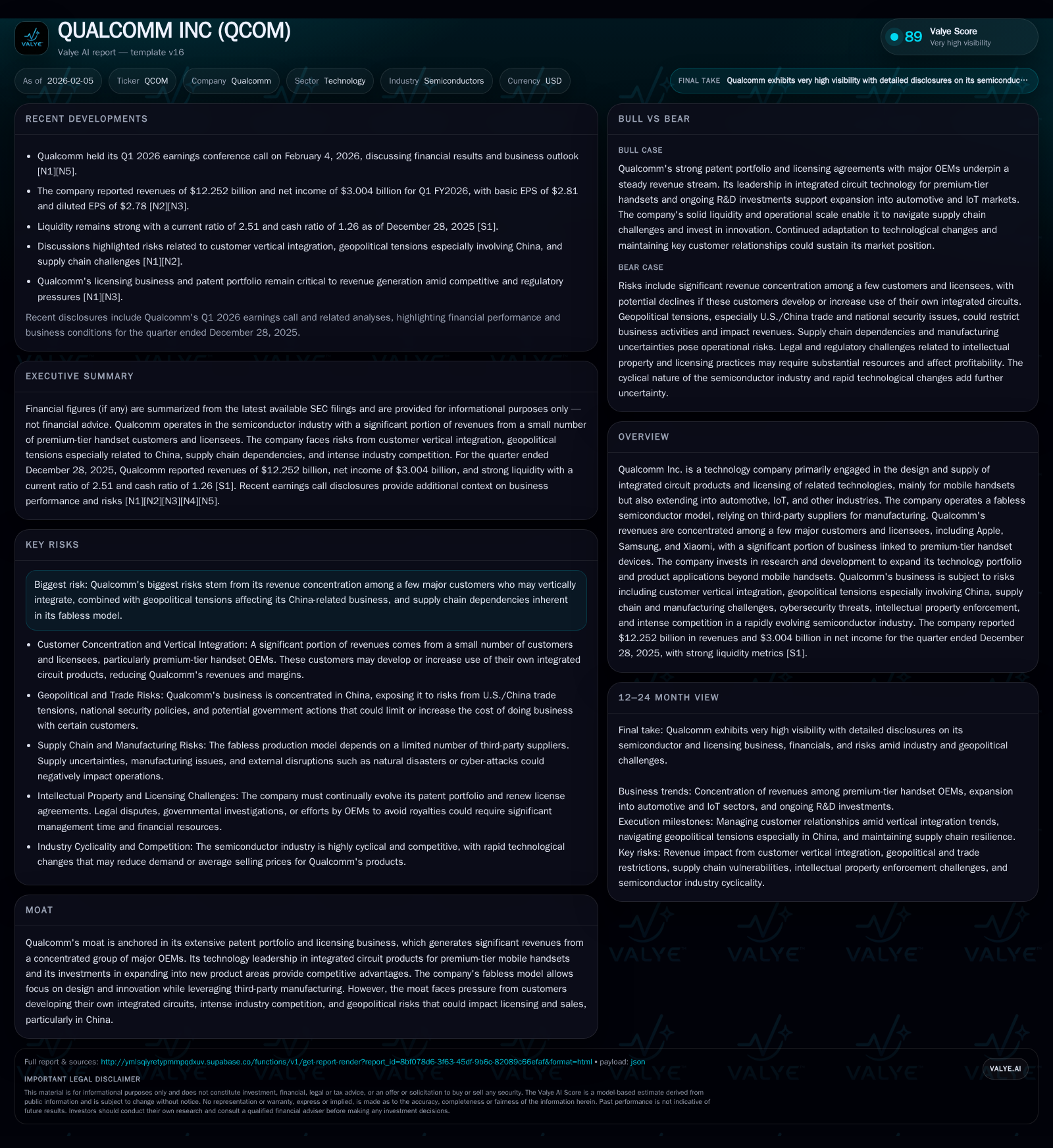
Qualcomm Inc. reported a notable Q1 2026 earnings beat amidst concerns about customer concentration and international trade tensions. The company leans heavily on major OEMs like Apple and Samsung, making its revenue streams vulnerable to shifts in their design strategies and geopolitical developments, especially involving China. Qualcomm’s patent licensing business provides a strong moat but faces threats from vertical integration by handset manufacturers. Its fabless manufacturing model offers agility but introduces supply chain risks that require ongoing management. Meanwhile, substantial R&D investments highlight ambitions to diversify beyond mobile devices into automotive and IoT sectors, although these initiatives carry execution risks that cloud the long-term outlook.
Navigating the Earnings Upside: Q1 2026 Results Contextualized
Qualcomm began fiscal 2026 on a strong note, beating consensus revenue estimates with $12.25 billion reported for the quarter ended December 28, 2025 [F1]. Net income reached $3.004 billion, reflecting operational efficiency despite prevailing global uncertainties [F1]. Early skepticism around demand softness in premium handsets failed to fully materialize as key customers maintained steady orders. During the earnings call, management emphasized resilience in chipset sales and strong licensing royalty inflows that bolstered overall profitability [N1]. This financial outperformance sets a cautiously optimistic tone but also invites scrutiny over sustainability given the underlying structural risks in Qualcomm’s business model.
The Customer Concentration Conundrum: Apple, Samsung, Xiaomi and Beyond
At the heart of Qualcomm’s risk profile is its dependency on a narrowly concentrated customer base. Apple, Samsung, and Xiaomi contribute disproportionately to revenue through chipset purchases and licensing agreements [S2]. These customers target premium-tier handsets where Qualcomm holds technological leadership; yet their increasing capabilities to design proprietary integrated circuits pose an ever-present threat [valye_report_excerpt]. The timing of device launches by these OEMs causes revenue volatility that complicates precise forecasting. Any strategic pivot from these partners toward vertical integration or alternative suppliers would materially impact Qualcomm’s top line due to reduced royalty payments and component sales [S2]. Thus, the company's fortunes remain tightly linked to this limited set of high-profile collaborators.
Licensing Moat Under Fire: Patent Strength Versus Vertical Integration Threats
Qualcomm's industry moat is fundamentally rooted in an extensive patent portfolio that commands royalties on critical mobile standards technologies [valye_report_excerpt][S2]. This licensing stream generates significant recurring revenue, underpinning its financial stability. However, recent trends reveal increasing vertical integration moves by large handset manufacturers attempting to internalize chip design functions to cut costs or enhance control over product roadmaps [S2]. Such efforts threaten to erode Qualcomm’s royalty base and challenge the legal enforcement landscape for patents internationally. Though Qualcomm continues aggressive patent litigation defenses and innovation investment to maintain dominance, the persistence of competitive IC development by customers injects uncertainty into the longevity of this competitive advantage.
Geopolitical Chessboard: U.S.-China Tensions Impacting Revenue Streams
Qualcomm operates within a geopolitical environment marked by strained U.S.-China relations that complicate its substantial business exposure in China [valye_report_excerpt][S2]. Chinese OEMs represent a sizeable portion of revenues both for chip sales and licensing royalties. Escalating trade restrictions, export controls targeting advanced semiconductor technologies, and national security scrutiny introduce added layers of operational risk for Qualcomm's China strategy [S2]. These multifaceted headwinds not only threaten direct revenue streams but may inhibit timely product deliveries or access to critical manufacturing equipment due to regulatory constraints. Qualcomm thus must navigate this chessboard delicately—balancing compliance with leveraging growth opportunities in one of the largest handset markets globally.
Fabless Model Dynamics: Advantages, Vulnerabilities, and Supply Chain Realities
As a fabless semiconductor company, Qualcomm concentrates on IC design while outsourcing fabrication to external foundries—a capital-light model fostering agility [valye_report_excerpt][S2]. This approach enables rapid technology iteration without heavy fixed asset burdens but introduces dependencies on third-party suppliers for manufacturing quality and delivery schedules [S2]. Supply chain disruptions—from geopolitical events to natural disasters or logistics bottlenecks—pose risks that can delay chipset shipments or inflate costs impacting margins. Moreover, maintaining technology leadership requires close coordination with foundries employing leading-edge process nodes. While Qualcomm benefits from flexible scale-up capabilities inherent in this model, supplier concentration limits room for maneuvering when capacity constraints arise.
R&D Ambitions: Expanding Qualcomm’s Footprint Beyond Mobile Devices
Recognizing the limitations of relying solely on smartphone-related revenues, Qualcomm invests heavily in R&D aimed at diversification [valye_report_excerpt][S1][S2]. Critical areas include automotive semiconductors for connected vehicles, IoT applications spanning smart infrastructure devices, and emerging wireless communication technologies beyond traditional handsets. These efforts reflect strategic intent to capture growth from next-generation platforms where integrated connectivity is essential. Yet such ventures currently represent nascent opportunities often characterized by longer development timelines and uncertain near-term contribution margins. Balancing robust R&D expenditure with prudent allocation remains imperative as Qualcomm seeks new profitable vectors without diluting core mobile chipset strengths.
Risk Radar: Cybersecurity, Market Volatility, and Acquisition Strategies
Among ongoing risks detailed recently are cybersecurity vulnerabilities that could imperil proprietary designs or cause operational disruptions if breached [S2]. Given the sensitive nature of industry IP assets and reliance on digital channels for licensing enforcement, robust defense mechanisms are critical. Additionally, semiconductor sector cyclicality introduces volatility risks amplified by macroeconomic factors influencing consumer device demand. Management’s strategy includes selective acquisitions designed to bolster technological capabilities or enter complementary markets; however integration complexities may pose challenges requiring careful stewardship to avoid value erosion [S2][valye_report_excerpt].
Financial Stability & Liquidity: Recent Balance Sheet Highlights
Qualcomm's balance sheet exhibits solid health with cash and cash equivalents totaling approximately $7.2 billion as of December 28, 2025 [F1]. Current assets reach $24.6 billion against current liabilities near $9.8 billion yielding a strong current ratio around 2.51 indicative of ample liquidity to meet short-term obligations comfortably [F1]. This financial stability provides a buffer amid fluctuating order cycles and allows sustained investment in R&D alongside potential strategic transactions.
Long-Term Outlook: Balancing Innovation Drive And Sector Competition
Looking ahead, Qualcomm faces a complex interplay of forces shaping its competitive stance [valye_report_excerpt][N8][N9]. Technological innovation remains its lifeblood; continued leadership in wireless modem chips paired with expanding patent coverage supports future relevancy. Yet intensifying competition from rivals advancing in both silicon design and alternative connectivity solutions demands relentless pace in product development cycles alongside astute business model evolution. Navigating customer consolidation trends while managing geopolitical crosscurrents will be crucial factors determining whether Qualcomm maintains its stronghold or experiences margin pressures undermining growth aspirations.
This analysis aims to provide an objective view of Qualcomm’s evolving strategic position grounded in recent disclosures and market commentary. It does not constitute investment advice but serves as a resource for understanding key operational dynamics influencing this important semiconductor player.
Disclaimer: This is research-only, informational analysis and not investment advice. It may include AI-generated interpretation and general industry context. Always verify important details using primary sources.

Comments