
Vicarious Surgical’s Path Toward FDA Approval and Market Impact
Evaluation of Vicarious Surgical’s innovative single-port robotics, regulatory challenges, and fragile financial state in early 2026.
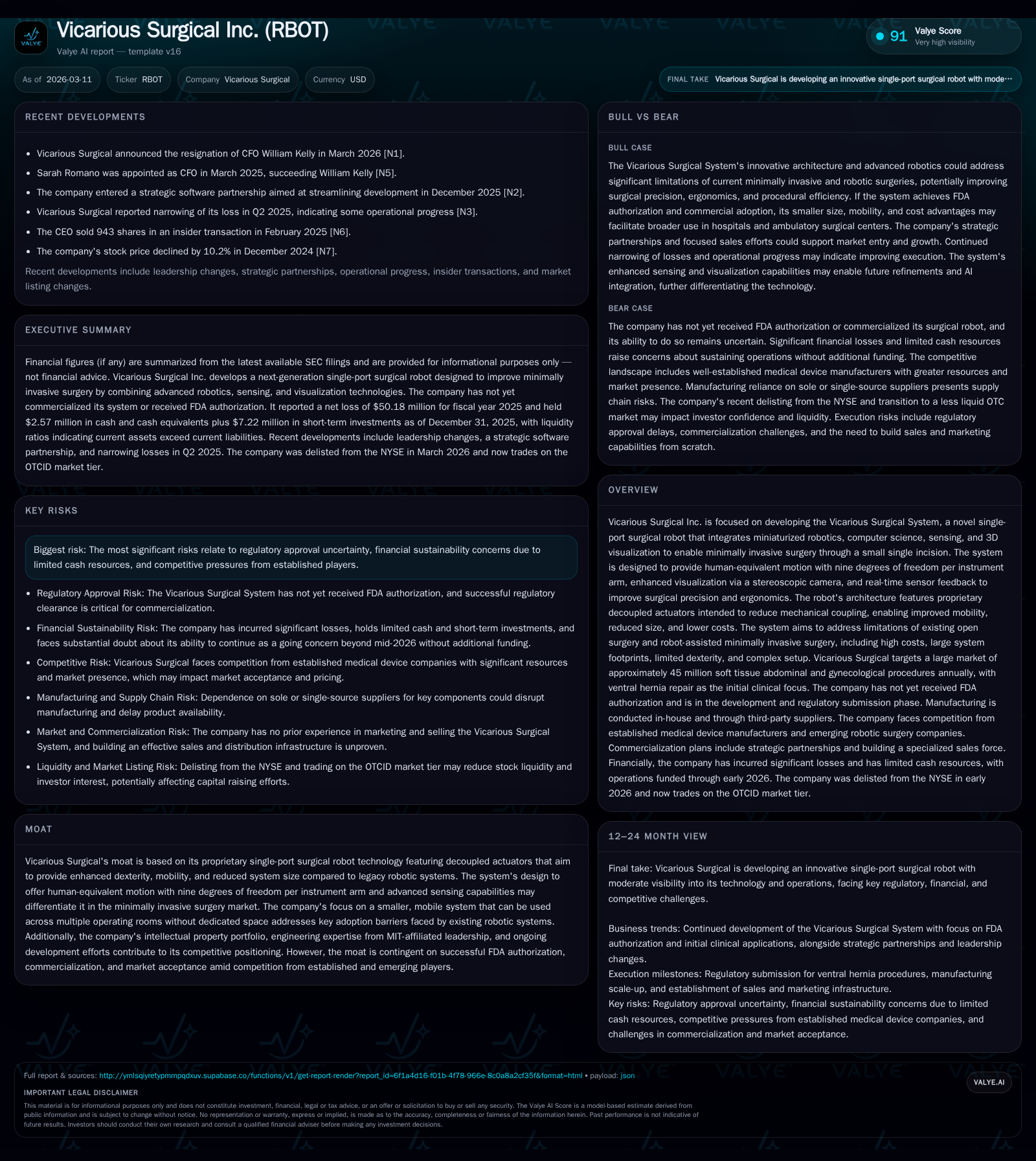
Vicarious Surgical Inc. is pioneering a novel single-port surgical robotic system with human-like dexterity and enhanced visualization, targeting unmet needs in minimally invasive surgery. Despite technological promise rooted in proprietary decoupled actuators and advanced sensing, the company faces significant headwinds including uncertain FDA approval timelines and severe financial constraints marked by sustained operating losses and limited cash runway. Its NYSE delisting and recent CFO departure underscore mounting investor concerns. Key upcoming FDA decisions and funding developments will be critical inflection points for commercialization feasibility and long-term viability.
Innovating Single-Port Robot-Assisted Surgery: Technology Overview and Differentiators
Vicarious Surgical’s principal innovation centers on its eponymous robotic system designed to facilitate minimally invasive surgeries via a single small abdominal incision. This approach contrasts with prevailing multi-port robotic systems that require several entry points, imposing spatial constraints often described as "triangulation" limitations among instrument arms [S1]. The company's technology employs proprietary decoupled actuators that mitigate mechanical coupling between joints—a source of bulkiness and restricted maneuverability in legacy platforms. This refinement theoretically enables more fluid robotic mobility akin to natural human arm movements.
The system's instruments boast nine degrees of freedom per arm, delivering surgeon-equivalent dexterity not commonly achieved in minimally invasive robotics. Complementing mechanical design is an advanced stereoscopic camera mounted on a gimbal capable of three degrees of rotational freedom (yaw, pitch, roll), which enhances intraoperative visualization across extended abdominal surfaces. Embedded force feedback sensors—28 per instrument—provide real-time haptic data allowing surgeons subtle control over manipulation forces during procedures [S1]. Together these features aim not only to improve precision but also operator ergonomics.
By addressing both space footprint reduction through single-port access and augmenting tactile plus visual feedback loops, Vicarious Surgical targets existing barriers limiting adoption of robot-assisted surgery—namely high cost structures, bulky hardware setups requiring dedicated OR space, and dexterity restrictions [S1]. The system’s modular architecture intends to support portability across multiple operating theaters potentially lowering hospital capital expenditure burdens compared to entrenched competitors.
Historical Performance and Key Growth Drivers Through 2025
Despite clear technological ambitions, Vicarious Surgical’s financial trajectory underscores severe operating challenges. From fiscal year (FY) 2022 through FY2025, the company has recorded persistent operating losses though with some amelioration most recently. Operating income deteriorated from -$80.1 million in FY2022 to -$80.7 million in FY2023 before trimming to -$66.6 million in FY2024 and further narrowing to -$50.0 million in FY2025 [F1]. Net income followed a similar pattern: a reported modest positive net income in FY2022 ($5.2 million) reversed sharply into losses exceeding $71 million in FY2023; improving somewhat over successive years (-$63.2 million in FY2024; -$50.2 million in FY2025) though remaining deeply negative [F1].
Operating cash flow mirrored this trend with large negative values each year (-$61.2 million in FY2022 tapering slightly to -$45.1 million by FY2025). Capital expenditures contracted steeply from $1.67 million down to just $132 thousand by FY2025 indicating a scaling back of fixed asset investments consistent with financial conservation efforts [F1]. Equity capital declined substantially year-over-year—from approximately $111 million at end-FY2022 down to $9.8 million at end-FY2025—reflecting cumulative losses eroding net assets [F1].
Historical performance (annual)
| FY | Net ($mm) | CFO ($mm) | OpInc ($mm) | Capex ($) | Net YoY |
|---|---|---|---|---|---|
| 2025 | -50 | -45 | -50 | 132000 | +20.6% |
| 2024 | -63 | -50 | -67 | 180000 | +11.0% |
| 2023 | -71 | -62 | -81 | 1670000 | -1478.1% |
| 2022 | 5 | -61 | -80 |
Source: SEC companyfacts cache [F1].
Capital returns and efficiency (annual)
| FY | FCF ($mm) | ROE% |
|---|---|---|
| 2025 | -45 | -509.9 |
| 2024 | -50 | -135.4 |
| 2023 | -64 | -72.5 |
| 2022 | 4.6 |
Source: SEC companyfacts cache [F1].
This table summarizes the annual financial performance reflecting consistent deep operating losses despite modest improvement starting in late cycles.
Regulatory Milestones: FDA Authorization Prospects and Risks
The Vicarious Surgical System is classified as a medical device regulated under the Federal Food Drug & Cosmetic Act (FDCA) by the U.S. Food and Drug Administration (FDA) [S7]. This regulatory environment mandates rigorous pre-market testing for safety and efficacy including potentially costly clinical trials along with manufacturing controls under Quality Management System Regulations.
Vicarious submitted its device for regulatory clearance expecting breakthrough designation benefits aimed at expediting review timelines; however authorizations remain pending [S9]. The company acknowledges the uncertainty surrounding FDA authorization timing compounded by evolving legislative scrutiny over medical device approvals more broadly [S14]. Additional complexities arise from requirements for diversity action plans in pivotal trials which may introduce delays if negotiations with the FDA prove protracted [S26].
Post-market compliance will demand adherence to adverse event reporting rules alongside surveillance inspections necessitating ongoing investment beyond approval [S26]. Failure at any stage can delay or block market introduction or trigger costly recalls affecting reputation.
Navigating Financial Constraints: Operating Losses, Cash Runway, and Capital Structure
Liquidity represents one of Vicarious Surgical’s most pressing issues at present. As of December 31, 2025 the company held approximately $2.57 million in cash equivalents supplemented by $7.2 million in short-term investments totaling roughly $9.8 million readily accessible funds [F1]. Given operating burn rates evidenced by cash flow trends near negative $45 million annually even adjusted conservatively implies operational viability lasting only until mid-2026.
Management has disclosed "substantial doubt about going concern" status in its latest annual report outlining urgent need for fresh capital infusion or strategic partnerships to continue operations beyond Q2 2026 without discontinuation risk [S1]. The recent resignation of CFO William Kelly on March 11 reflects possible internal instability during this liquidity crunch period [N1].
The firm was subject on March 3 to NYSE suspension of its common stock trading due to failure to meet minimum market capitalization listing criteria of $15 million prompting delisting proceedings; shares shifted immediately onto a far less liquid OTCID market tier under ticker RBOT risking depressed valuation levels [S16][N1]. This transition restricts access to broader capital markets complicating fundraising efforts critical for sustaining product development or commercial launch preparations.
Commercialization Challenges and Market Adoption Considerations
Even with eventual regulatory approval secured months or possibly years hence commercialization hurdles remain formidable according to SEC-documented risk disclosures [S6][S7]. Surgeon training complexity inheres in mastering a new single-port approach divergent from multi-port standard practice where triangulation facilitates intuitive spatial manipulation — here constrained precision requires thorough retraining mitigating widespread rapid adoption.
Third-party reimbursement environments add further uncertainty as government payors including Medicare/Medicaid require proof of medical necessity coupled with pricing transparency before covering such surgical modalities often delaying revenue recognition until clinical efficacy is well demonstrated [S6]. Fierce competition persists from incumbents like Intuitive Surgical whose Da Vinci platform dominates with entrenched installed base limiting immediate market share gains for newcomers [S18].
Accordingly Vicarious anticipates leveraging strategic partnerships initially alongside developing specialized direct sales capability post-approval rather than immediate broad-based marketing expansion given commercial scale limitations [S18][F1].
Strategic Capital Allocation: Evaluating Use of Cash, Returns, and Capital Raises
Reflecting its startup phase nature compounded by regulatory uncertainties the company exhibits deeply negative return on equity approximated near minus 510 percent using trailing net income over equity book value as proxy [F1]. Free cash flow remains negative given dramatic operating cash outflows dwarf minimal capital expenditure activities constrained below $150 thousand annually recently indicative of stringent cost containment measures adjusting burn rate but also stifling growth investments [F1].
Fiscal reports indicate no dividends or buyback programs reflecting prioritization of survival capital preservation over shareholder returns currently [F1].[S1] Management explicitly cites pursuing multiple funding avenues—public equity offers or private placements alongside potential licensing agreements or strategic alliances aiming at liquidity extension—but caveats on success probability reinforce fragility of outlook.
Risk Assessment: Competitive Landscape and Regulatory Compliance
Risks extend beyond financing into formidable competition within an industry dominated by established players possessing scalable manufacturing capabilities plus deep clinical relationships including Intuitive Surgical and conglomerates like Johnson & Johnson and Medtronic entering robotic surgery via acquisitions or internal development initiatives [S18]. Emerging industrial robotics entrants also threaten technology commoditization dynamics increasing price sensitivity.
Additionally stringent federal anti-kickback statutes alongside physician self-referral laws impose complex compliance frameworks addressed extensively in filings underscoring risks tied to contractual arrangements impacting reimbursement eligibility risking penalties or exclusion from government-funded healthcare programs if breached inadvertently or otherwise [S4][S7][S23]. Elevating this regulatory burden are transparency laws such as Physician Payments Sunshine Act mandating public disclosures on manufacturer-provider financial transfers complicating marketing practices compliance further raising operational costs.[S24]
Cybersecurity regulations newly mandated after FDORA amendments impose requirements on embedded software safeguarding necessitating robust software bill-of-materials submissions plus vulnerability monitoring intensifying pre-approval documentation demands.[S13]
Looking Ahead: Key Catalysts, Potential Licensing Deals, and Investor Takeaways
Among pivotal catalysts shaping near-term outlook are expected FDA marketing authorization outcomes critical for unlocking commercialization pathways given system integration uniqueness versus established platforms.[S9][S14] Parallelly investor focus must remain acute on ongoing liquidity management progress including identification of viable funding rounds or strategic agreements as recounted by management dialogue underscoring existential stakes.[N1][S16]
No explicit public forward guidance exists; therefore observers should monitor updates regarding trial completions or regulatory feedback alongside potential partnership announcements signaling market validation.[S1] These binary events hold potential either conversely exacerbating valuation pressures if delayed or materially de-risking path toward revenue generation if positive.
This analysis is based exclusively on publicly filed data with SEC references as of early March 2026 along with credible news reports capturing leadership transitions affecting corporate governance dynamics without extrapolating beyond disclosed facts. It aims solely at illuminating technological innovation juxtaposed against the consequential financial realities confronting Vicarious Surgical Inc., abstaining from investment recommendations.
Disclaimer: This is research-only, informational analysis and not investment advice. It may include AI-generated interpretation and general industry context. Always verify important details using primary sources.

Comments