
Roadzen Inc.'s AI Platform Advances Insurance Efficiency with Regulatory Moat Amid Litigation
Roadzen’s August 2026 quarter highlights growing client traction and regulatory differentiation counterbalanced by costly unresolved litigation risks.
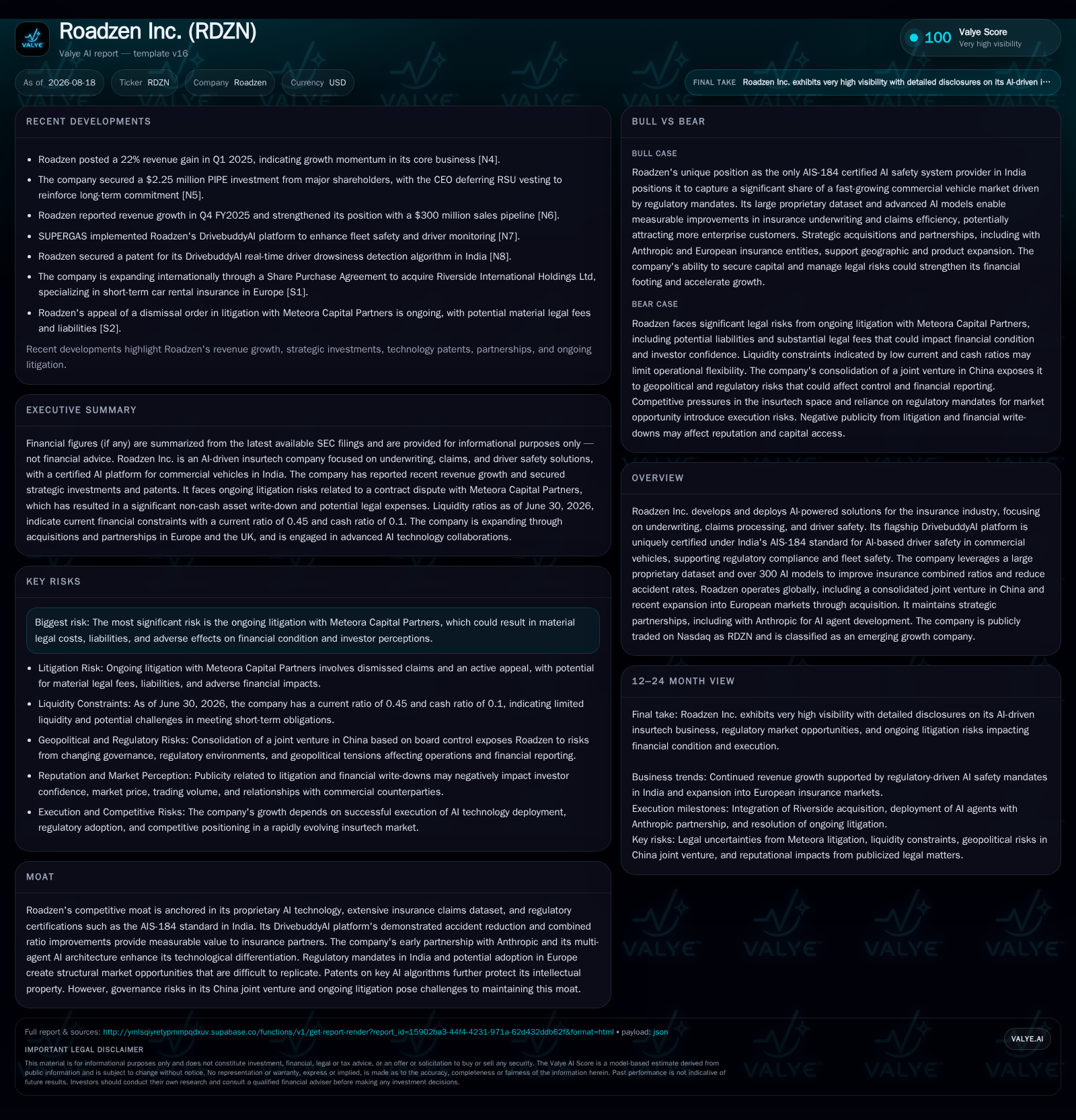
Roadzen Inc.'s latest quarterly filing shows expansion in insurance and automotive customer agreements underpinning deeper adoption of its DrivebuddyAI platform, uniquely certified under India's AIS-184 standard. The company's hybrid revenue model blends embedded commission income and fee-based AI telematics services across global markets including Europe via MGA licenses. However, ongoing litigation with Meteora Capital Partners presents significant legal expense pressures and outcome uncertainty that restrain near-term financial visibility. Roadzen’s growth depends on regulatory mandates, telematics adoption, and distribution scale, while risk concentrates in client renewals and legal disputes.
Latest Quarter Signals: Operational Scale Gains Versus Heightened Legal Headwinds
Roadzen Inc.’s August 13, 2026 quarterly report highlights continued operational progress characterized by a rise in insurance customer agreements to 61 from 34 in prior year and increased automotive/fleet client signings as detailed in the latest SEC disclosures [S2][S1]. This growth underscores enhanced penetration of their AI-driven Insurance as a Service (IaaS) platform across underwriting, distribution, claims, and driving safety domains. Concurrently, the company faces mounting legal expenses associated with its protracted litigation against Meteora Capital Partners. Although the US District Court for the Southern District of New York dismissed most of Roadzen’s claims in July 2026, Roadzen has notified an appeal to the Second Circuit Court, introducing uncertainty around recoverable contract proceeds from this dispute [S2]. The simultaneous expansion of client agreements alongside considerable legal headwinds frames Roadzen’s near-term operating environment.
'DrivebuddyAI' Platform Differentiation Bolstered by AIS-184 Certification in India
A cornerstone of Roadzen's competitive positioning is its DrivebuddyAI platform's unique certification under India’s AIS-184 regulatory standard governing AI-based driver safety technology for commercial vehicles. This certification not only validates technical rigor but effectively establishes a regulatory moat enabling mandated adoption among Indian commercial fleets seeking compliance and risk mitigation [S1]. The platform leverages extensive telematics data combined with computer vision-driven AI models—which number over 300—to reduce accident rates meaningfully and improve insurance combined ratios for insurer partners. By quantifying accident reduction impacts linked to DrivebuddyAI usage, Roadzen provides insurers measurable underwriting cost reductions, enhancing value proposition durability versus peers without such recognized certifications or demonstrated efficacy.
Hybrid Revenue Model Anchored by Embedded Commissions and Fee-Based AI Services
Roadzen operates a hybrid business model combining commission-generated revenues from embedded insurance brokerage with recurring fee-based income derived from its cloud-hosted AI telematics and claims adjudication platforms. Embedded insurance through B2B2C channels—selling policies via insurers, OEMs, fleets, or brokers rather than direct-to-consumer—lowers customer acquisition costs relative to pure retail insurers or SaaS vendors by leveraging existing distribution infrastructure [S1]. Meanwhile, fee-based licensing of AI-driven analytics generates higher-margin recurring revenue streams that enhance long-term revenue visibility as platform adoption scales. This blended monetization strategy contrasts with peers like Lemonade or Root Insurance who focus primarily on direct digital sales or telematics underwriting respectively—highlighting Roadzen’s differentiated positioning as both technology enabler and managing general agent (MGA) in some regions.
MGA Model in Europe Supports Regulatory Compliance but Adds Execution Complexity
To navigate varied European insurance regulations, Roadzen operates a specialized MGA headquartered in Coventry, UK. Holding local underwriting licenses allows it to write policies directly compliant with national frameworks while offering ancillary extended warranties and claims management services. This MGA acts as delegated authority on behalf of insurers facilitating both policy issuance and claims adjudication through brokerage platforms integrated with insurer back-end systems [S1]. While this model supports rapid market access amidst complex regulatory landscapes—paramount for scaling internationally—it introduces operational complexity requiring managing distinct compliance regimes across jurisdictions. Such arrangements differ from typical insurtech SaaS vendors who focus more narrowly on software licensing without underwriting responsibilities.
Client Concentration And Proprietary Dataset As Growth Moats Amid Competition
Despite the growing breadth of its client base across insurers, automotive OEMs, and fleet operators—now totaling over 4,200 agents/fleet agreements with insurers comprising ~40% of enterprise customers—Roadzen retains significant revenue concentration risk. Three customers constituted approximately 13%, 10%, and 8% of total revenue respectively in fiscal year ended March 31, 2026; together with top ten clients they represent about 56% of revenue [S1]. Contracts may be cancellable or non-renewed on relatively short notice due to the brokerage nature or service engagement models. Nevertheless, Roadzen’s proprietary AI dataset amassed from telematics feeds combined with computer vision-derived driver behavior analytics supports higher-accuracy underwriting and loss prediction models that are difficult for competitors to replicate quickly. This dual effect reinforces competitive moats but necessitates ongoing client retention focus.
Scaling Growth Drivers: Regulatory Mandates, Telematics Adoption, And B2B2C Channels
Roadzen’s mid-term growth prospects hinge upon several converging structural catalysts. First is the increasing regulatory push globally for driver safety mandates similar to India’s AIS-184 requirement compelling commercial fleet operators toward telematics-enabled monitoring solutions evidencing compliance and accident reduction efficacy [S1]. Rising insurer appetite for granular usage data intensifies adoption of AI-augmented underwriting techniques that improve risk segmentation beyond traditional rating factors. Additionally, expanding embedded insurance distribution through OEMs and captive broker networks facilitates efficient scale via B2B2C platforms lowering customer acquisition costs relative to retail-focused competitors [S2][S1]. Collectively these drivers align with key insurtech sector trends favoring integrated technological ecosystems coupling AI analytics with distribution capabilities.
Risks Spotlight: Ongoing Meteora Litigation And Client/Renewal Dependence
The largest identifiable near-term risk factor remains the unresolved contractual dispute with Meteora Capital Partners stemming from an August 2023 Forward Purchase Agreement under which Meteora agreed to acquire shares but allegedly failed to remit owed payments per terms agreed by Roadzen. After the USDC NY court's July dismissal order granted much of Meteora’s motion to dismiss—including breach of contract and RICO-related counts—Roadzen has lodged an appeal pending at the appellate level but outcome uncertainties loom large [S2][S19][S25]. The company incurs significant ongoing legal costs related to this litigation which also diverts management attention away from commercial execution. Further complicating risk exposure is heavy client concentration where loss or non-renewal of key contracts could materially disrupt revenue streams given that a small number of clients account for over half total revenues [S1].
What To Watch: Litigation Appeal Outcome And Customer Agreement Expansion
Investors should closely monitor procedural developments in the Second Circuit appeal concerning the Meteora litigation as timing or adverse rulings could materially impact balance sheet valuation assumptions related to receivables under dispute [S2][S3]. Additionally, forthcoming quarterly filings will be critical to assess continued momentum in new insurance customer agreements and renewals signaling sustained traction of platform adoption amid intensifying competition. However, the company’s current liabilities exceed current assets, yielding a current ratio around 0.45, which may reflect accrued legal payables among other operational expenses [F1]. While the balance sheet indicates net positive liquidity, ongoing legal expense accruals related to the Meteora proceedings add pressure on earnings quality and cash flow visibility. These factors underscore the challenges faced during this investment phase, consistent with scaling-stage insurtech peers focused on market capture over near-term profitability [F1][S2].
This analysis synthesizes all latest publicly available operating details from Roadzen Inc.’s SEC filings through August 2026 contextualized within the broader insurtech AI landscape without inferring speculative financial outcomes or undisclosed commercial terms. No investment advice is provided herein.
Disclaimer: This is research-only, informational analysis and not investment advice. It may include AI-generated interpretation and general industry context. Always verify important details using primary sources.

Comments