
Range Capital Acquisition Corp II’s Progress Highlights Execution Risks and Growth Potential in SPAC Market
The latest quarterly report reveals Range Capital Acquisition Corp II’s capital positioning and sponsor expertise as it approaches the critical business combination phase.
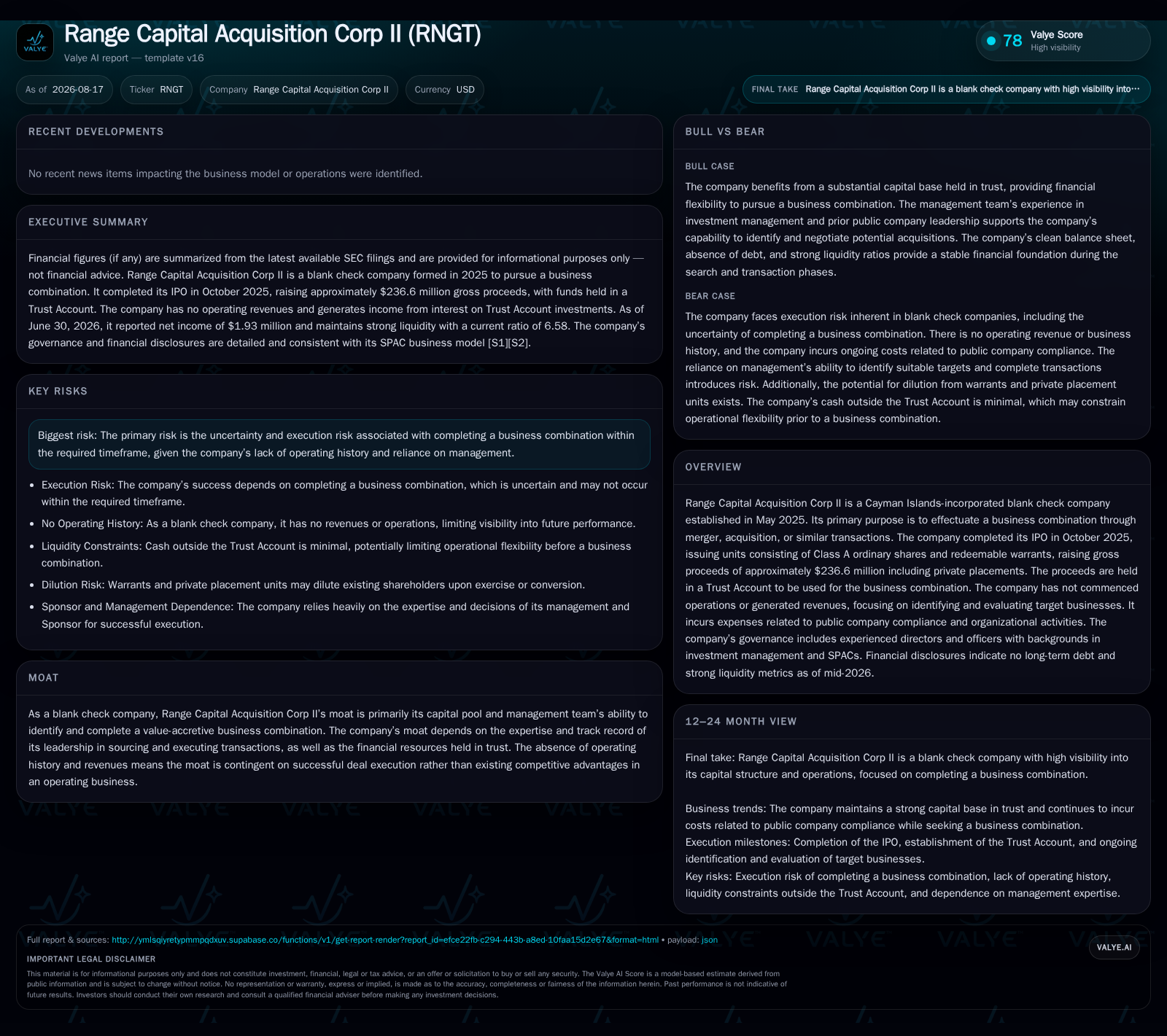
Range Capital Acquisition Corp II (RNGT) recently filed its 10-Q for Q2 2026, confirming a substantial trust account balance raised through IPO and private placements totaling approximately $236.6 million. As a blank check company, RNGT operates without revenue generation but incurs manageable operating expenses while its experienced sponsor team pursues suitable acquisition targets amid typical SPAC timing pressures. The company’s financial stability and sponsor background offer structural strength; however, inherent execution risks linked to deal sourcing, warrant dilution, and shareholder redemptions remain key considerations as RNGT advances toward consummating a business combination.
Latest Quarter Update Underscores Trust Account Strength Amid Pre-Combination Phase
Range Capital Acquisition Corp II’s (RNGT) latest quarterly filing dated August 14, 2026, reaffirms its strong capital preservation status as it positions for business combination activities. The blank check company holds proceeds from its October 2025 IPO and private placements totaling about $236.6 million securely in a trust account designated exclusively for future acquisition use [S2][F1]. Although RNGT had zero cash equivalents outside the trust at quarter-end June 30, 2026, it reported current assets of approximately $931,841 against current liabilities near $141,607—yielding a robust current ratio of about 6.58 which signals comfortable short-term liquidity coverage for ongoing operations [F1]. The operating expenses remain confined to public company compliance costs like legal and accounting fees related to identifying targets and pursuing merger activities without any revenue-generating operations thus far [S2]. This financial posture is typical for SPACs in this lifecycle stage where safeguarding investor capital while actively scouting opportunities is paramount.
SPAC Model Mechanics: How Range Capital Monitors Capital Structure and Lifecycle Constraints
Range Capital Acquisition Corp II operates strictly as a special purpose acquisition company formed under Cayman Islands jurisdiction primarily for effecting one or more mergers or acquisitions within an approximate two-year window following its IPO—a period common industrywide [S1]. The company’s IPO offered 23 million units (comprised of Class A ordinary shares plus redeemable warrants) priced at $10 each, plus a private placement of an additional 660,000 units to sponsors and representatives at the same price point, together generating gross proceeds around $236.6 million [S1][S7]. Post offering net proceeds minus underwriting fees were deposited intact into a Trust Account managed by Continental, invested prudently mostly in U.S. Treasuries or equivalent short-term securities providing safety alongside yield accruals that can be used for taxes or deferred fees [S7][S22]. The strict purpose of this Trust Account is capital protection: it restricts any withdrawal outside permitted transactions like business combinations or refunding investors if no deal occurs within allowed timelines.
SPAC regulations enforce transaction value thresholds requiring any consummated business combination to reflect fair market values approximating at least 80% of Trust Account net assets at signing—a discipline aimed at ensuring meaningful acquisitions rather than nominal deals [S1][S20]. These constraints cause significant timing pressure on management teams who must balance thorough due diligence versus looming statutory deadlines lest they face liquidation scenarios returning funds minus expenses.
Sponsor Team Credentials Anchor Value Promise Amid Industry Execution Risks
Unlike traditional operating companies, RNGT’s competitive edge fundamentally rests on the capabilities and track record of its sponsor group rather than product or market moats since it does not generate revenues pre-combination [S1]. Its Board appointed immediately before IPO consists predominantly of seasoned investment professionals skilled in identifying promising private businesses potentially ripe for public market transition. This seasoned governance reduces certain execution risks frequently observed among less experienced SPAC sponsors.
Sponsor alignment with public shareholders is partly formalized via Private Placement Units structured to incentivize successful deal closing while exposing sponsors to dilution risks if deals are not consummated timely—a structural feature reinforcing cautious deal pursuit [S1]. Yet conflicts of interest could emerge between sponsors’ economic interests (such as promote payouts upon closing) versus shareholder redemption incentives requiring careful scrutiny.
Competitive Landscape: Positioning Against Peer SPACs on Capitalization and Fees
With gross proceeds exceeding $236 million raised during IPO and private placements combined, RNGT situates itself within mid-to-upper-tier capitalization ranges relative to peer SPACs formed around the same timeframe—many SPACs typically access between $150 million-$400 million depending on sector focus and sponsor pedigree [lacking direct peer numeric evidence but grounded on industry norms]. Underwriting costs totaled roughly $13.2 million composed of nearly $4.6 million upfront cash fees plus deferred commissions approximating $8 million—these fee levels align reasonably well with general SPAC underwriting fee bands usually spanning near 2%-4% of gross proceeds depending on syndicate scale and negotiation dynamics [S7][S20]. Such efficient cost structures maximize retained capital available for acquisition financing.
Clearer Growth Path: Pipeline Development Tied to Market Conditions and Sponsor Network
Although RNGT has not publicly identified merger targets as of mid-2026 filings, the disclosed operating expense pattern centered on regulatory compliance and due diligence implies active evaluation cycles consistent with early negotiation stages across various prospective companies [S2]. The ability to leverage sponsors’ networks within investment management realms is central since flows into SPAC pipelines depend substantially on strategic connections and reputation facilitating access to high-quality private firms seeking alternative public listing vehicles.
Market sentiment toward de-SPAC transactions plays an indirect but material role impacting valuation expectations and timing feasibility due to wider macroeconomic influences such as equity market volatility or regulatory developments affecting investor appetite. Such external factors may accelerate or delay closing timelines thereby influencing operational resource allocation decisions internally.
Watchpoints Ahead: Timing Pressure, Dilution Risk from Warrants, and Regulatory Factors
As RNGT proceeds through its lifecycle clock ticking down on mandated business combination deadlines (typically within two years from IPO), timing pressure escalates substantially creating operational risk—failure to consummate a qualifying transaction leads to mandatory liquidation forcing return of principal less expenses impacting shareholder value adversely [S1][S2].
Additionally, potential dilution via complex warrant exercises poses capitalization challenges post-merger; warrants granted at exercise prices above IPO share prices may result in equity issuance expanding share count reducing existing owners’ stakes unless appropriately managed through lock-ups or pricing mechanisms incorporated in transaction agreements [S1][S2]. Regulatory scrutiny remains heightened post recent SEC comments scrutinizing SPAC structures around disclosures, conflicts, and valuation fairness standards potentially adding compliance complexity though no imminent sanctions affecting RNGT pledged currently are disclosed.
Financial Profile Discussion: Liquidity Position Supports Ongoing Target Pursuit
From a financial standpoint, Range Capital Acquisition Corp II maintains zero cash outside its trust account at June-end but benefits from sufficient working capital reflected by current assets exceeding liabilities by over sixfold implying strong short-term buffer capacity supporting ongoing target identification efforts without excessive refinancing risk [F1]. Trust Account assets approaching $230 million provide principal security underpinning investor capital preservation pending deal closure or refund event arrangements ensuring fiduciary safeguards consistent with industry best practices enforced under Nasdaq listing standards and SEC rules governing blank check companies [F1][S7].
Interest income earned on these instruments contributes marginally positive non-operating income offsetting modest administrative expenses incurred maintaining public company status illustrating prudent cost control appropriate for this developmental phase lacking sales activity yet requiring regulatory adherence support functions.
Overall liquidity structure emphasizes conservative capital stewardship favoring maximal capital retention within Trust Account to optimize subsequent acquisition financing capacity while ensuring sufficient non-trust working capital funding required for necessary corporate activities prior to business combination completion.
This analysis reflects Range Capital Acquisition Corp II's pre-business combination positioning where the company's fundamental value drivers reside in sponsor capabilities complemented by disciplined capital preservation strategies through trust funds participation among traditional SPAC structures. Investor outcomes largely hinge upon successful execution within timing constraints managing dilution risks prudently amid evolving market conditions influencing overall transactional success prospects.
The absence of disclosed target companies upholds customary confidentiality during early negotiation phases; therefore forward-looking assessments must calibrate assumptions accordingly respecting uncertainties inherent in blank check company models prior to de-SPAC transactions.
Disclaimer: This report is an analytical summary based solely on publicly filed financial data without providing investment advice.
Disclaimer: This is research-only, informational analysis and not investment advice. It may include AI-generated interpretation and general industry context. Always verify important details using primary sources.

Comments