
Rapid7’s Financial Turnaround and Strategic Liquidity Management in Cybersecurity
An analysis of Rapid7’s transition from losses to profitability, emphasizing its liquidity strategies and evolving leadership amid industry pressures.
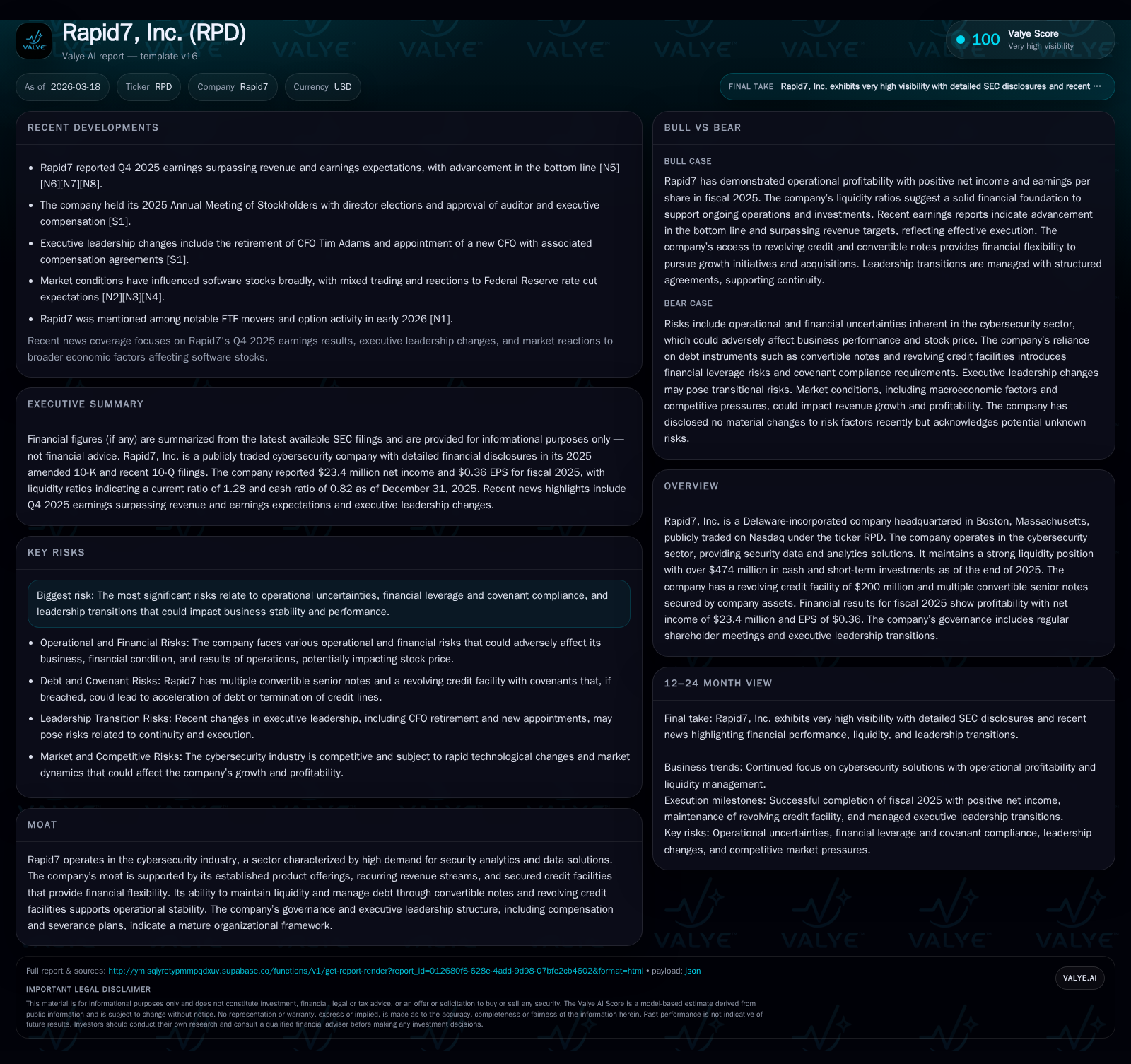
Rapid7 has shifted from multi-year large net losses to achieving profitability in fiscal 2025, underpinned by sustained revenue growth of approximately 28% year-over-year through 2022. This turnaround comes alongside compressed operating income margins due to increased capital expenditures. The company’s $200 million revolving credit facility and convertible senior notes provide a solid liquidity framework essential for operational stability and strategic initiatives. Leadership changes and covenant compliance risks represent notable challenges as Rapid7 navigates a competitive cybersecurity landscape.
From Deficits to Net Income: Tracing Rapid7’s Financial Evolution
Rapid7’s financial trajectory over recent years paints a vivid picture of a cybersecurity firm transitioning from heavy deficits toward profitability. Revenue exhibited steady increases, climbing from roughly $327 million in fiscal 2019 to about $685 million by the end of 2022, implying a compounded double-digit growth rate near 28% year-over-year during this period ([F1]). Despite top-line gains, the company grappled with substantial operating losses reaching −$111.6 million in 2022. This loss magnitude lessened sequentially through fiscal 2023 (−$80.7 million) culminating in an operating income of $11.6 million by fiscal 2025—signaling a significant structural shift.
Net income followed a similar arc—transitioning from losses exceeding −$124.7 million in 2022 to positive earnings of $23.4 million in fiscal 2025 ([F1]). Concurrently, equity swung from negative territory (−$120.1 million at end-2022) into positive book value ($154.7 million at end-2025), enabling an approximate return on equity (ROE) of circa 15.1%. This swing underscores the strengthening business model stability likely supported by persistent recurring revenue streams characteristic of SaaS-based cybersecurity offerings.
Historical performance (annual)
| FY | Net ($mm) | CFO ($mm) | OpInc ($mm) | Capex ($mm) | Net YoY |
|---|---|---|---|---|---|
| 2025 | 23 | 154 | 12 | 8 | -8.4% |
| 2024 | 26 | 172 | 35 | 3 | +117.1% |
| 2023 | -149 | 104 | -81 | 4 | -19.7% |
| 2022 | -125 | 78 | -112 | 20 |
Source: SEC companyfacts cache [F1].
Capital returns and efficiency (annual)
| FY | FCF ($mm) | ROE% |
|---|---|---|
| 2025 | 146 | 15.1 |
| 2024 | 168 | 144.1 |
| 2023 | 100 | 126.3 |
| 2022 | 58 | 103.9 |
Source: SEC companyfacts cache [F1].
Note: Some YoY comparisons omitted due to data gaps.
Liquidity Backbone: Revolving Credit and Convertible Notes Supporting Operational Stability
Liquidity management remains central to Rapid7’s operational resilience amid its financial recovery phase. In June 2025 the company secured a senior secured revolving credit facility totaling up to $200 million ([S4],[S5],[S7],[S26],[S27]). This facility is designed for flexible use across working capital needs and permitted acquisitions. It allows voluntary prepayment without penalty but imposes financial covenants including net leverage ratio limits and minimum interest coverage thresholds.
Rapid7 must maintain liquidity above certain thresholds near maturity dates of convertible senior notes due in 2027 and 2029; failure here triggers accelerated repayment or termination conditions ([S4],[S5]). As of fiscal year-end 2025 reporting a cash & equivalents balance around $246.7 million ([F1]), these measures suggest sufficient buffers but necessitate disciplined leverage monitoring given the underlying debt structure.
The credit agreement also extends guarantees by subsidiaries on substantially all assets supporting lenders’ collateral positions ([S4],[S5]). Covenants restrict indebtedness levels and mandate compliance with affirmative/negative conditions impacting dividends and corporate actions—factors directly influencing financial flexibility going forward.
Profitability Pressures: Revenue Gains Offset by Operating Income Fluctuations
Although revenue growth remains robust historically (28% CAGR through FY22), operating income volatility highlights ongoing pressures within Rapid7’s expense structure. After swinging back into positive territory with $35 million operating income in FY24 ([F1]), the subsequent FY25 result declined roughly by two-thirds (67%) to about $11.6 million despite top-line momentum.
This contraction aligns closely with rising capital expenditure commitments ($7.6 million vs $3.4 million prior year), representing a nearly +122% jump ([F1]). Elevated capex likely reflects intensified investment in product enhancements critical for sustaining competitive differentiation within cybersecurity analytics markets where innovation velocity is vital.
Such elevated reinvestment pressures temporarily compress margins even amid revenue strength—a characteristic tension seen in software-driven security firms balancing scale efficiencies against R&D intensity.
Governance and Leadership Shifts: Navigating Executive Transitions and Risk Factors
Governance dynamics illustrate ongoing executive turnover risks that could impact strategic continuity. In August-November 2025 periods spanning Rapid7 saw its Chief Financial Officer announce retirement effective early-2026 ([S8],[S21]) with a successor appointed later that year bringing experience from cybersecurity SaaS firms ([S22],[S26]). Simultaneously board leadership changed with new Chairman appointments at mid-2025 ([S16]).
Severance arrangements attached to executive departures denote typical protections but also potential short-term cost considerations ([S9]). Operational uncertainties tied to these shifts coincide with existing financial leverage risks flagged across SEC risk disclosures highlighting covenant compliance as materially significant ([S6],[S8]).
While mature governance structures support risk mitigation capacity broadly investors should remain alert to execution volatility stemming from leadership transitions.
Future Growth Prospects in Security Analytics: Opportunities and Headwinds
Given strong industry tailwinds favoring expanded security data analytics adoption fueled by escalating cyber threats globally , Rapid7’s accelerating revenue base aligns with sector demand momentum ([N3],[N10]). However analysts highlight concerns about near-term earnings softness driven by elevated reinvestment needs and macroeconomic tightening reflected in decreased expectations for federal rate cuts affecting funding costs ([N5],[N7],[N8],[N9]).
Operationally building upon established recurring revenue streams remains crucial yet growth ceilings may arise if leverage-induced constraints limit aggressive expansion or if increased competition intensifies pricing pressure ([S6],[S8]).
Continued product innovation powered through capital expenditure is essential but places short-run strain on profitability metrics even as it lays groundwork for mid-term scalability.
Capital Allocation: Cash Flow Strength and Absence of Dividends or Buybacks
Robust operating cash flow generation remains a hallmark with approximately $154 million produced in fiscal year ending December 31st, 2025 offsetting capex spend resulting in free cash flow near $146 million ([F1]). This liquidity reflects operational robustness supportive of servicing debt obligations arising from convertible notes and revolver borrowings.
Return on equity near +15% signals improving shareholder value creation after years affected by losses ([F1]). Importantly no dividends or share repurchases have been declared recently indicating conservative capital deployment priorities focused on reinvestment and balance sheet strengthening over distributions ([S23],[S25]). This approach aligns with typical growth-stage cybersecurity firms managing covenant limits.
What to Monitor: Quarterly Earnings, Covenant Compliance and Market Sentiment
Looking ahead into calendar year quarters post FY25 close investors should focus closely on earnings calls clarifying sustainability of profitability gains given recent margin compression noted by ~67% operating income decline despite revenue growth ([N1],[N2],[N3],[S13]). Monitoring covenant threshold adherence within the revolver debt agreement will be critical since breaches could trigger liquidity shocks or refinancing demands.
Market sentiment may remain cautious as sector-wide macro uncertainties unfold including changing rate outlooks impacting technology stocks more broadly ([N6]-[N9]). Regulatory filings such as SEC Form 8-K updates will be useful indicators concerning liquidity changes or unexpected covenant matters reported between regular quarterly disclosures.
Disclaimer: This analysis synthesizes publicly available financial statements and regulatory disclosures without extending investment advice or price projections.
Disclaimer: This is research-only, informational analysis and not investment advice. It may include AI-generated interpretation and general industry context. Always verify important details using primary sources.

Comments