
Seapeak LLC’s Fleet Restructuring and Debt Management Shape 2025 Recovery
Seapeak balances asset impairments and refinancing amid oversupply and evolving LNG transport demand.
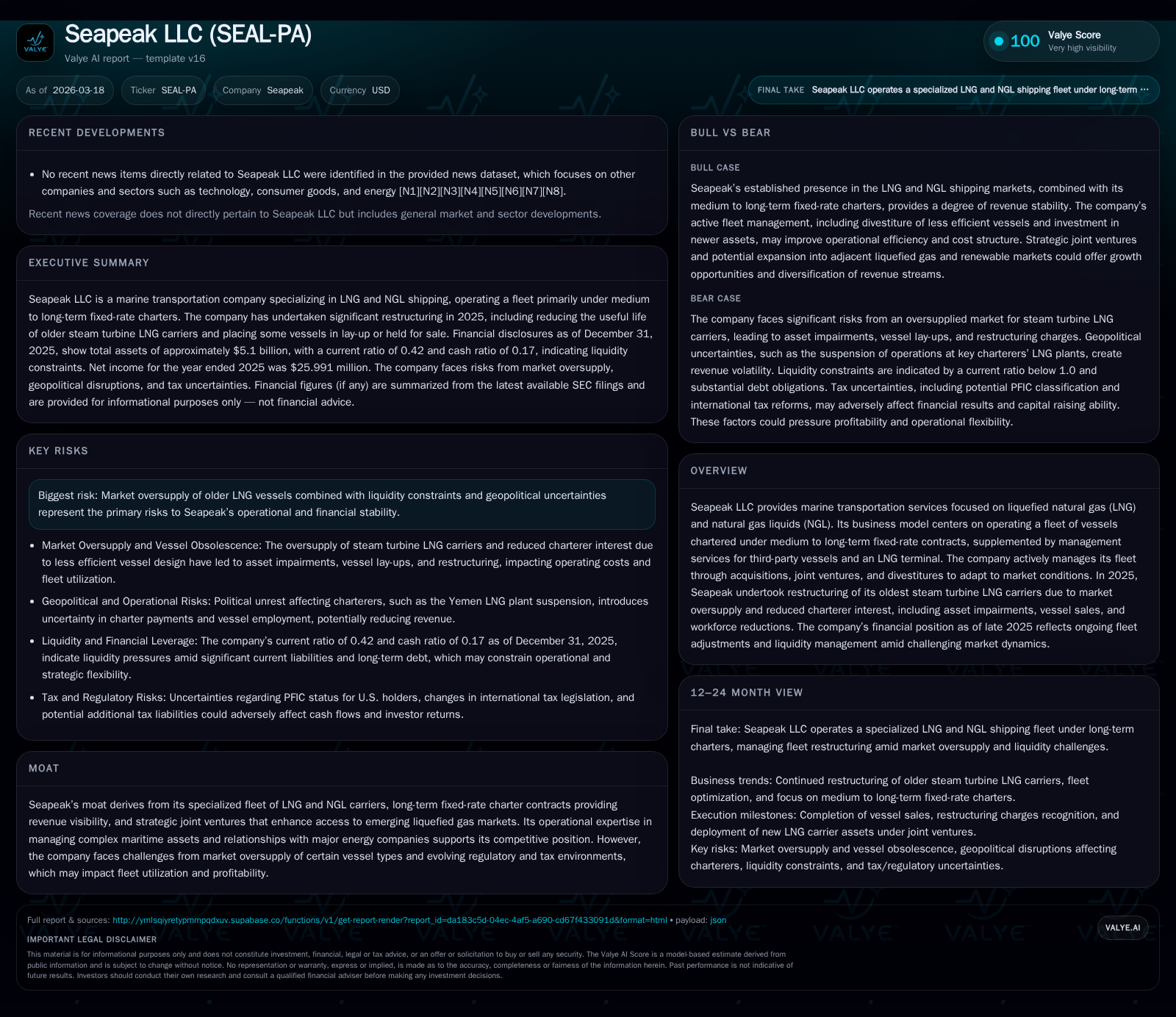
Seapeak LLC, specializing in LNG and NGL maritime transport, faced significant challenges in 2024 with substantial asset impairments on older steam turbine LNG carriers due to market oversupply and diminished charterer interest. In 2025, the company undertook fleet restructuring, vessel sales, and workforce reductions while maintaining a core focus on medium- to long-term fixed-rate charters that provide revenue visibility. Despite a sharply negative operating income in 2024, Seapeak rebounded to positive operating income and modest profitability in 2025, supported by improved equity earnings from joint ventures and effective liquidity management. Going forward, growth is tied closely to newbuild deliveries and charter contracting efforts, with downside risks stemming from geopolitical uncertainties and vessel oversupply.
Company Overview and Business Model
Seapeak LLC is a specialized maritime transportation company focusing predominantly on liquefied natural gas (LNG) and natural gas liquids (NGL). Its business model revolves around operating a fleet of LNG carriers primarily chartered under medium to long-term fixed-rate contracts with major energy companies, providing stable revenue streams despite the sector's inherent cyclical nature. Alongside this core activity, Seapeak offers management services for third-party-owned vessels as well as operating one LNG receiving/regasification terminal—reflecting an integrated position within the liquefied gas value chain [N#],[S1].
Historical Performance: Growth Drivers and Challenges
The company's recent history is marked by volatile financial performance tied closely to market dynamics impacting charter rates and vessel utilization. The annual operating income trend illustrates this:
Historical performance (annual)
| FY | Net ($mm) | CFO ($mm) | OpInc ($mm) | Capex ($mm) | Net YoY |
|---|---|---|---|---|---|
| 2025 | 26 | 131 | 61 | +127.1% | |
| 2024 | -96 | 395 | -95 | 258 | -130.2% |
| 2023 | 318 | 363 | 315 | 148 | +31.5% |
| 2022 | 242 | 277 | 177 | 108 |
Source: SEC companyfacts cache [F1].
Capital returns and efficiency (annual)
| FY | FCF ($mm) |
|---|---|
| 2025 | |
| 2024 | 138 |
| 2023 | 215 |
| 2022 | 169 |
Source: SEC companyfacts cache [F1].
Operating income plummeted from strong profits in '22–'23 to a $94.5 million loss in '24 before rebounding sharply in '25 [F1].
The stark downturn in 2024 was driven largely by significant impairments on older steam turbine LNG carriers—seven vessels written down by nearly $387 million due to an oversupplied market segment characterized by reduced charterer interest attributed to their less efficient design [S1]. Management also revised these vessels' useful lives downward from an expected span of 35 years to around 25 years, signaling a more cautious asset utilization outlook.
During this period, the company also recorded impairment charges for individual vessels like Seapeak Arctic and Polar earlier (in '23), reducing carrying values following contract completions or sales with minimal gains or losses recognized on disposal [S1].
Operational Actions Taken: Fleet Restructuring and Cost Management
In response to oversupply conditions, compounded by weaker demand for older LNG tonnage, Seapeak initiated comprehensive restructuring steps across late '24 into '25:
- Disposals of legacy steam turbine vessels through sales or impairment-driven write-downs.
- Workforce reduction measures catering to streamlined operations aligned with reduced fleet size.
- Strategic refinancing arrangements including sale-leaseback transactions like the Marvel Swan LNG carrier deal (January '25), securing long-term bareboat charters with repurchase options enhancing liquidity while managing capital expenditures [S23].
Fleet adjustment has been complemented by active management of financing costs through interest rate swaps and cross-currency swaps mitigating exposure associated particularly with NOK-denominated bonds coming due shortly alongside Euro-linked capital expenses [S8][S11].
Financial Position: Liquidity and Capital Allocation
At December 31, 2025, the company held approximately $123 million in cash and equivalents—a reduction from prior years but sufficient given ongoing operational cash flow generation [F1]. Available undrawn revolving credit capacity stood at about $215 million against a facility capped at $350 million, maturing June '27; however, scheduled capacity step-downs warrant careful liquidity monitoring going forward [S3][S4].
Long-term debt totaled around $892 million, down from over $1 billion at prior year-end due mainly to repayments and refinancings during the year. Notably, nearly one-third of total debt ($296 million) matured or was current portion at year-end reflecting concentrated near-term repayment obligations through '26–'27 [S3][S21]. Interest rates vary across instrument type—from fixed coupon bonds around low-mid single digits through SOFR-linked floating rate debt plus credit spreads reaching beyond the mid-single digits—adding complexity in interest expense forecasting amidst fluctuating base rates [S21][S22].
Debt covenants tied principally to minimum tangible net worth thresholds, vessel appraised values relative to loan balances, maximum leverage ratios, as well as restrictions on dividends/distributions at certain subsidiary levels were all maintained in compliance at last reporting date [S5][S6][S22][S27].
Capital Expenditure Trends and Free Cash Flow Generation
Capex expenditures exhibited a steep decline between '24 ($258 million) and '25 ($61 million), reflecting lower installments on newbuild LNG carriers following heavy investment cycles around '22–'24 coinciding with fleet expansion via orders of larger capacity Electronically Controlled Gas Admission propulsion vessels scheduled for mid-late decade delivery [F1][S23].
Operating cash flow remained robust though slightly down year-over-year at about $273 million for full-year '25 versus $395 million in prior year period—a normalization post asset impairment reversals alongside cost containment effects [F1]. The free cash flow metric (operating cash flow minus capex) was approximately $334 million in '25 underscoring meaningful positive cash generation capacity despite cyclical headwinds [F1].
Future Growth Prospects: Drivers and Constraints
Seapeak's ability to grow fundamentally hinges on several variables:
- Newbuild Delivery Deployment: Scheduled additions of next-generation M-type electronically controlled propulsion LNG carriers during '26–'27 could unlock enhanced operational efficiencies and attract premium fixed-rate charters.
- Long-Term Charter Contracting: Renewals or new charters secured for both owned vessels and those operated via joint ventures will underpin revenue visibility amid fluctuating spot market demands.
- Strategic Joint Ventures: Ongoing collaboration through equity-accounted ventures provides access to emerging liquefied gas markets geographically diversified across Asia-Pacific, Middle East, and Africa regions enhancing fleet utilization rates while sharing capital risks.
Conversely there remain notable restraints:
- Vessel Oversupply Dynamics: Persistent surplus tonnage particularly among legacy steam turbine classes will pressure hire rates suppressing margins until phase-outs or conversions reduce capacity.
- Interest Cost Inflation: Floating-rate debt service costs could materially increase if SOFR trends upward materially against hedging protections.
- Regulatory & Tax Environment Changes: Potential adverse tax rulings related to passive foreign investment company (PFIC) status pose uncertainty impacting U.S. investor appetite [S1].[N#]
- Geopolitical Factors: Disruptions related to global LNG trade routes or sanctions can affect charter demand volatility.
Forecasts / Milestones / Expectations – What To Watch For
While no explicit official guidance was provided for calendar year '26 within the disclosed documents, key indicators include:
- Progression of delivery schedules for newbuildings ordered in late '22 whose operational commencement is slated through '27.
- Refinancing maneuvers addressing approaching debt maturities concentrated within the next two years.
- Charter renewal negotiations outcome results especially for fleet segments vulnerable to oversupply effects.
- Ongoing execution of cost rationalization programs post workforce adjustments finalized during '25.
- Monitoring currency fluctuations impacting NOK bond servicing costs reflects critical operational impacts detailed under foreign exchange risk disclosures [S1].
Returns / Capital Allocation Practices
Approximate return on equity based on available data equates roughly to ~2.3% in FY2025 derived from reported net income relative to equity base—indicative of transitional recovery rather than robust profitability level yet consistent with cyclical fleet repositioning phases [F1].
No dividend distributions were declared or paid during recent periods covered; instead capital allocation emphasis has focused on deleveraging initiatives combined with accretive investments into advanced propulsion technology newbuilds enhancing future competitive positioning [F1].
Shareholder buybacks have not been significant over recent years reflecting balance sheet preservation priorities amid market uncertainties.
Strategic Moat and Competitive Positioning Analysis (Industry Context)
Seapeak’s central moat is embedded within its specialized LNG/NGL fleet equipped for complex operations requiring high technical know-how plus long-term fixed-rate time-charter contracts that insulate revenue against short-term spot market shocks. Its strategic joint ventures extend geographic reach into emergent liquefied gas markets essential for diversification beyond traditional Atlantic basin flows often dominated by larger shipping conglomerates.
Nonetheless, legacy fleet oversupply—particularly older steam turbine LNG carriers—is eroding asset values whilst regulatory pressures necessitate continuous capital expenditure reinvestment for compliance innovation. Sector-wide trends towards environmental sustainable shipping technologies may further bifurcate competitive advantage towards operators possessing technically advanced fleets aligned with IMO emissions regulations tightening post-2030 horizons.
Conclusion Summary
Seapeak LLC has transitioned from marked financial distress in calendar year ’24 driven by material asset impairments linked to legacy vessel oversupply toward moderate profitability restoration backed by disciplined restructuring actions executed during ’25. Key challenges persist including managing liquidity through large upcoming debt maturities alongside maintaining fleet relevance amid evolving regulatory constraints. Prospective growth depends mainly on successful deployment of next-generation newbuilds coupled with long-term charter agreements secured via robust relationship networks within key LNG supply chains. Continuous scrutiny of macroeconomic factors such as interest rate environments, currency volatility, global energy demand shifts, and geopolitical developments will remain paramount influences on corporate trajectory.
This analysis is prepared solely for informational purposes based on public filings up to March 18, 2026. It does not constitute investment advice or recommendations.
Disclaimer: This is research-only, informational analysis and not investment advice. It may include AI-generated interpretation and general industry context. Always verify important details using primary sources.

Comments