
Surgery Partners Expands Outpatient Surgery Footprint Amid Rising Debt and Competitive Pressures
Surgery Partners operates a large network of surgical facilities focused on outpatient care, balancing growth ambitions with a complex capital structure and evolving regulatory risks.
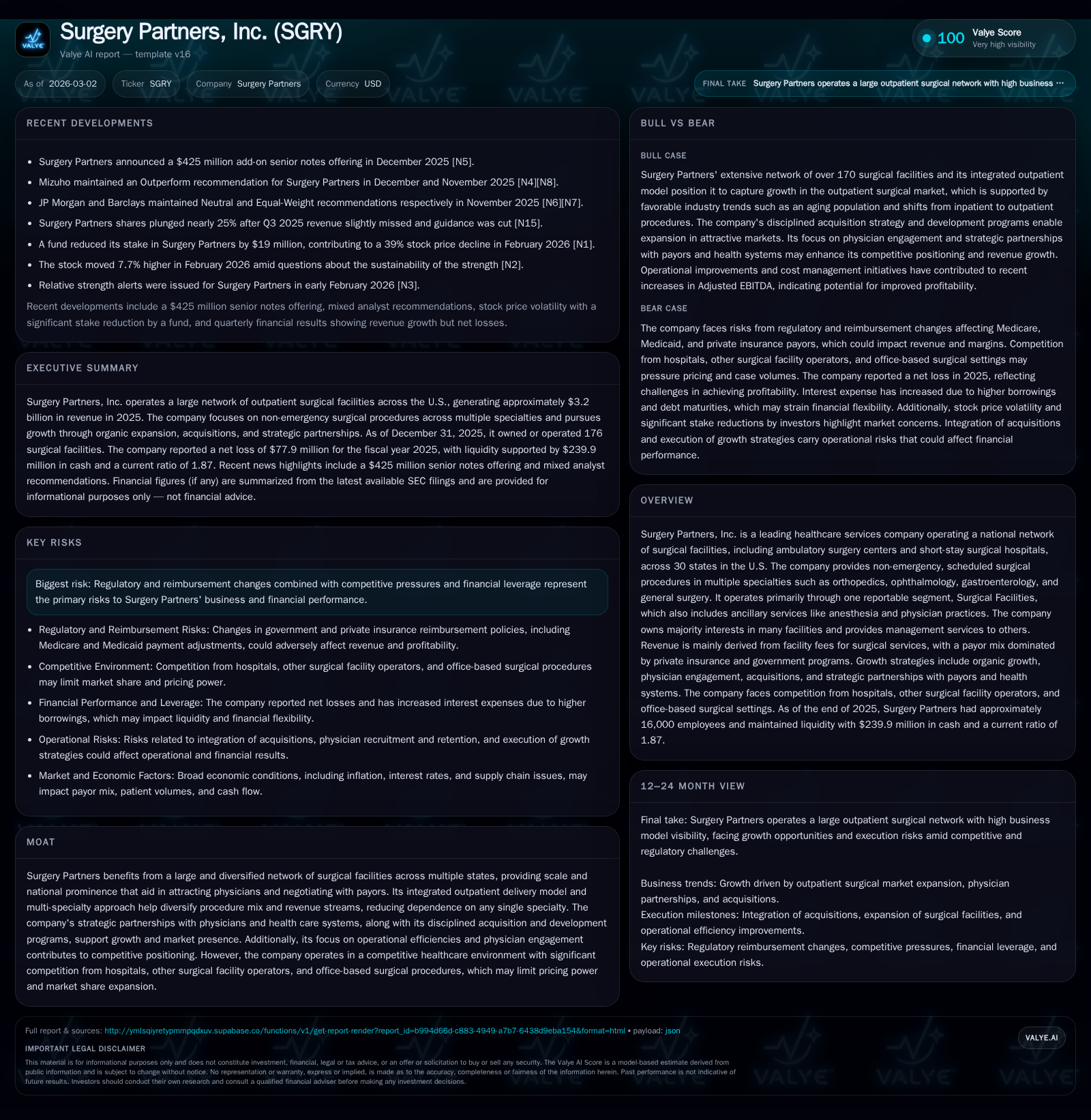
Surgery Partners, Inc. is one of the largest U.S. outpatient surgical services providers with over 200 facilities across 30 states, generating approximately $3.2 billion in revenue in 2025. The company’s growth has been driven by acquisitions, organic expansion, and strategic partnerships, supported by robust physician engagement and operational efficiencies. Despite growing operating income and positive operating cash flow, Surgery Partners continues to report net losses due to financial leverage and integration costs. Its capital structure features significant long-term debt refinanced recently, which may constrain flexibility amid economic uncertainty and industry headwinds such as reimbursement pressures and regulatory scrutiny.
Company Overview and Industry Position
Surgery Partners, Inc. operates a national network of more than 200 ambulatory surgery centers (ASCs) and short-stay surgical hospitals across 30 states [S1][S14]. The company’s integrated outpatient delivery model focuses on providing cost-effective surgical and ancillary care while maintaining quality standards. It owns or manages facilities through majority equity stakes or management agreements often formed with physicians or health systems [S14][S15]. This structure facilitates strong physician engagement and advantageous payor contracting.
Historical Growth and Financial Performance
The company’s outpatient surgical facility revenues reached approximately $3.2 billion in 2025 [S14]. This growth reflects both organic volume increases driven by physician recruitment and service line expansion as well as acquisitions enhancing geographic coverage.
Key annual financial highlights include:
Historical performance (annual)
| FY | Net ($mm) | CFO ($mm) | OpInc ($mm) | Capex ($mm) | Net YoY |
|---|---|---|---|---|---|
| 2025 | -78 | 274 | 390 | 79 | +53.7% |
| 2024 | -168 | 300 | 349 | 90 | -1312.6% |
| 2023 | -12 | 294 | 328 | 89 | +78.2% |
| 2022 | -55 | 159 | 345 | 81 |
Source: SEC companyfacts cache [F1].
Capital returns and efficiency (annual)
| FY | FCF ($mm) | ROE% |
|---|---|---|
| 2025 | 196 | -4.5 |
| 2024 | 210 | -9.4 |
| 2023 | 205 | -0.6 |
| 2022 | 78 | -2.7 |
Source: SEC companyfacts cache [F1].
Operating income improved by nearly 12% year-over-year in 2025 benefiting from scale efficiencies despite integration costs related to acquisitions [F1]. Although net losses persist due to interest expense on substantial leverage and transaction charges, the loss narrowed significantly versus prior years.
Capital Structure and Liquidity
Surgery Partners maintains a complex capital structure with significant indebtedness:
- In August 2025, it refinanced its term loans with a new tranche totaling $1.4 billion at interest rates based on SOFR plus margins resulting in an effective annual rate around 6.22% as of year-end [S4][S5].
- In December 2025, the company issued $425 million senior unsecured notes due in 2032 at a slight premium to par alongside existing notes from April 2024 issuance consolidating maturities [S4][S5].
- Total contractual obligations for long-term debt including interest exceed $5.7 billion with operating lease obligations pushing total commitments above $6.2 billion payable over various time horizons [S4][S5].
Net working capital stood at approximately $535 million at December 31, 2025, supported by cash balances near $240 million and available revolving credit capacity [S4][F1]. Management anticipates that operating cash flows combined with revolver availability will meet both short- and long-term liquidity needs despite macroeconomic uncertainties including inflationary pressures affecting payer reimbursements [S6][S12].
No share repurchases or dividends have been declared recently; historical buybacks were minimal several years ago indicating capital allocation focused on growth investments rather than returns to shareholders [F1].
Growth Strategy
The company’s growth initiatives include:
- Driving organic growth through targeted physician recruitment, service line expansions, and operational efficiencies.
- Pursuing disciplined acquisitions of complementary surgical facilities to broaden geographic reach.
- Developing new de novo surgical centers aligned with local demand.
- Forming strategic partnerships with payors to enhance affordability and expand patient access.
- Collaborating with health systems seeking to expand ambulatory surgery capabilities leveraging Surgery Partners’ integrated platform [S14][S24].
Industry dynamics favor ASCs like Surgery Partners as hospital outpatient departments face procedure volume declines (2% annually forecasted), while ASC volumes are expected to grow about three times faster (6% annually), driven by payor incentives encouraging lower-cost settings without compromising quality [S14].
Regulatory Environment and Risks
Key challenges include:
- Compliance with federal Anti-Kickback Statute and Stark Law provisions restricting remuneration practices related to physician referrals remains critical given ongoing scrutiny and potential penalties .
- Routine Medicare/Medicaid audits for payment accuracy expose the company to potential liabilities; current exposures are disclosed as immaterial but remain uncertain due to pending appeals [S16].
- Competition from hospital systems expanding ambulatory offerings as well as other ASC operators and office-based surgical alternatives may pressure pricing power.
- Financial leverage exposes the company to interest rate risk amid rising global rates; economic downturns could impair patient collections impacting working capital needs [S6][S12].
- Cybersecurity risks are actively managed under frameworks aligned with NIST standards with governance involving board oversight led by an experienced Chief Information Security Officer; residual risks persist given healthcare sector trends [S10].
- Typical healthcare litigation risks related to personal injuries or employment claims exist but no material proceedings currently threaten business continuity according to management disclosures [S10].
Outlook Considerations
While explicit forward guidance is not provided publicly, investors should monitor:
- Integration progress on recent acquisitions including realization of anticipated synergies.
- Same-facility revenue growth relative to peers as a measure of operational effectiveness.
- Changes in payer contract terms impacting reimbursement rates or case mix.
- Debt servicing metrics alongside covenant compliance signaling credit profile stability.
- Expansion into new markets or specialties via de novo centers or partnerships.
- Regulatory developments affecting ownership structures or referral rules potentially influencing compliance costs.
Given the evolving healthcare landscape marked by reimbursement shifts and economic uncertainties, Surgery Partners' execution on growth strategies balanced against capital structure management will be pivotal for future performance.
This analysis is based on publicly available information including SEC filings dated March 2, 2026 ([F1], [S1]-[S29]) and news sources as of early 2026; it is not investment advice.

Comments