
Shopify's Strategic Tightrope: Innovation-Driven Growth Meets Execution Challenges Amid Rising Ecommerce Competition
Shopify’s Q4 2025 earnings reveal a complex interplay of revenue strength, earnings pressure, and strategic bets on AI to maintain its ecommerce leadership.
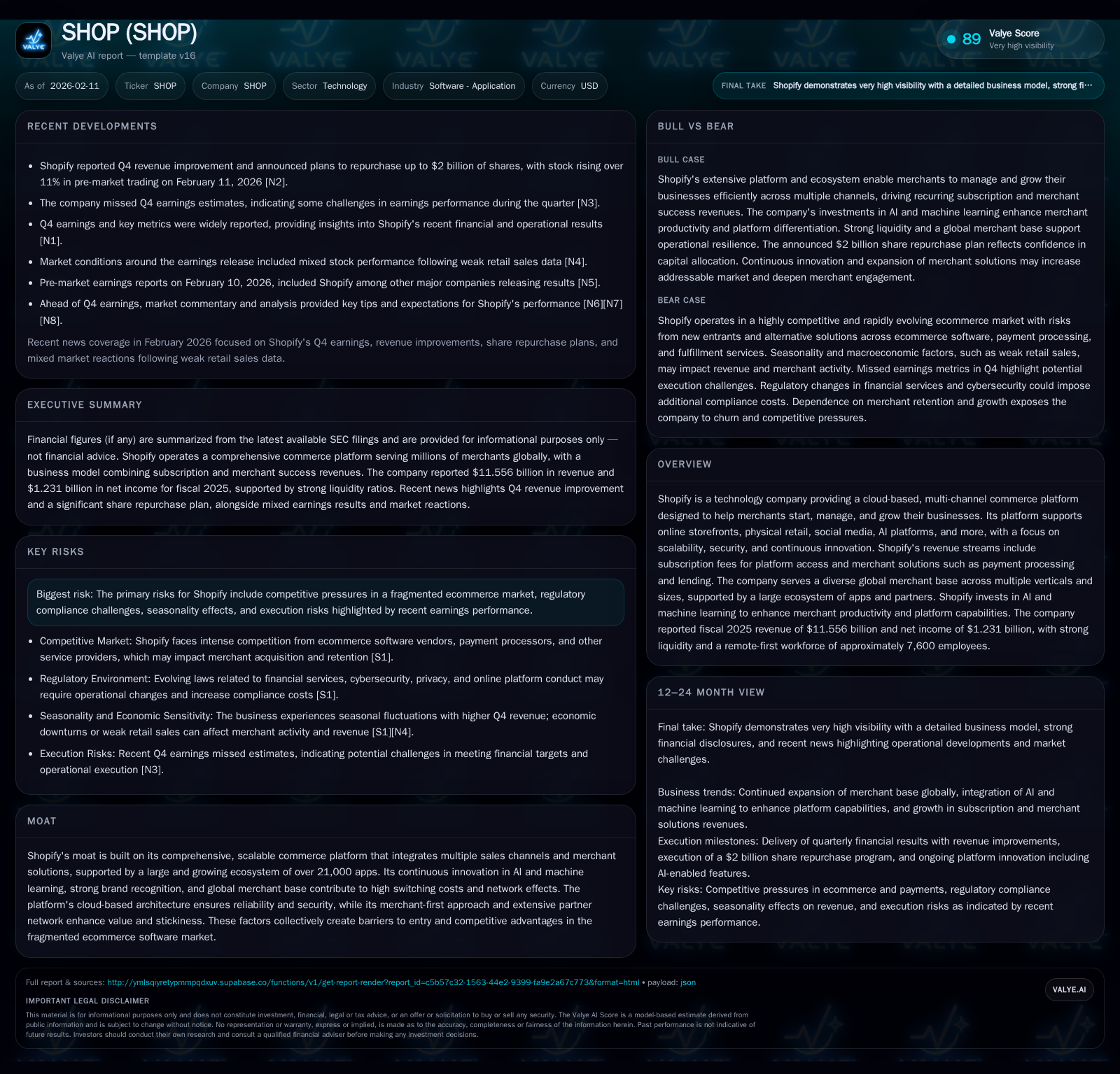
Shopify’s fiscal 2025 results delivered solid revenue growth of 30% reaching $11.56 billion, propelled predominantly by its merchant solutions segment. While subscription revenues grew at a steadier pace, the company faced a miss on earnings expectations in Q4, sparking volatile investor reaction despite a robust share repurchase announcement. Shopify’s large, diversified global merchant base and multi-channel platform remain key competitive advantages, but intensifying fragmentation in ecommerce software and operational execution risks frame near-term uncertainties. Its ongoing investment in artificial intelligence underscores a strategic focus on deepening merchant productivity and platform differentiation for sustainable growth.
Q4 Earnings: Highlights, Misses, and Market Response
Shopify’s fourth quarter of fiscal year 2025 painted a nuanced picture combining clear revenue momentum with profitability challenges that caught market participants’ attention. The company reported total revenues for FY2025 of $11.56 billion—surging 30% year-over-year—driven largely by robust merchant solutions growth. However, despite this topline strength, the company missed analysts' earnings expectations in the quarter, triggering volatile trading action where shares briefly spiked over 11% in pre-market before retracing due to profit-taking and concerns over margins [N1][N3][N4][N9][N11][F1].
Management commentary during the earnings call attributed the earnings miss partly to increased investments in product innovation — particularly intensified AI initiatives — plus some elevated expenses related to scaling infrastructure and supporting merchant growth. This reflects Shopify’s ongoing challenge balancing aggressive innovation spending with near-term profitability targets.
The market's bifurcated reaction underscores investor tension between appreciating Shopify’s growth trajectory and wariness about execution risks that increasingly mark the ecommerce software arena.
A Deep Dive into Shopify’s Revenue Engines: Subscription vs Merchant Solutions
At the heart of Shopify’s financial narrative is its dual-revenue model comprising subscription solutions and merchant solutions [S1][F1]. Subscription solutions encompass recurring fees from access to the core commerce platform—including tiered plans from basic storefronts up to Shopify Plus offering sophisticated enterprise features like B2B capabilities and ecommerce automation via Launchpad. These subscriptions represent a stable income floor; in FY2025 subscription revenue rose by a measured 17% to $2.8 billion (24% of total revenues), supported by a significant monthly recurring revenue (MRR) figure that hit $205 million by year-end—a healthy 15% increase [S1]. MRR serves as a reliable indicator of long-term merchant commitment beyond deferred revenue accounting nuances.
Where Shopify truly scaled was within merchant solutions — covering payment processing fees via Shopify Payments, currency conversions, lending services, shipping label sales, POS hardware sales, marketplace advertising such as Shop Campaigns, and partner referrals. Merchant solutions accounted for the lion’s share at 76% of total revenue ($8.8 billion in FY2025), climbing at an accelerated pace of 35% year-over-year. This segment is tightly correlated to GMV facilitated on the platform which expanded 29% to $378.4 billion [S1]. The high-margin nature of transactional fees combined with cross-selling embedded financial products enhances overall unit economics for Shopify.
Merchant Ecosystem Dynamics: Growth, Retention, and Expansion Insights
Shopify’s moat is deeply interwoven with its expansive merchant ecosystem spanning millions of active shops distributed across more than 175 countries—44% in the U.S., followed by Europe/Middle East/Africa at approximately 31%, Asia-Pacific at 16%, then Canada and Latin America making up remaining shares [S1]. This geographic diversity not only dilutes region-specific macroeconomic shocks but also positions Shopify well for localized feature customizations responsive to varied market needs.
Importantly, cohort analyses illustrate that although Shopify experiences natural churn as merchants close or migrate away from the platform, these losses are offset—and often surpassed—by increased sales from existing merchants upgrading subscription tiers or buying additional merchant solution services. This dynamic is strengthened by network effects arising from an ecosystem exceeding over 21,000 third-party apps [valye_report_excerpt] which augment core platform functionality—ranging from marketing automation to inventory optimization—thus enhancing stickiness.
This persistent expansion within historical cohorts reveals Shopify’s success in fostering sustained engagement through ongoing product enhancements matched with merchant-first orientation.
The AI Investing Push: How Machine Learning Is Shaping Shopify’s Platform Edge
Artificial intelligence is not just an abstract ambition at Shopify—it represents a concrete lever geared toward operational efficiency gains and differentiated client offerings [valye_report_excerpt]. Among deployed applications are:
- Automation tools: Features like Launchpad enable merchants to automate complex workflows such as product launches or flash sales without manual intervention,
- Personalization engines: Through products like Shopify Audiences sellers gain granular access to tailored buyer segments optimized via ML models,
- Operational analytics: Machine learning powers predictive insights around inventory management and demand forecasting,
- Enhanced checkout experience: AI underpins adaptive fraud prevention systems embedded within Shopify Payments.
These investments aim to create superior scalability for merchants across sizes while tightening security and reducing friction points—a critical advantage given ecommerce platforms’ inherent complexity. Importantly, AI advancements perpetuate network effects wherein richer data improves algorithms that benefit all users jointly thus reinforcing competitive barriers.
Competitive Landscape: Navigating Risks in a Fragmented Ecommerce Market
Though Shopify stands as one of the largest independent multi-channel commerce platforms globally, it operates within an increasingly fragmented landscape marked by diverse competitors ranging from specialized point solutions catering to niche verticals to comprehensive suites offered by tech giants that bundle ecommerce functionalities into broader ecosystems [S1][valye_report_excerpt]. These forces drive intensified customer acquisition competition and pressure margin structures.
Further complicating matters are regulatory compliance demands—as global jurisdictions tighten controls on data privacy, payments processing rules and cross-border commerce oversight—which carry potential cost inflation and operational complexity implications.
Seasonality effects inherent to retail flows add another layer of unpredictability impacting quarterly performance volatility.
Recent earnings highlighted tangible execution risks; while top-line growth robustly continued there were signs of margin compression stemming from both external pressures and internal scaling missteps acknowledged by management. This mosaic necessitates vigilant operational discipline alongside innovation agility going forward.
Financial Health & Operational Resilience: Liquidity, Cash Flow, and Workforce Model
Shopify enters the new fiscal year backed by considerable financial strength: its balance sheet showcases $1.55 billion in cash & cash equivalents alongside current assets totaling approximately $8.3 billion versus just $1.39 billion in current liabilities yielding a current ratio near six times—a hallmark of solid liquidity buffer capable of absorbing short-term shocks or funding strategic initiatives [F1][S1].
Cash flow trends are healthy but moderated by reinvestment into product development notably around AI capabilities.
Operationally Shopify maintains a predominantly remote workforce numbering roughly 7,600 employees globally [valye_report_excerpt]. This remote-first approach enables broad talent sourcing flexibility while constraining physical office costs—though it presents challenges around organizational cohesion and collaboration that management continuously addresses through cultural investments.
Strategic Capital Allocation: Share Repurchase and its Signal
In direct response to post-earnings volatility and perceived valuation runway constraints despite underlying growth fundamentals, Shopify announced a sizeable $2 billion share repurchase program concurrent with Q4 release [N3]. Such initiative serves multiple strategic functions:
- Signaling management confidence in intrinsic business value notwithstanding short-term earnings pressures,
- Enhancing shareholder value through capital return amid capital allocation alternatives,
- Potentially offsetting dilution from employee compensation programs tied to equity.
Notably timing aligns with market turbulence reflecting tactical opportunism rather than routine buybacks.
This sizable program underlines an assertive stance toward bolstering investor sentiment while preserving balance sheet flexibility due to strong liquidity positioning.
Future Outlook and Investor Considerations
Looking forward into FY2026 and beyond, Shopify faces the classic conundrum confronting many fast-growing technology leaders: how best to sustain aggressive innovation momentum—in particular via AI—while harnessing disciplined execution in an environment rife with escalating competitor sophistication and macroeconomic uncertainty [S1][N6].
The company’s entrenched multi-channel commerce platform anchored by a large-scale global merchant ecosystem constitutes formidable strategic assets nurturing high switching costs rooted in network effects mediated by its extensive app ecosystem.
Yet challenges linger on margins pressured by investment scale-ups coupled with sector fragmentation requiring continuous feature differentiation.
Ultimately investors may weigh Shopify's ability to convert its technological advances into scalable monetization streams against near-term operational headwinds highlighted during recent quarters.
Continued transparency from management regarding roadmap progress alongside measurable efficiencies will be critical metrics signaling emerging stabilization versus lingering volatility.
Disclaimer: This analysis is for informational purposes only based on publicly available information as of February 11th, 2026. It does not represent investment advice or recommendations.
Disclaimer: This is research-only, informational analysis and not investment advice. It may include AI-generated interpretation and general industry context. Always verify important details using primary sources.

Comments