
Solid Biosciences: Clinical Trials Progress Amid Intensifying Capital Needs
Solid Biosciences advances its gene therapy pipeline with pivotal Duchenne trials while grappling with substantial operating losses and liquidity management.
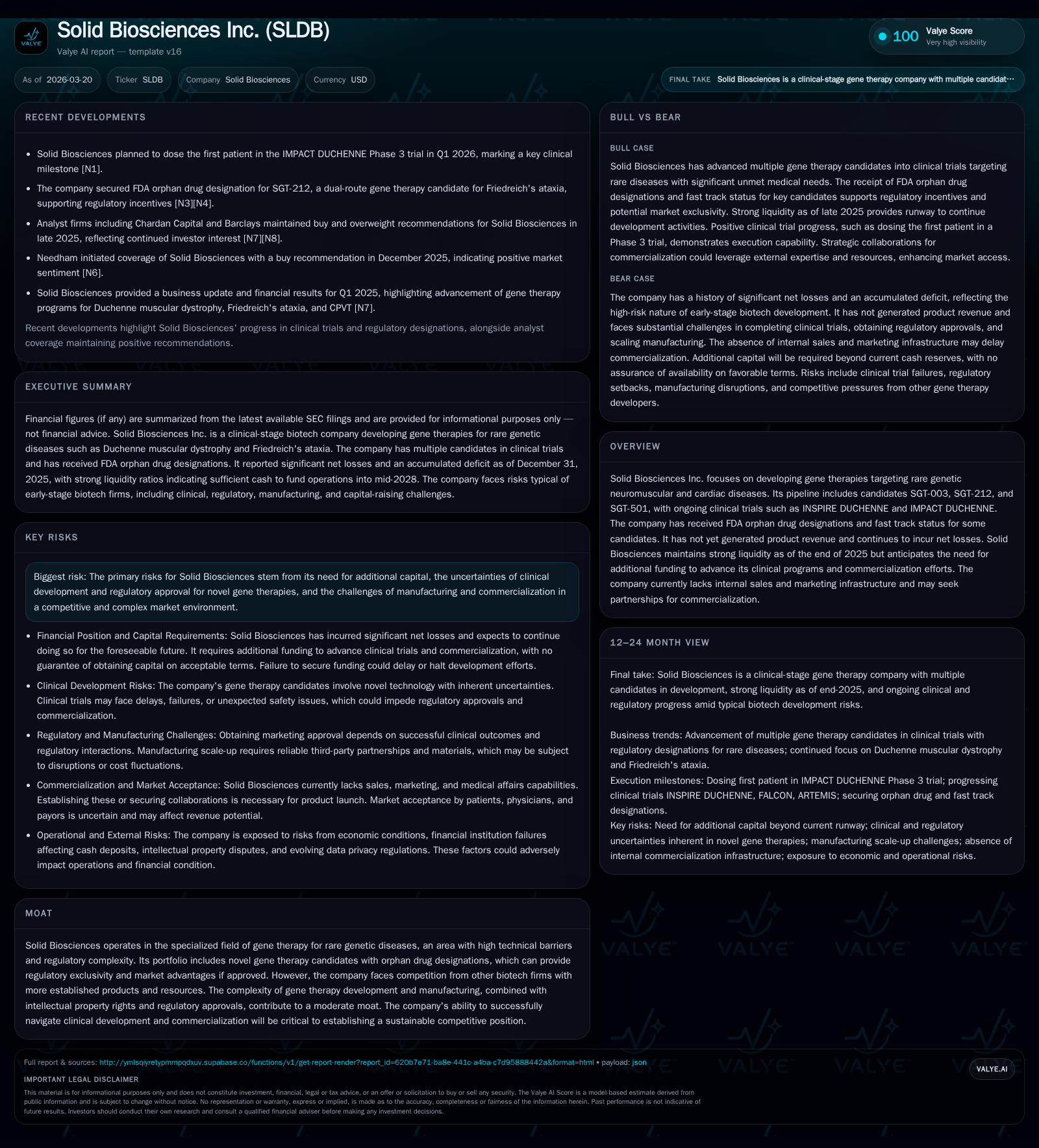
Solid Biosciences Inc. continues to push forward with its gene therapy efforts for rare neuromuscular diseases, highlighted by dosing the first patient in the Phase 3 IMPACT DUCHENNE trial. Despite clinical momentum, the company faces steep financial challenges, marked by mounting net losses and heavy cash burn reflective of intensive R&D spending. The firm's strong cash position supports ongoing operations but signals dependency on future capital raises to sustain pipeline advancement and eventual commercialization. Regulatory complexities, orphan drug advantages, and potential partnership needs underscore the multifaceted landscape shaping Solid’s near-term outlook.
Trajectory of Clinical Development and Historical Financial Outcomes
Solid Biosciences has methodically evolved its clinical programs over recent years, transitioning focus from earlier candidates such as SGT-001 to advancing the pipeline acquired via AavantiBio in late 2022. This transition has been accompanied by intensifying research and development activities centered on candidates SGT-003, SGT-212, and SGT-501 targeting Duchenne muscular dystrophy (DMD) and related conditions [S1].
Financially, this progression is mirrored by significant operating losses expanding alongside clinical spend. Operating income recorded a loss of approximately -$179.2 million in FY2025, worsening from -$129.7 million in FY2024 [F1]. Net income remains deeply negative dating back several years; for instance, it was approximately -$117.2 million as far back as FY2019 [F1]. Revenue generation remains nascent, with FY2022 revenue at $8.1 million—a decline from $13.6 million in FY2021—as the company remains pre-commercial [F1].
Operating cash flow (CFO) trends highlight increasing consumption of cash reaching -$156.3 million by FY2025; when combined with capital expenditures (~$1.15 million in FY2025), the company’s free cash flow stays deeply negative at roughly -$157.4 million [F1]. This pattern exemplifies the capital-intensive nature of gene therapy development characterized by extended R&D phases before product revenue realization.
Historical performance (annual)
| FY | CFO ($mm) | OpInc ($mm) | Capex ($mm) |
|---|---|---|---|
| 2025 | -156 | -179 | 1 |
| 2024 | -100 | -130 | 1 |
| 2023 | -94 | -104 | 2 |
| 2022 | -98 | -106 | 3 |
Source: SEC companyfacts cache [F1].
Capital returns and efficiency (annual)
| FY | FCF ($mm) |
|---|---|
| 2025 | -157 |
| 2024 | -101 |
| 2023 | -96 |
| 2022 | -101 |
Source: SEC companyfacts cache [F1].
Note: Revenue YoY is computable only through available data; operating income YoY compares FY2024 to FY2025.
Recent Trial Milestones: Initiating IMPACT DUCHENNE Phase 3
In early Q1'26, Solid dosed the first patient in its pivotal Phase 3 IMPACT DUCHENNE trial evaluating SGT-003, marking a watershed event validating years of preclinical and earlier clinical work [N1][S1]. This trial elevates their lead candidate into late-stage development needed for regulatory approval pathways.
IMPACT DUCHENNE’s significance is amplified not only because it involves a larger cohort allowing more robust efficacy data but also because successful readouts could pave the way toward FDA marketing authorization under accelerated or traditional approval routes common for orphan neuromuscular disorders.
Given the rarity of DMD patients suitable for gene therapy enrollment and challenges linked with vector immunogenicity and durable transgene expression, this milestone reflects critical operational progress beyond preceding studies like INSPIRE DUCHENNE that laid groundwork on safety parameters.
Pipeline Composition and Orphan Drug Advantages
Solid's lead pipeline consists primarily of three candidates: SGT-003 (for DMD), SGT-212 (cardiomyopathy-related indications), and SGT-501—each leveraging adeno-associated virus-based gene vectors engineered to deliver functional copies of relevant genes or gene constructs with improved transduction efficiency and tropism [S1].
Crucially, multiple candidates have received FDA orphan drug designations which confer seven years of market exclusivity post-approval as well as Fast Track designation that facilitates expedited developmental interactions with regulators.
Orphan exclusivity serves as a moat improvement by legally restricting direct competition during a critical commercial window after launch while Fast Track access can potentially accelerate clinical timelines amid high unmet medical needs prevalent in ultra-rare indications.
Enrollment challenges persist since patient populations are small—impacting statistical power—and necessitating sophisticated biomarker/assay technologies for monitoring therapeutic impact alongside safety evaluations required by regulators .
Evolving Operating Expenses and Revenue Trends
R&D expenses dominate Solid’s cost structure driven by extensive clinical trial protocols encompassing complex protocols involving vector production scale-up under cGMP conditions alongside longitudinal patient follow-ups required for chronic diseases evaluation [F1][S1]. The Acquisition of AavantiBio expanded the candidate portfolio but also added costs related to integration and additional management staffing.
The drop in minimal revenues from $13.6 million in 2021 to just over $8 million in 2022 underscores no product sales activity; these figures mostly reflect milestone or licensing fee recognition rather than commercial income streams [F1]. Given no marketed products exist yet, Solid continues reporting escalating operating losses aligning with sector norms where heavy investment precedes any revenue realization.
The expansion from early-stage candidate SGT-001 to diversified assets like SGT-003 has intensified operational expenditures particularly given intricate viral vector manufacturing complexities typical across gene therapy companies striving for reproducibility and regulatory compliance.
Capital Structure, Cash Position, and Liquidity Dynamics
At fiscal year-end December 31, 2025, Solid held approximately $59.9 million in cash & equivalents within total current assets of around $205.5 million against current liabilities near $33.5 million yielding a robust current ratio near 6.14—indicative of strong short-term liquidity capacity [F1]. However, this must be contextualized against operating cash outflows exceeding $156 million annually demonstrating high burn rates inherent to biotech innovation cycles.
Equity stands at roughly $180 million indicating a solid book capitalization though profitability remains elusive with an approximate return on equity (ROE) around -65% based on available net income approximations juxtaposed against shareholders’ equity [F1]. No dividends or buyback activities have been reported consistent with a growth-focused biotech without commercialized revenue streams.
Future fundraising rounds are anticipated given accelerating expense profiles related to late-stage trials and manufacturing scale-up needs coupled with establishing commercialization capabilities if approvals materialize [S1].
Forecasting Near-Term Catalysts and Funding Needs
Explicit financial guidance has not been provided; however, market participants should closely monitor:
- Enrollment progress updates across INSPIRE DUCHENNE (earlier phases), IMPACT DUCHENNE (Phase 3), FALCON (a potential cardiac indication trial), and ARTEMIS programs which collectively represent multi-indication pipeline maturation efforts [N1][S1];
- Data readouts timing from IMPACT DUCHENNE that would underpin regulatory submission agendas;
- Regulatory interactions feedback concerning marketing applications submissions;
- Any announcements regarding partnership agreements addressing commercialization or manufacturing scalability obstacles.
These milestones will be pivotal indicators shaping investor sentiment given their direct correlation with clinical validation timelines intertwined with capital consumption rates typical of gene therapy providers .
Navigating Regulatory Complexities and Risk Factors
Solid operates within stringent regulatory frameworks imposing comprehensive standards including compliance with current Good Manufacturing Practices (cGMP) specifically tailored for viral vector production—a technically demanding area prone to yield variability affecting product quality consistency . Post-marketing surveillance demands like Risk Evaluation and Mitigation Strategies (REMS) add layers of complexity requiring resource-intensive monitoring.
Legal risks include ongoing potential investigations under health care fraud laws due to promotional activities if unapproved indications are discussed internally or externally incorrectly. Intellectual property enforcement also remains uncertain given patent law evolutions adding vulnerability despite extensive filings .
Further federal legislation such as the Inflation Reduction Act introduces pricing scrutiny though orphan drug exemptions mitigate some price negotiation pressures subject to indication approval status [S25]. Socio-political factors like importation rules or international data privacy laws across multiple jurisdictions add operational risk dimensions requiring agile compliance mechanisms.
Commercialization Pathways and Partnership Prospects
Currently lacking internal sales or marketing infrastructures necessitates that Solid either build substantial go-to-market capabilities or pursue alliances/licensing deals with established biopharma players for eventual product launch commercialization [S1]. Partnerships would leverage external expertise around payer engagement strategies, physician education platforms, distribution networks, reimbursement processes, especially important given complex gene therapy supply chains demanding cold chain logistics.
Such models align with sector trends wherein early-stage companies specialize primarily on R&D while executing strategic collaborations downstream permitting scalable commercialization without prohibitive fixed cost burdens until products demonstrate market viability.
Disclaimer: This report is based solely on publicly available information without consideration of non-public insights or subjective forecasts. It does not constitute investment advice or recommendations but serves as an analytic overview designed for institutional quality diligence purposes only.
Disclaimer: This is research-only, informational analysis and not investment advice. It may include AI-generated interpretation and general industry context. Always verify important details using primary sources.

Comments