
Sow Good Inc. 2026 Q2 Update: Cash Depletion and Executive Turnover Highlight Financial and Operational Risks
Sow Good Inc.'s Q2 2026 filing reveals critical liquidity shortages and major leadership changes that raise substantial doubt about its operational continuity.
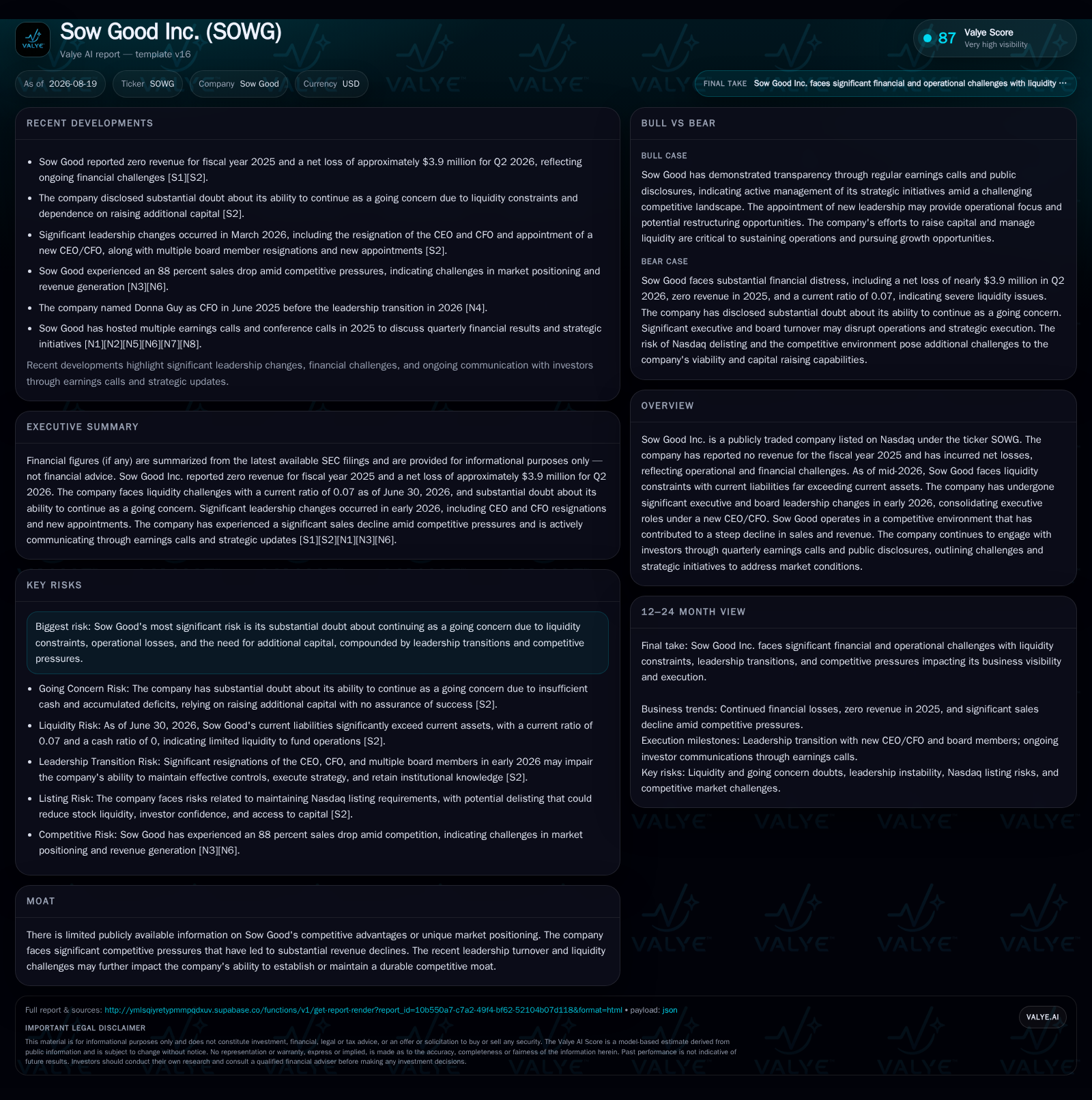
Sow Good Inc. reported a severe liquidity shortfall at the end of Q2 2026, with a current ratio of 0.07 and cash reserves of only $8,492, insufficient to sustain ongoing operations. The company also experienced significant executive and board turnover in early 2026, concentrating leadership roles and risking disruption to disclosure controls and strategic execution. These factors compound the challenges of a pre-revenue business model marked by an accumulated deficit of $4.4 million and no reported revenue. The company’s ability to continue depends heavily on securing additional funding, with failure to do so potentially forcing operational curtailment or liquidation.
Sow Good Inc. disclosed severe liquidity constraints and significant executive and board leadership changes in its Q2 2026 report ending June 30, 2026 [S2]. The company reported a current ratio of 0.07 and cash and cash equivalents of only $8,492, highlighting a critical imbalance between its current assets and liabilities [F1]. These financial challenges raise substantial doubt about Sow Good's ability to continue as a going concern, which could adversely impact its operational capacity, ability to raise capital, and investor confidence [S2].
In the context of pre-revenue development companies like Sow Good, cash runway and working capital are critical metrics. Without revenue inflows, the company relies entirely on external capital raises to finance research, development, and operational expenses. The company’s CEO and CFO resigned simultaneously, with a new CEO/CFO appointed to consolidate executive authority [S2]. Additionally, five board members resigned, replaced by four new directors, resulting in near-complete board turnover [S2].
This concentration of executive roles in a single individual, alongside the loss of institutional knowledge from multiple board departures, introduces material operational risks. The company acknowledges potential impairments to maintaining effective disclosure controls and procedures, executing its business strategy, and retaining critical operational expertise [S2]. Such governance disruptions can delay decision-making, complicate regulatory compliance, and undermine investor confidence.
For a pre-revenue company reliant on timely capital raises and strategic execution, leadership stability is a key factor in navigating development milestones and market uncertainties. The recent turnover elevates governance risk and may exacerbate existing financial challenges if the new team struggles to manage these responsibilities effectively.
Business Model and Revenue Challenges
Sow Good operates as a pre-revenue development company, with no reported revenue for fiscal year 2025 [S1]. This lack of sales highlights structural challenges in commercializing its product offerings within a competitive environment. The company currently has no paying customers and depends entirely on capital raises to fund ongoing research and development activities [S1][S2].
Operating at a loss with negative margins and cash burn, Sow Good’s business model is typical of early-stage development firms that must progress through product development milestones before generating revenue [S2]. Sow Good’s absence of revenue and critical liquidity constraints suggest structural headwinds that will require successful capital raises and operational execution to overcome.
Scenario Analysis and Outlook
Looking forward, three plausible scenarios frame Sow Good’s near-term outlook based on its ability to secure funding and stabilize operations:
Bear Case: Failure to obtain additional financing on acceptable terms could force Sow Good to curtail operations or liquidate, resulting in loss of investor capital. This scenario is supported by the company’s negligible cash reserves and explicit going concern disclosures [S2][F1]. Confirmation would come from subsequent filings indicating inability to raise capital or announcements of operational shutdown.
Base Case: The company successfully raises capital sufficient to sustain near-term operations but continues to face revenue generation challenges and operational losses. This scenario aligns with ongoing disclosures of operational difficulties and the company’s active exploration of financing alternatives [S2][S1]. Confirmation would include SEC filings showing capital infusion without immediate revenue growth.
Bull Case: New leadership stabilizes governance and executes a turnaround strategy that leads to revenue growth and improved liquidity. While this outcome is less certain given recent disruptions, it remains possible if capital is secured and operational controls improve [S2]. The severe cash depletion and negative working capital limit operational flexibility, while the consolidation of executive authority and loss of board institutional knowledge increase governance risks. These factors compound the structural challenges of a pre-revenue business model marked by ongoing net losses and no revenue.
Investors and stakeholders should closely monitor subsequent quarterly filings for disclosures regarding capital raising efforts, liquidity improvements, and leadership stability. Additionally, announcements of revenue generation or new product developments would materially affect the company’s outlook. Changes in disclosures related to liquidity, cash burn, and working capital trends will also provide important information about Sow Good’s operational trajectory.
Absent successful capital raises and effective governance, the risk of operational curtailment or liquidation remains significant. Conversely, stabilization under new leadership combined with improved funding and revenue progress could enable Sow Good to navigate its current challenges and advance toward commercialization.
Disclaimer: This is research-only, informational analysis and not investment advice. It may include AI-generated interpretation and general industry context. Always verify important details using primary sources.

Comments