
Spire Global’s Strategic Shift to Data and Space Services Tests Profitability and Growth Levers
Spire Global pivots post-maritime sale to expand its nanosatellite constellation and deepen analytics capabilities amid competitive pressures.
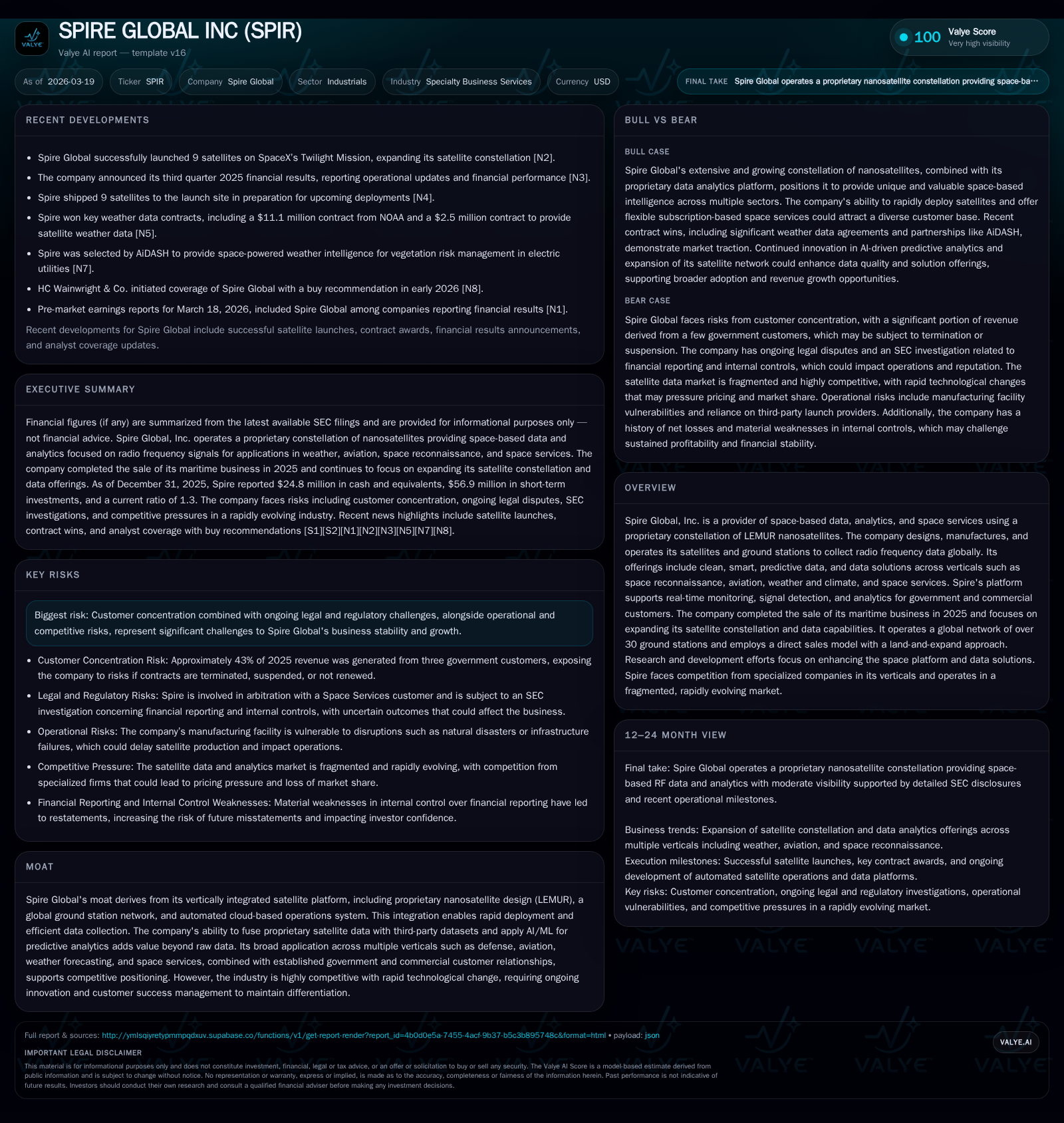
Spire Global, Inc. has evolved from a multi-vertical satellite data provider into a more focused pure-play on space-based data analytics and space services following the 2025 sale of its maritime business. The company’s proprietary LEMUR nanosatellite constellation underpins its unique data sets across weather, aviation, defense, and space situational awareness. Despite this strategic sharpening, Spire continues to operate at operating losses, supported by equity financings and cash from the maritime exit. Its growth prospects hinge critically on scaling constellation deployment, advancing predictive data offerings through AI/ML integration, and realizing Space Services customer traction. Risks remain significant: tight government contract exposure, ongoing legal disputes including arbitration with a key space services customer, an SEC probe into accounting practices, and technological competition that demands continual innovation.
Company Overview
Spire Global, Inc., founded in 2012 and headquartered in Vienna, Virginia, operates in the specialty business services segment within Industrials. The company designs, manufactures, launches, and operates a proprietary fleet of Low Earth Orbit Multi-Use Receiver (LEMUR) nanosatellites that collect radio frequency (RF) data globally. Unlike imagery or communications satellites companies that "look" or "talk," Spire specializes in "listening" satellites — gathering large volumes of RF signals to provide diverse datasets integrating weather forecasting via radio occultation technology, ship and aircraft tracking through AIS/ADS-B receivers, space situational awareness, and more [S1][S6][S9][S17].
Following the strategic divestiture of its maritime business segment to Kpler Holding SA for roughly $238.9 million in April 2025 [S12], Spire shifted its focus squarely on scaling its satellite constellation and enhancing higher-value predictive analytics offerings empowered by advanced AI/ML methods. This repositioning leverages Spire’s vertically integrated model combining satellite design/manufacturing at a UK facility, a global network exceeding 30 ground stations facilitating low-latency data delivery, cloud-based automated operations systems for real-time satellite tasking via API, and a direct sales approach emphasizing "land-and-expand" strategies within large enterprise accounts [S9][S11][S16].
Historical Performance Trends
Spire's top-line stood near $110.5 million as of FY2024 according to latest SEC-reported figures [F1]. The company's track record reveals persistent unprofitability tied largely to investment phases:
Historical performance (annual)
| FY | Net ($mm) | CFO ($mm) | OpInc ($mm) | Capex ($mm) | Net YoY |
|---|---|---|---|---|---|
| 2025 | 51 | -60 | -96 | 33 | +149.9% |
| 2024 | -103 | -18 | -69 | 27 | -32.6% |
| 2023 | -78 | -36 | -59 | 17 | +13.3% |
| 2022 | -89 | -48 | -69 | 19 |
Source: SEC companyfacts cache [F1].
Capital returns and efficiency (annual)
| FY | FCF ($mm) | ROE% |
|---|---|---|
| 2025 | -93 | 45.4 |
| 2024 | -45 | 879.8 |
| 2023 | -54 | -205.3 |
| 2022 | -67 | -81.2 |
Source: SEC companyfacts cache [F1].
Note: Revenue figure only available for FY2024 [F1]. Net income for FY2025 includes non-recurring gains tied to maritime business sale [S1].
Operating losses worsened by nearly 40% in FY25 compared to prior year despite a slight decline in total operating expenses attributable to divestiture effects; losses mostly reflect ramp-up investments across sales & marketing and R&D targeting expansion of the core satellite data platform [F1][S16]. Adjusted for one-time gains related to maritime asset disposal recognized in Q2 FY25 [S1], net income from ongoing operations remains negative though not explicitly quantified.
Operating cash flow was significantly negative at almost $60M in FY25 underscoring continued cash burn despite proceeds from asset sales used partly to retire debt facilities [F1][S12]. Capital expenditures increased over prior years reflecting higher satellite manufacturing throughput supporting constellation expansion plans.
Equity recovered strongly from negative book values reported throughout FY24 reflecting infusion of capital combined with profits from asset disposition [F1]. Approximate return on equity based on latest figures is estimated at ~45%, driven predominantly by non-core gains rather than operational profitability.
Business Model and Industry Positioning
Spire's moat stems largely from its full vertical integration — owning design IP for LEMUR nanosats deployed since company inception with over 200 launched historically; operating ground stations enabling rapid signal relay globally; leveraging proprietary cloud orchestration automating complex multi-satellite coordination — altogether yielding scale advantages difficult for peers lacking end-to-end control [S9][S11].
The company’s product segmentation emphasizes four tiers:
- Clean Data: Raw but processed feeds directly sourced from LEMUR satellites' RF sensors covering weather patterns via GNSS Radio Occultation(RO), maritime AIS transponders onboard vessels globally outside core maritime market post-sale,
- Smart Data: Fusion with third-party datasets augmented by AI-driven analysis delivering enhanced insights,
- Predictive Data: Big data models forecasting weather-driven events impacting supply chains or asset security,
- Space Services: Offering customers white-label access to Spire’s platform enabling scaled own-satellite constellation deployments under subscription-based partnership models converting CAPIEX into OPEX.
This multi-front approach targets defense/intelligence clients requiring space reconnaissance data; aviation stakeholders leveraging flight tracking/timing analytics; weather/climate sectors demanding highly localized forecasts; alongside emerging private space customers seeking turnkey satellite launch & operation support bundled with API access [S6][S24].
Sales leverage a direct geographic-focused team executing land-and-expand motions primarily on large enterprises complemented by technical sales engineers supporting customer success teams fostering usage renewal/expansion outcomes [S6][S13]. Marketing efforts are aligned around thought leadership campaigns positioning Spire as an innovator within the new space economy focused on real-time predictive analytics [S6][S11].
Growth Prospects and Constraints
The future growth case centers on several vectors:
- Constellation Growth: Incremental launches targeting >75 operational LEMUR satellites by end CY26 aiming to improve revisit frequency and spatial coverage critical for industry-specific predictive accuracy [S9].
- AI/ML Integration: Expanding smart and predictive analytics offerings could unlock higher-value use cases driving subscription upgrades across customers currently receiving clean/raw feeds.
- Space Services Expansion: Monetizing infrastructure via enabling customers’ own satellites offers recurring revenue streams with lower capex intensity relative to core operations.
- Customer Diversification: Reducing concentration risk away from three government entities constituting ~43% of revenue seen in FY25 is pivotal given susceptibility to political shifts including recent contract suspensions as seen with Public Services & Procurement Canada halting WildFireSat development work until at least August '26 [S14].
- Government Demand Dynamics: Defense-related programs benefit from high entry barriers but face project risk inherent in multi-year procurements subject to rebids/cancellations.
On the other hand critical challenges loom:
- Legal Uncertainties: The ongoing arbitration initiated September '24 by NorthStar Earth & Space targeting claims above $15 million — subsequently revised upward nearing $46 million alleging breaches/fraud related to Space Services contracts — constitutes meaningful contingent liability while also necessitating management bandwidth diversion; tribunal outcomes remain pending as of early '26 [S7][S10].
- SEC Investigation: A subpoena received mid-'25 investigating past financial restatements plus internal controls casts uncertainty over timing/reputation impacts though cooperation is ongoing without yet definitive consequences disclosed [S7][S8].
- Competitive Pressures: Multiple well-capitalized competitors like Aireon (aviation ADS-B coverage), PlanetiQ (GNSS RO services), HawkEye360 (RF space reconnaissance), Muon Space (space service infrastructure) intensify pricing/technology races adding pressure on margins/market share [S11].
- Macroeconomic Risks: Elevated inflation rates globally along with geopolitical tensions threatening supply chains for specialized satellite components or launch vehicle availability introduce potential delay/cost risks [S16][N2].
- Operational Risks: Reliance on centralized UK manufacturing hub for nanosat production creates single-point-of-failure concerns compounded by third-party cloud service dependencies primarily Amazon Web Services exposing platform continuity threats [S23].
Financial Returns and Capital Allocation
Despite recent net income reflecting one-off resolver transaction gains mainly linked to the Maritime Business divestiture ($239 million sale realized in Q2 ‘25), Spire still manifests sustained negative operational cash flows (-$59.8M in FY25) fueled by heavy reinvestment primarily into R&D ($33M capex up +23% YoY) aimed at maintaining pace with evolving tech standards [F1][S16]. Free Cash Flow remains deeply negative (~-$93M approximated by CFO minus capex).
Equity has swung considerably over prior years toggling between negative values—likely driven by accumulated losses—and positive territory post capital raises plus asset sale proceeds providing balance sheet relief [F1]. No dividend payments nor share repurchases are noted reflecting focus on growth reinvestment amid cash deficits.
The Company reports approximately a ~45% ROE figure if calculated simply as latest net income over equity; however this metric is heavily influenced by non-recurring items unrelated to sustainable profit generation which remains elusive given continuing underlying operating losses near $96M USD annually [F1].
Debt levels have been reduced partly through allocation of sale proceeds towards retirement of prior borrowings under Blue Torch Finance LLC & Strategic Innovation Fund loan facilities improving financial flexibility albeit further financing might be needed as constellation-scale investments accelerate or if revenues do not meet ramp-up expectations adequately [S12][S26].
What to Watch Forward: Analysis Perspective
With explicit guidance sparse beyond previously stated constellation size goals (>75 satellites by end '26) and continued emphasis on AI-enhanced offering evolution [N3], key milestones will surface around:
- Satellite deployment cadence achieving constellation scale underpinning improved data resolution/frequency,
- Expansion of Space Services customer base evidencing operational scaling versus NorthStar arbitration uncertainties,
- Contract renewals/award announcements particularly within government verticals offering sizable backlog visibility,
- Progress updates on SEC inquiry ramifications affecting reporting transparency/timelines,
- Evidence that expanding smart/predictive datasets triggers subscription uplifts compensating increased opex costs,
- Competitive positioning enhancements validated through product wins or partnerships mitigating pricing pressures.
Given lengthy sales cycles especially within government segments compounded by project re-bids/stops such as noted Canadian program issuance suspension until August ‘26 [S14], revenue recognition timing variability will likely persist creating quarterly earnings volatility.
Summary
Spire Global exhibits an ambitious but challenging refocus centered on scaling proprietary nanosatellite constellation capabilities paired with advanced data analytic solutions serving multiple critical sectors including defense/intelligence agencies alongside commercial aviation/weather/climate markets. Its vertically integrated platform affords differentiation hard for newer entrants but requires continuous capital infusion where returns remain uneven hinged notably on scaling execution success amidst stiff competition.
Key upside lies in strong technology backbone leveraging AI-driven predictive insights coupled with growing demand for real-time earth observations essential amid increasing climate volatility and geopolitical complexities reshaping national security priorities. Conversely downside risks underscore notable litigation exposure entwined with fiduciary scrutiny plus significant government contract dependency that can abruptly alter demand trajectories.
Free cash flow negativity amid increasing capex reinforces prudence surrounding near-term funding pathways while operational execution will dictate whether cumulative investments translate efficiently into sustainable revenue growth offsetting inherent cost structures. In this context monitoring market reception toward recently bolstered offerings alongside resolution progress regarding regulatory/legal contexts is paramount.
This report synthesizes publicly filed financial statements dated March 19th 2026 along with referenced news coverage relevant up to early Q1 calendar year ending December 31st ‘25. It provides no buy/sell recommendation or price guidance but frames Spire Global’s financial trajectory poised between innovative advancements against operational/legal headwinds typical in high technology aerospace sectors.
Disclaimer: This is research-only, informational analysis and not investment advice. It may include AI-generated interpretation and general industry context. Always verify important details using primary sources.

Comments